SEOUL: North Korea offered a rare glimpse into a secretive facility to produce weapons-grade uranium as state media reported Friday that leader Kim Jong Un visited the area and called for stronger efforts to “exponentially” increase the number of his nuclear weapons.
It’s unclear if the site is at the North’s main Yongbyon nuclear complex, but it’s the North’s first disclosure of a uranium-enrichment facility since it showed one at Yongbyon to visiting American scholars in 2010. While the latest unveiling is likely an attempt to apply more pressure on the US and its allies, the images North Korea’s media released of the area could provide outsiders with a valuable source of information for estimating the amount of nuclear ingredients that North Korea has produced.
During a visit to the Nuclear Weapons Institute and the production base of weapon-grade nuclear materials, Kim expressed “great satisfaction repeatedly over the wonderful technical force of the nuclear power field” held by North Korea, the official Korean Central News Agency reported.
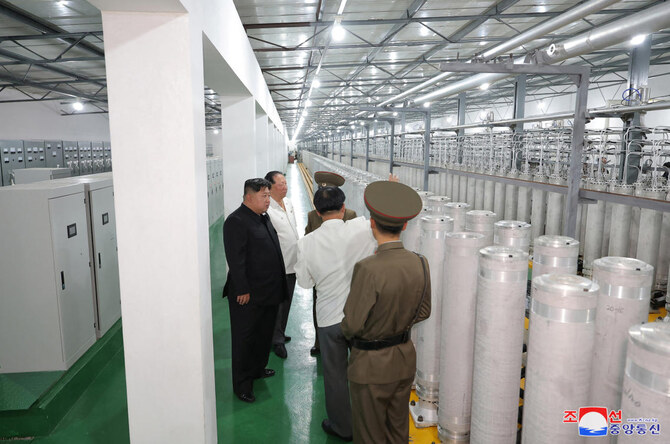
KCNA said that Kim went around the control room of the uranium enrichment base and a construction site that would expand its capacity for producing nuclear weapons. North Korean state media photos showed Kim being briefed by scientists while walking along long lines of tall gray tubes, but KCNA didn’t say when Kim visited the facilities and where they are located.
KCNA said Kim stressed the need to further augment the number of centrifuges to “exponentially increase the nuclear weapons for self-defense,” a goal he has repeatedly stated in recent years. It said Kim ordered officials to push forward the introduction of a new-type centrifuge, which has reached its completion stage.
Kim said North Korea needs greater defense and preemptive attack capabilities because “anti-(North Korea) nuclear threats perpetrated by the US imperialists-led vassal forces have become more undisguised and crossed the red-line,” KCNA said.
South Korea’s Unification Ministry said it strongly condemned North Korea’s unveiling of a uranium-enrichment facility and Kim’s vows to boost his country’s nuclear capability. A ministry statement said North Korea’s “illegal” pursuit of nuclear weapons in defiance of UN bans is a serious threat to international peace. It said North Korea must realize it cannot win anything with its nuclear program.
North Korea first showed a uranium enrichment site in Yongbyon to the outside world in November 2010, when it allowed a visiting delegation of Stanford University scholars led by nuclear physicist, Siegfried Hecker, to tour its centrifuges. North Korean officials then reportedly told Hecker that 2,000 centrifuges were already installed and running at Yongbyon.
Satellite images in recent years have indicated North Korea was expanding a uranium enrichment plant at its Yongbyon nuclear complex. Nuclear weapons can be built using either highly enriched uranium or plutonium, and North Korea has facilities to produce both at Yongbyon. It’s not clear exactly how much weapons-grade plutonium or highly enriched uranium has been produced at Yongbyon and where North Korea stores it.
“For analysts outside the country, the released images will provide a valuable source of information for rectifying our assumptions about how much material North Korea may have amassed to date,” said Ankit Panda, an expert with the Carnegie Endowment for International Peace.
“Overall, we should not assume that North Korea will be as constrained as it once was by fissile material limitations. This is especially true for highly enriched uranium, where North Korea is significantly less constrained in its ability to scale up than it is with plutonium,” Panda said.
In 2018, Hecker and Stanford University scholars estimated North Korea’s highly enriched uranium inventory was 250 to 500 kilograms (550 to 1,100 pounds), sufficient for 25 to 30 nuclear devices.
The North Korean photos released Friday showed about 1,000 centrifuges. When operated year-round, they would be able to produce around 20 to 25 kilograms (44 to 55 pounds) of highly enriched uranium, which would be enough to create a single bomb, according to Yang Uk, a security expert at Seoul’s Asan Institute for Policy Studies.
The new-type centrifuge Kim wants to introduce is likely an advanced carbon fiber-based one that could allow North Korea to produce five to 10 times more highly enriched uranium than its existing ones, said Lee Choon Geun, an honorary research fellow at South Korea’s Science and Technology Policy Institute.
Some US and South Korean experts speculate North Korea is covertly running at least one other uranium-enrichment plant. In 2018, a top South Korean official told parliament that North Korea was estimated to have already manufactured up to 60 nuclear weapons. Estimates on how many nuclear bombs North Korea can add every year vary, ranging from six to as much as 18.
Since 2022, North Korea has sharply ramped up weapons testing activities to expand and modernize its arsenal of nuclear missiles targeting the US and South Korea. Analysts say North Korea could perform nuclear test explosions or long-range missile tests ahead of the US presidential election in November with the intent to influence the outcome and increase its leverage in future dealings with the Americans.
“Overall, the message they are trying to send is that their nuclear capability is not just an empty threat, but that they are continuing to produce (bomb fuel),” Yang said. “And who are they speaking to? It could obviously be South Korea but also certainly the United States.”
North Korea had conducted test-launches of multiple short-range ballistic missiles on Thursday. In an apparent reference to those launches, KCNA said Kim had supervised test-firing of nuclear-capable 600mm multiple rockets to examine the performance of their new launch vehicles.


![]()

North Korea discloses a uranium enrichment facility as Kim calls for more nuclear weapons
Short Url
https://arab.news/5p3wf
North Korea discloses a uranium enrichment facility as Kim calls for more nuclear weapons
- It’s unclear if the site is its previously known nuclear-enrichment site in Yongbyon, north of Pyongyang, or another that was undisclosed until now


Latest updates


© 2026 SAUDI RESEARCH & PUBLISHING COMPANY, All Rights Reserved And subject to Terms of Use Agreement.