

China defense minister calls for ‘negotiation’ to end Ukraine, Gaza wars

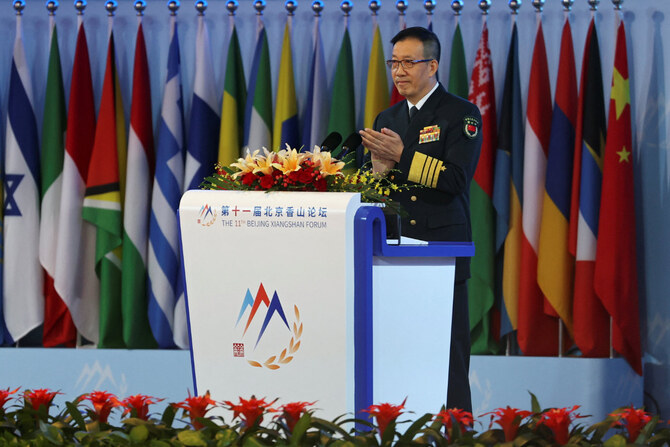
Chinese Defense Minister Dong Jun delivers a speech at the opening ceremony of the Beijing Xiangshan Forum in the Chinese capital on September 13, 2024. (REUTERS)
Short Url
Updated 13 September 2024
Follow

China defense minister calls for ‘negotiation’ to end Ukraine, Gaza wars

  • “Promoting peace and negotiation is the only way out,” Dong Jun tells gathering of military officials in Beijing
  • “There is no winner in war and conflict, and confrontation leads nowhere,” he said

BEIJING: Chinese Defense Minister Dong Jun said Friday that “negotiation” was the only solution to conflicts such as the wars in Gaza and Ukraine, as he addressed a global gathering of military officials in Beijing.
Scores of delegates are in Beijing for the Xiangshan Forum, dubbed China’s answer to the annual Shangri-La meeting in Singapore.
It is hosting more than 500 representatives from over 90 countries and organizations across three days, according to state media.
Dong told the opening ceremony: “To resolve hotspot issues such as the crisis in Ukraine and the Israeli-Palestinian conflict, promoting peace and negotiation is the only way out.”
“There is no winner in war and conflict, and confrontation leads nowhere,” Dong said.
“The more acute the conflict, the more we cannot give up dialogue and consultation. The end of any conflict is reconciliation,” he added, calling on all countries to promote “peaceful development and inclusive governance.”


Chinese Defense Minister Dong Jun and other military leaders attend the Beijing Xiangshan Forum on September 13, 2024. (REUTERS)

More official speeches are expected on Friday, and top military representatives from Russia, Pakistan, Singapore, Iran, Germany and others will participate in roundtable talks.
Topics for discussion at the forum include US-China relations, security in Europe and Asia, and the challenges of defense in a multipolar world.
Dong in his speech urged against “the proliferation of national security concepts” to ensure “new technologies can better benefit the whole mankind” — a likely reference to the United States’ efforts to block Beijing’s access to advanced technology.
“At a time of high global security risks and increased instability and unpredictability, the responsibility for building the defense and security capacity of all countries is enormous,” Dong said.
Beijing, he added, “is willing to work with all parties to strengthen strategic alignment, deepen defense consultations, discuss the signing of bilateral and multilateral agreements on defense cooperation.”

US Deputy Assistant Secretary of Defense Michael Chase is attending the forum, just a few days after top Washington and Beijing commanders held their first talks.
Washington and Beijing remain at odds on issues from trade to the status of self-ruled Taiwan and China’s increasingly assertive approach in disputed maritime regions.
But they have sought to re-establish regular military-to-military talks in a bid to prevent flashpoint disputes from spinning out of control.
A key flashpoint is the South China Sea, where Chinese vessels have engaged in a series of high-profile confrontations with Philippine ships in recent months.
China claims almost all of the economically vital body of water despite competing claims from other countries and an international court ruling that its assertion has no legal basis.
On Thursday, senior military official Lt. Gen. He Lei told journalists at the forum that China would “crush” any foreign incursion into its sovereign territory including in the South China Sea.


‘I admire Vision 2030’: Bangladesh’s new PM aims for stronger Saudi, GCC ties

Updated 4 sec ago
Follow

‘I admire Vision 2030’: Bangladesh’s new PM aims for stronger Saudi, GCC ties

  • Saudi Arabia congratulates Tarique Rahman on assuming Bangladesh’s top office
  • Relations between Bangladesh and Kingdom were formalized during his father’s rule

DHAKA: After 17 years in exile, Tarique Rahman has taken office as prime minister of Bangladesh, inheriting his parents’ political legacy and facing immediate economic and political challenges.

Rahman led his Bangladesh Nationalist Party to a landslide victory in the Feb. 12 general election, winning an absolute majority with 209 of 300 parliamentary seats and marking the party’s return to power after two decades.

The BNP was founded by his father, former President Ziaur Rahman, a 1971 Liberation War hero. After his assassination in 1981, Rahman’s mother, Khaleda Zia, took over the party’s helm and served two full terms as prime minister — in 1991 and 2001.

Rahman and his cabinet, whose members were sworn in alongside him on Tuesday, take over from an interim administration which governed Bangladesh for 18 months after former premier Sheikh Hasina — the BNP’s archrival who ruled consecutively for 15 years — was toppled in the 2024 student-led uprising.

As he begins his term, the new prime minister’s first tasks will be to rebuild the economy — weakened by uncertainty during the interim administration — and to restore political stability. Relations with the Middle East, particularly Saudi Arabia and other GCC states, are also high on his agenda.

“Saudi Arabia is one of our long-standing friends,” Rahman told Arab News at his office in Dhaka, two days before his historic election win.

“I admire the Saudi Vision 2030, and I am sincerely looking forward to working with the leadership of the Kingdom of Saudi Arabia. BNP always had a great relationship with the Muslim world, especially GCC nations — UAE, Qatar, Bahrain, Kuwait and Oman — and I look forward to working closely with GCC countries and their leadership to build a long-term trusting partnership with mutual interest,” Rahman said.

The Saudi government congratulated him on assuming the top office on Tuesday, wishing prosperity to the Bangladeshi people. 

Bangladesh and Saudi Arabia established formal diplomatic relations in August 1975, and the first Bangladeshi ambassador presented his credentials in late 1976, after Rahman’s father rose to power. That year, Bangladesh also started sending laborers, engineers, doctors, and teachers to work in the Kingdom.

Today, more than 3 million Bangladeshis live and work in Saudi Arabia — the largest expat group in the Kingdom and the biggest Bangladeshi community outside the country.

“I recall that when my father, President Ziaur Rahman, was in office, bilateral relations between our two nations were initiated,” Rahman said. “During the tenure of my mother, the late Begum Khaleda Zia, as prime minister, those relations became even stronger.”

Over the decades, Saudi Arabia has not only emerged as the main destination for Bangladesh’s migrant workers but also one of its largest development and emergency aid donors.

Weeks after Rahman’s mother began her first term as prime minister in 1991, Bangladesh was struck by one of the deadliest tropical cyclones in its history. Riyadh was among the first who offered assistance, and Zia visited Saudi Arabia on her earliest foreign tour and performed Hajj in June 1991.

For Rahman, who had been living in London since 2008 and returned to Bangladesh in December — just days before his mother’s death — the Kingdom will also be one of the first countries he plans to visit.

“I would definitely like to visit Saudi Arabia early in my term,” he said. “Personally, I also wish to visit the holy mosque, Al-Masjid Al-Haram, Makkah, to perform Umrah.”