



Studies on pigeon-guided missiles, swimming abilities of dead fish among Ig Nobels winners

1 / 2
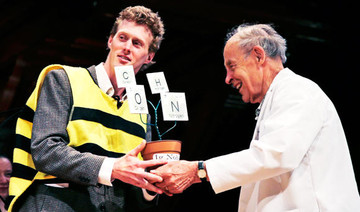
Professor James Liao displays a stuffed fish while accepting a prize for physics for demonstrating and explaining the swimming abilities of a dead trout during a performance at the Ig Nobel Prize ceremony at Massachusetts Institute of Technology in Cambridge, Massachusetts, on Sept. 12, 2024. (AP)
2 / 2
People in the audience throw paper airplanes toward the stage during a performance at the Ig Nobel Prize ceremony at Massachusetts Institute of Technology in Cambridge, Massachusetts, on Sept. 12, 2024. (AP)
Short Url
Updated 14 September 2024
Follow

Studies on pigeon-guided missiles, swimming abilities of dead fish among Ig Nobels winners

  • Held less than a month before the actual Nobel Prizes are announced, the 34th annual Ig Nobel prize ceremony at the Massachusetts Institute of Technology was organized by the Annals of Improbable Research magazine’s website to make people laugh and think

BOSTON: A study that explores the feasibility of using pigeons to guide missiles and one that looks at the swimming abilities of dead fish were among the winners Thursday of this year’s Ig Nobels, the prize for comical scientific achievement.
Held less than a month before the actual Nobel Prizes are announced, the 34th annual Ig Nobel prize ceremony at the Massachusetts Institute of Technology was organized by the Annals of Improbable Research magazine’s website to make people laugh and think. Winners received a transparent box containing historic items related to Murphy’s Law — the theme of the night — and a nearly worthless Zimbabwean $10 trillion bill. Actual Nobel laureates handed the winners their prizes.
“While some politicians were trying to make sensible things sound crazy, scientists discovered some crazy-sounding things that make a lot of sense,” Marc Abrahams, master of ceremonies and editor of the magazine, said in an email interview.

The ceremony started with Kees Moliker, winner of 2003 Ig Noble for biology, giving out safety instructions. His prize was for a study that documented the existence of homosexual necrophilia in mallard ducks.
“This is the duck,” he said, holding up a duck. “This is the dead one.”

After that, someone came on stage wearing a yellow target on their chest and a plastic face mask. Soon, they were inundated with people in the audience throwing paper airplanes at them.
Then, the awards began — several dry presentations which were interrupted by a girl coming on stage and repeatedly yelling “Please stop. I’m bored.” The awards ceremony was also was broken up by an international song competition inspired by Murphy’s Law, including one about coleslaw and another about the legal system.
The winners were honored in 10 categories, including for peace and anatomy. Among them were scientists who showed a vine from Chile imitates the shapes of artificial plants nearby and another study that examined whether the hair on people’s heads in the Northern Hemisphere swirled in the same direction as someone’s hair in the Southern Hemisphere.


Students walk past the "Great Dome" atop Building 10 on the Massachusetts Institute of Technology campus in Cambridge, Massachusetts, on Sept. 12, 2024. (AP)

Other winners include a group of scientists who showed that fake medicine that causes side effects can be more effective than fake medicine that doesn’t cause side effects and one showing that some mammals are capable of breathing through their anus — winners who came on stage wearing a fish-inspired hats.
Julie Skinner Vargas accepted the peace prize on behalf of her late father B.F. Skinner, who wrote the pigeon-missile study. Skinner Vargas is also the head of the B.F. Skinner Foundation.
“I want to thank you for finally acknowledging his most important contribution,” she said. “Thank you for putting the record straight.”
James Liao, a biology professor at the University of Florida, accepted the physics prize for his study demonstrating and explaining the swimming abilities of a dead trout.
“I discovered that a live fish moved more than a dead fish but not by much,” Liao said, holding up a fake fish. “A dead trout towed behind a stick also flaps its tail to the beat of the current like a live fish surfing on swirling eddies, recapturing the energy in its environment. A dead fish does live fish things.”

Britain’s Harris Dickinson on John Lennon, directing and news overload

Updated 11 February 2026
Follow

Britain’s Harris Dickinson on John Lennon, directing and news overload

  • He’s acted as Nicole Kidman’s love interest, delivered an acclaimed directorial debut, and been cast in Sam Mendes’ upcoming “The Beatles” films

PARIS: He’s acted as Nicole Kidman’s love interest, delivered an acclaimed directorial debut, and been cast in Sam Mendes’ upcoming “The Beatles” films, but Britain’s Harris Dickinson insists he’s keeping his feet on the ground.
The modest Londoner, who turns 30 later this year, has had a whirlwind year that has seen his stock rise further as an actor who can straddle both art house cinema and more commercial TV and film work.
But the “Babygirl” star and upcoming on-screen John Lennon insists he won’t be swapping Hollywood for his beloved home in the British capital — now or ever.
“It feels like I’m grounded by London, east London specifically. It feels like a very important place,” he told AFP in an interview.
“I have my people. I have my family. I have my own little community there,” he added.
The city is the backdrop to “Urchin,” his first film as a director which premiered at the Cannes Film Festival last May and which includes a cameo from his mum.
’Stay on track’
The premiere in Cannes, where he starred in 2022 prize-winner “Triangle of Sadness” by Ruben Ostlund, was so stressful Dickinson felt sick before the screening.
But his film, about a homeless man struggling after his release from prison, won over critics with the strength of the acting and directing, as well as its wry humor.
Dickinson sees it as containing an important message about community: the importance of it, as well as the dangers for drug users of “exhausting (their) support networks.”
“It’s very common, even for people with good family setups, or friends and family, they get to a point where no one wants to help them anymore,” he said.
Keeping destructive behavior at bay is a battle he relates to, having seen the ravages of alcohol in his family — but also as a member of the notoriously addiction-prone entertainment industry.
“Ultimately no one’s safety or path is guaranteed. You have to do a certain amount of work in order to stay on track, especially if you’ve got addictive tendencies or destructive tendencies,” he explained.
’Get obsessed’
Dickinson is currently in the middle of an exhausting filming schedule for four biographical films about “The Beatles” from “American Beauty” and James Bond director Mendes.
Each one is shot from the perspective of one of the Fab Four, with Dickinson landing what is arguably the plum role as Lennon.
Paul Mescal (“Hamnet,” “Gladiator II“) plays Paul McCartney.
“I’m getting up at 4:45 am every day, and I’m getting home at 8:00 pm,” Dickinson explained.
Working with Mendes has made a big impression — “he’s a big canvas director” — but one of the hardest things is pulling himself out of the daily news doom cycle and his research into the 1960s.
“I do go through periods where I tune out from news a little bit because I can get obsessed with it. I go deep, and I get very troubled by it,” Dickinson explained.
“I don’t think our brains and our systems are designed to be that tuned into injustice and tragedy and darkness.”
The troubled post-war era “doesn’t feel any different to what we’re going through today, that’s the alarming thing really,” he added.
“The Beatles” is a long-term job that will keep him busy until December.
After that?
“I’m quite interested in anything apocalyptic, anything dystopian, or a survival film,” he explained.
“I’m interested in the idea of what happens when society falls, what happens when we are left with nothing or we’re stripped of everything.”