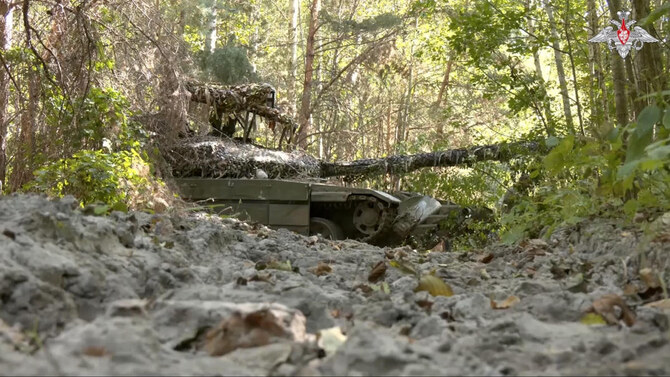
MOSCOW: Russian forces have begun a significant counter-offensive against Ukrainian troops who smashed their way into western Russia last month, and have taken some territory back, pro-Moscow war bloggers and a senior Russian commander said.
Ukraine on Aug. 6 launched the biggest foreign attack on Russia since World War Two, bursting through the border into the region of Kursk with thousands of troops supported by swarms of drones and heavy weaponry, including Western-made arms.
Major General Apti Alaudinov, who commands Chechnya’s Akhmat special forces fighting in Kursk, said that Russian troops had gone on the offensive and taken back control of about 10 settlements in Kursk, TASS reported.
“The situation is good for us,” said Alaudinov, who is also deputy head of the Russian defense ministry’s military-political department.
“A total of about 10 settlements in the Kursk region have been liberated,” he said.
Reuters was unable to verify the battlefield reports due to reporting restrictions on both sides of the war. Russia’s defense ministry said it had defeated Ukrainian units at a number of villages in Kursk.
There was no immediate comment from Ukraine.
Ukrainian President Volodymyr Zelensky said last week that his forces controlled 100 settlements in Kursk region over an area of more than 1,300 sq km (500 sq miles), a figure disputed by Russian sources.
Yuri Podolyaka, an Ukrainian-born, pro-Russian military blogger, and two other influential bloggers — Rybar and the Two Majors — said that Russian forces had begun a significant counter-offensive in Kursk.
“In the Kursk region, the Russian Army launched counter-offensive actions on the western flank of the enemy’s wedge, reducing the Ukrainian zone of control near the state border,” the Two Majors blog said.
Podolyaka said that Russian forces had taken several villages on the west of the sliver of Russia that Ukraine carved out, pushing Ukrainian forces to the east of the Malaya Loknya River south of Snagost.
Russian forces also advanced in eastern Ukraine, and were fighting in the center of the town of Ukrainsk in the Donetsk region, according to Russian war bloggers and open source maps of the war.

Russia pushes back Ukrainian troops in some areas of Kursk, commander says
Short Url
https://arab.news/96e3v
Russia pushes back Ukrainian troops in some areas of Kursk, commander says
- Major General Apti Alaudinov, who commands Chechnya’s Akhmat special forces fighting in Kursk, said that Russian troops had gone on the offensive and taken back control
- “A total of about 10 settlements in the Kursk region have been liberated”
Merz pushes PA’s Abbas on reforms ahead of Israel trip
BERLIN: German Chancellor Friedrich Merz called for reforms of the Palestinian Authority in a phone call with its leader Mahmud Abbas early Saturday, hours before taking off for Israel.
Speaking from Berlin, Merz urged Abbas to push through “urgently necessary reforms” at the Palestinian Authority so that the organization could “play a constructive role in a post-war order,” according to German government spokesman Stefan Kornelius.
Merz also underscored German support for US President Donald Trump’s peace plan for Gaza and “welcomed the Palestinian Authority’s cooperative attitude” toward the deal in the call, the spokesman said.
The fragile ceasefire agreement to end the Gaza war is supposed to be just the first phase of the plan.
Germany is among Israel’s closest allies and most outspoken supporters.
Merz’s call with Abbas came hours before the chancellor was scheduled to leave Berlin late Saturday morning for an overnight visit to Israel.
After a brief stop in Jordan, where Merz is scheduled to meet with the Jordanian King Abdullah II, Merz is expected to arrive in Jerusalem for meetings with top Israeli leaders, including Prime Minister Benjamin Netanyahu.
Merz also plans to visit the Yad Vashem Holocaust memorial in Israel.
In his call with Abbas, Merz reiterated Germany’s position that a two-state solution remains the ultimate way to achieve peace and security for Israelis and Palestinians, according to the spokesman.
Netanyahu and other senior Israeli officials hvae repeatedly rejected the prospect of an independent Palestinian state.
The Palestinian militant group Hamas, which seized control of the Gaza Strip from the Palestinian Authority in 2007, has also explicitly ruled out a two-state solution.
Speaking from Berlin, Merz urged Abbas to push through “urgently necessary reforms” at the Palestinian Authority so that the organization could “play a constructive role in a post-war order,” according to German government spokesman Stefan Kornelius.
Merz also underscored German support for US President Donald Trump’s peace plan for Gaza and “welcomed the Palestinian Authority’s cooperative attitude” toward the deal in the call, the spokesman said.
The fragile ceasefire agreement to end the Gaza war is supposed to be just the first phase of the plan.
Germany is among Israel’s closest allies and most outspoken supporters.
Merz’s call with Abbas came hours before the chancellor was scheduled to leave Berlin late Saturday morning for an overnight visit to Israel.
After a brief stop in Jordan, where Merz is scheduled to meet with the Jordanian King Abdullah II, Merz is expected to arrive in Jerusalem for meetings with top Israeli leaders, including Prime Minister Benjamin Netanyahu.
Merz also plans to visit the Yad Vashem Holocaust memorial in Israel.
In his call with Abbas, Merz reiterated Germany’s position that a two-state solution remains the ultimate way to achieve peace and security for Israelis and Palestinians, according to the spokesman.
Netanyahu and other senior Israeli officials hvae repeatedly rejected the prospect of an independent Palestinian state.
The Palestinian militant group Hamas, which seized control of the Gaza Strip from the Palestinian Authority in 2007, has also explicitly ruled out a two-state solution.
© 2025 SAUDI RESEARCH & PUBLISHING COMPANY, All Rights Reserved And subject to Terms of Use Agreement.


