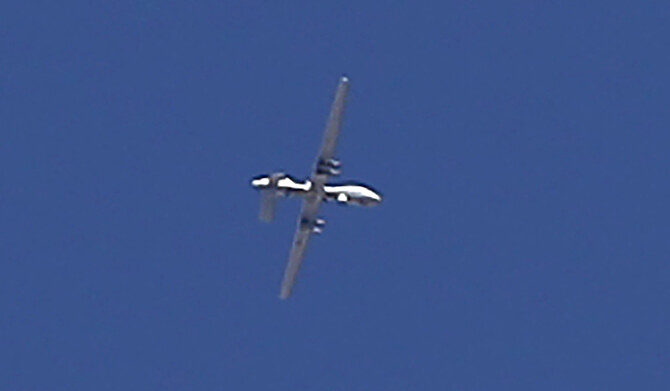

AL-MUKALLA: US and UK warplanes have blasted Houthi sites in Yemen’s Ibb province after the Yemeni militia claimed to have shot down a new US drone.
The Houthi-run official news agency reported on Sunday that American and British warplanes carried out three airstrikes on the Maytam region, north of Ibb province, the latest in a series of military operations against the Houthis in response to their attacks on ships.
The Houthis did not provide information on the targeted area in the region, or if there were any human or property damages.
Since early this year, US and UK forces have launched strikes on Houthi-held Yemeni provinces including Sanaa, Saada, Hodeidah, Ibb, and others, targeting missile and drone launchers and storage facilities, as well as explosive-laden drone boats ready to attack ships in international shipping lanes off Yemen.
This comes as Houthi military spokesman Yahya Sarea claimed on Saturday night that the Yemeni militia had shot down a US military MQ-9 drone engaged in “hostile activities” over the central province of Marib, the eighth such claim since the start of their anti-ship campaign in November.
The Houthis did not immediately publish a video of the operation to back up their claim, something they routinely do hours or days later.
The Houthis earlier claimed to have shot down the same kind of US drone over Hodeidah, Saada, and Marib using locally produced missiles.
Since late last year, the Houthis have launched hundreds of ballistic missiles, drones, and drone boats at over 100 commercial and naval ships in the Red Sea, Bab Al-Mandab Strait, Gulf of Aden, and Indian Ocean, claiming to be acting in solidarity with the Palestinian people against Israel’s war in Gaza.
During their campaign, the Houthis captured one commercial ship, sank two others, and set fire to numerous more.
The Greek-flagged Sounion oil ship carrying 150,000 tonnes of crude oil is still burning and abandoned in the Red Sea, having been repeatedly struck by Houthi fire.
Rescuers who visited the ship last week determined that it was too dangerous to relocate and looked at various possibilities for defusing the hazard on-site.
At the same time, the EU naval operation in the Red Sea, EUNAVFOR ASPIDES, said on Saturday that its three naval units had defended 230 ships on the major commerce artery, shot down 17 drones, two drone boats, and four ballistic missiles, and rescued 29 sailors since the mission began in February.
In a separate development, the Houthis said on Saturday that lightning bolts had killed 160 people in regions under their control since the beginning of the year, including 22 deaths in strikes during the last two days.
The most recent round of torrential and intense rains, which started in late July, has killed over 100 people, displaced thousands of families, destroyed hundreds of houses, and washed away roads and other infrastructure throughout Yemen, mainly in the country’s central highlands and western coastal provinces.
Meanwhile, heavy fighting between Yemeni government troops and the Houthis has erupted in hilly parts of the southern province of Lahj, killing or injuring numerous combatants from both sides.
Local media reported on Sunday that joint government soldiers from the Security Belt and the Giants Brigades recovered two areas in the Al-Musaymir District of Lahj that had fallen to the Houthis in recent days.
During the fighting, a Yemeni government soldier was killed, as well as an undetermined number of Houthis.
Despite a dramatic decline in hostilities in Yemen since April 2022 under the UN-brokered ceasefire, the Houthis have continued to wage lethal attacks on government soldiers in Taiz, Lahj, Dhale, and Marib.