US sees potential Iran transfer of missiles to Russia as alarming

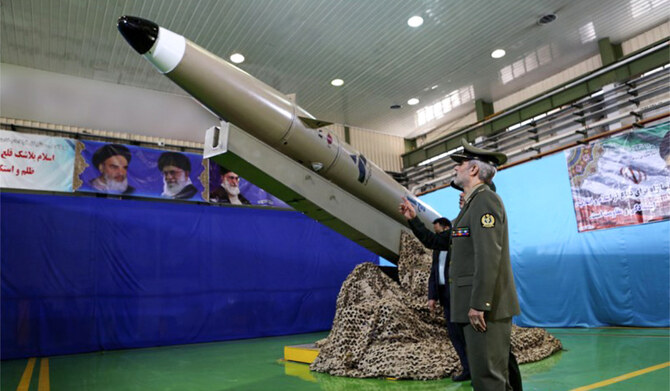
A handout picture released by Iran's Defence Ministry on August 13, 2018 shows Defence Minister, Brigadier General Amir Hatami, standing by the next generation short-range ballistic missile "Fateh Mobin", during an unveiling ceremony in the capital Tehran. (AFP)
Short Url
Updated 07 September 2024
Follow

US sees potential Iran transfer of missiles to Russia as alarming

  • The potential moves come after the United States and partners, including in Europe, warned that such a step by Iran could meet with consequences

WASHINGTON: Any Iranian transfer of ballistic missiles to Russia would mark a sharp escalation in the Ukraine war, the United States said on Friday, following reports that the two countries had deepened ties in recent weeks with such an arms transfer.
Reuters reported in August that Russia was expecting the imminent delivery of hundreds of Fath-360 close-range ballistic missiles from Iran and that dozens of Russian military personnel were being trained in Iran on the satellite-guided weapons for eventual use in the war in Ukraine.
Short-range missiles have now been delivered to Russia by Iran, the Wall Street Journal reported on Friday, citing an unnamed US official.
“We have been warning of the deepening security partnership between Russia and Iran since the outset of Russia’s full-scale invasion of Ukraine and are alarmed by these reports,” said White House National Security Council spokesperson Sean Savett.
“Any transfer of Iranian ballistic missiles to Russia would represent a dramatic escalation in Iran’s support for Russia’s war of aggression against Ukraine.”
Another US official told Reuters they were watching the potential Iranian-Russian missile transfers closely.
The potential moves come after the United States and partners, including in Europe, warned that such a step by Iran could meet with consequences. The Western countries have been watching Iran and Russia’s deepening ties in recent months with increasing concern.
Iran’s mission to the United Nations in New York said on Friday that Tehran’s position on the Ukraine conflict was unchanged.
“Iran considers the provision of military assistance to the parties engaged in the conflict — which leads to increased human casualties, destruction of infrastructure, and a distancing from ceasefire negotiations — to be inhumane,” it said.
“Thus, not only does Iran abstain from engaging in such actions itself, but it also calls upon other countries to cease the supply of weapons to the sides involved in the conflict,” the mission said.


Italian PM pledges to deepen cooperation with African states

Updated 4 sec ago
Follow

Italian PM pledges to deepen cooperation with African states

  • The plan, launched in 2024, aims to promote investment-led cooperation rather than traditional aid

ADDIS ABABA: Italy pledged to deepen cooperation with African countries at its second Italy-Africa summit, the first held on African soil, to review projects launched in critical sectors such as energy and infrastructure during Italy’s first phase of the Mattei Plan for Africa.

The plan, launched in 2024, aims to promote investment-led cooperation rather than traditional aid.

Italy’s Prime Minister Giorgia Meloni addressed dozens of African heads of state and governments in Ethiopia’s capital, Addis Ababa, and reiterated that a successful partnership would depend on Italy’s “ability to draw from African wisdom” and ensure lessons are learned.

“We want to build things together,” she told African heads of state.  “We want to be more consistent with the needs of the countries involved.”

Ethiopian Prime Minister Abiy Ahmed said Italy had provided Africa with a gateway to Europe through these partnerships.

“This is a moment to move from dialogue to action,” he said. 

“By combining Africa’s energetic and creative population with Europe’s experience, technology, and capital, we can build solutions that deliver prosperity to our continents and beyond.”

After the Italy-Africa summit concluded, African leaders remained in Addis Ababa for the annual African Union Summit.

Kenyan writer and political analyst Nanjala Nyabola said tangible results from such summits depend on preparations made by countries.

African governments often focus on “optics instead of actually making summits a meaningful engagement,” she said.

Instead of waiting for a list of demands, countries should “present the conclusions of an extended period of mapping the national needs” and engage in dialogue to determine how those needs can be met.

Since it was launched two years ago, the Mattei Plan has directly involved 14 African nations and has launched or advanced around 100 projects in crucial sectors, including energy and climate transition, agriculture and food security, physical and digital infrastructure, healthcare, water, culture and education, training, and the development of artificial intelligence, according to the Italian government.