Rarely sighted Blanford’s fox caught on camera during UAE wildlife-mapping initiative

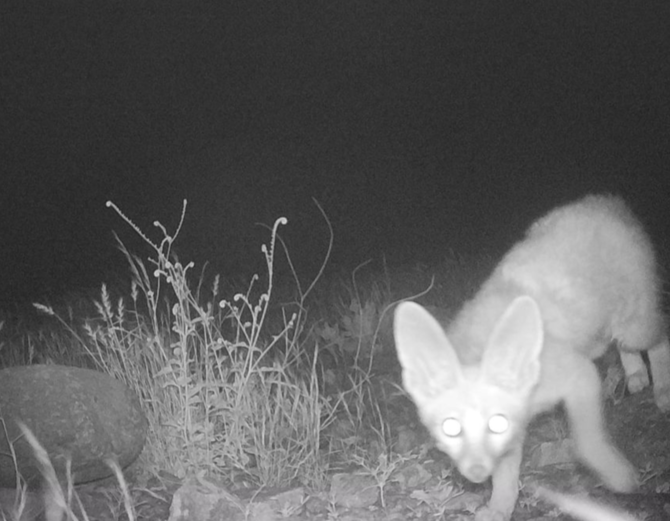
The Blanford’s fox is the latest species to be captured on camera during a wildlife-mapping initiative in the UAE. (ENWWF/Emirates News Agency)
Short Url
Updated 06 September 2024
Follow

Rarely sighted Blanford’s fox caught on camera during UAE wildlife-mapping initiative

  • The fox — strictly nocturnal and rarely caught on camera — was in Fujairah and was mapped as part of the Notice Nature initiative

ABU DHABI: The Blanford’s fox is the latest species to be captured on camera during a wildlife-mapping initiative in the UAE, the Emirates News Agency (WAM) reported on Friday.

The fox — strictly nocturnal and rarely caught on camera — was in Fujairah and was mapped as part of the Notice Nature initiative, a collaboration between Emirates Nature-WWF, the Fujairah Environment Authority, and Mashreq Bank launched last year.

The initiative uses infrared motion-sensor cameras, which offer a non-intrusive way to monitor wildlife, especially shy species like the Blanford’s fox, and provide an insight into the state of biodiversity in the area and the effectiveness of designating protected areas to wildlife conservation.

While the Blanford’s fox is rated as being of “least concern” on the International Union for Conservation of Nature’s threat-of-extinction list, it is classified as vulnerable on the National UAE Red List and the Arabia Regional Red List.

Vulnerable species are those whose populations have decreased significantly across the region, making them likely to be classified as endangered in the near future if current challenges persisted.

Andrew Gardner, associate director of biodiversity conservation at Emirates Nature-WWF said in a statement: “We are excited to capture such clear images of the rare and secretive Blanford’s fox. These animals are very rarely seen and so each record gives new information on the distribution of the species and its status.

He continued: “We are confident that we will be able to collect more records of Blanford’s fox and other rare species, such as the Arabian tahr and caracal, in the UAE mountains. This is incredibly valuable scientific information, that feeds into the conservation management of these species.”

Mina Al-Ghurari, group head of marketing and corporate communication at Mashreq, said the sighting showed the importance and effectiveness of local conservation efforts.

“These sightings provide critical insights into the UAE’s rich biodiversity, helping us understand and protect our unique wildlife. We are proud of our collaboration with Emirates Nature-WWF, for this exclusive biodiversity and wildlife mapping system,” she said. “This data not only expands our knowledge of the UAE’s diverse ecosystems but also allows us to address the detrimental impacts of urbanization, pollution, and climate change on the country’s flora and fauna.”


Cambodia takes back looted historic artifacts handled by British art dealer

Updated 28 February 2026
Follow

Cambodia takes back looted historic artifacts handled by British art dealer

  • The objects were returned under a 2020 agreement between the Ministry of Culture and Fine Arts and the family of the late Douglas Latchford, a British art collector and dealer who allegedly had the items smuggled out of Cambodia

PHNOM PENH, Cambodia: Cambodian officials on Friday received more than six dozen historic artifacts described as part of the country’s cultural heritage that had been looted during decades of war and instability.
At a ceremony attended by Deputy Prime Minister Hun Many, the 74 items were unveiled at the National Museum in Phnom Penh after their repatriation from the United Kingdom.
The objects were returned under a 2020 agreement between the Ministry of Culture and Fine Arts and the family of the late Douglas Latchford, a British art collector and dealer who allegedly had the items smuggled out of Cambodia.
“This substantial restitution represents one of the most important returns of Khmer cultural heritage in recent years, following major repatriations in 2021 and 2023 from the same collection,” the Culture Ministry said in a statement. “It marks a significant step forward in Cambodia’s continued efforts to recover, preserve, and restore its ancestral legacy for future generations.”
The artifacts were described as dating from the pre-Angkorian period through the height of the Angkor Empire, including “monumental sandstone sculptures, refined bronze works, and significant ritual objects.” The Angkor Empire, which extended from the ninth to the 15th century, is best known for the Angkor Wat archaeological site, the nation’s biggest tourist attraction.
Latchford was a prominent antiquities dealer who allegedly orchestrated an operation to sell looted Cambodian sculptures on the international market.
From 1970 to the 1980s, during Cambodia’s civil wars and the communist Khmer Rouge ‘s brutal reign, organized looting networks sent artifacts to Latchford, who then sold them to Western collectors, dealers, and institutions. These pieces were often physically damaged, having been pried off temple walls or other structures by the looters.
Latchford was indicted in a New York federal court in 2019 on charges including wire fraud and conspiracy. He died in 2020, aged 88, before he could be extradited to face charges.
Cambodia, like neighboring Thailand, has benefited from a trend in recent decades involving the repatriation of art and archaeological treasures. These include ancient Asian artworks as well as pieces lost or stolen during turmoil in places such as Syria, Iraq and Nazi-occupied Europe. New York’s Metropolitan Museum of Art is one of the prominent institutions that has been returning illegally smuggled art, including to Cambodia.
“The ancient artifacts created and preserved by our ancestors are now being returned to Cambodia, bringing warmth and joy, following the country’s return to peace,” said Hun Many, who is the younger brother of Prime Minister Hun Manet.