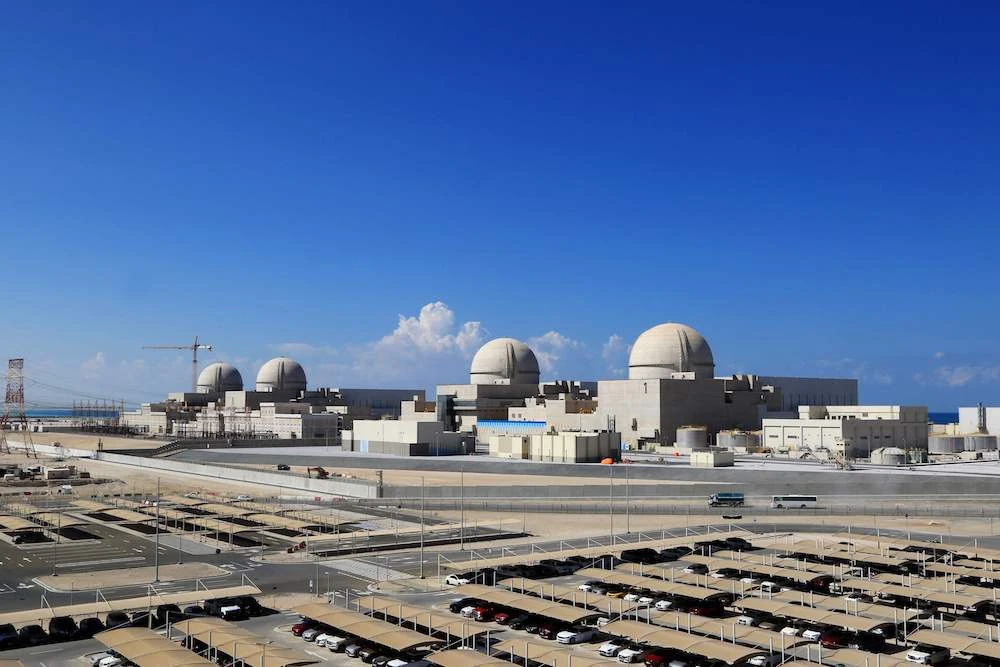
UAE completes Arab world’s first nuclear plant

A general view of the power plant in the Gharbiya region of Abu Dhabi on the Gulf coastline about 50 kilometers west of Ruwais. File/AFP/Barakah Nuclear Power Plant
Short Url
Updated 05 September 2024
Follow

UAE completes Arab world’s first nuclear plant

  • It will generate 25 percent of the electricity needs
  • The station will power companies including the Abu Dhabi National Oil Company, Emirates Steel and Emirates Global Aluminium

DUBAI: The UAE on Thursday announced the completion of the Arab world’s first nuclear power plant, calling it a “significant step.”
Abu Dhabi’s Barakah Nuclear Energy Plant will produce 40 terawatt-hours of electricity annually after its fourth and final reactor has entered commercial operation, the state-owned Emirates Nuclear Energy Corporation (ENEC) said in a statement.
It will generate 25 percent of the electricity needs of the hot, desert Gulf state, where air-conditioning is ubiquitous — nearly the equivalent of New Zealand’s annual consumption, ENEC said.
The station will power companies including the Abu Dhabi National Oil Company, one of the world’s biggest oil producers, Emirates Steel and Emirates Global Aluminium, ENEC said.

Barakah, which means “blessing” in Arabic, started operations in 2020 when the first of its four reactors went into service.
Saudi Arabia, the world’s top oil exporter, has also said it plans to build nuclear reactors.
Emirati President Sheikh Mohammed bin Zayed hailed Barakah’s completion as a “significant step on the journey toward net zero.”
“We will continue to prioritize energy security and sustainability for the benefit of our nation and our people today and tomorrow,” he said in a post on social media platform X.
According to the International Atomic Energy Agency, the plant “will have to be disassembled at the end of its useful life, in around 60-80 years.”

The UAE, which is made up of seven emirates, including the capital Abu Dhabi and economic hub Dubai, is one of the largest oil producers in the OPEC cartel.
The country was largely built on oil but is spending billions to develop enough renewable energy to cover half of its needs by 2050.
Last year, it hosted the COP28 UN climate talks which resulted in an agreement to “transition away” from fossil fuels.
The UAE lies across the Gulf from Iran which has a Russian-built nuclear power plant outside the coastal city of Bushehr, as well as a controversial uranium enrichment program.
The UAE has repeatedly said its nuclear ambitions are for “peaceful purposes” and ruled out developing any enrichment program or nuclear reprocessing technologies.
The country uses gas-powered stations for much of its electricity needs, but also has one of the world’s biggest solar plants outside Abu Dhabi.
Ma’aden forms JV with Hancock for mineral exploration across Saudi Arabia 

Updated 11 sec ago
Follow

Ma’aden forms JV with Hancock for mineral exploration across Saudi Arabia 

RIYADH: A new joint venture aimed at accelerating mineral exploration across Saudi Arabia has been formed under a shareholders’ agreement between Saudi Arabian Mining Co., known as Ma’aden, and Australia-based Midana Exploration Pty Ltd, part of Hancock Prospecting.  

According to a regulatory filing, the initial work will focus on the Nabita–Ad-Duwayhi Gold Belt, following a successful bid for exploration licenses awarded by the Ministry of Industry and Mineral Resources. The licensed areas span more than 24,000 sq. km of mineral-rich territory.

The partnership comes as Saudi Arabia steps up efforts to expand its mining sector as a pillar of economic diversification, encouraging international participation and private investment to unlock the Kingdom’s estimated $2.5 trillion in untapped mineral resources under Vision 2030.  

The government has accelerated licensing rounds and increased exploration incentives to boost geological mapping and downstream development. 

In a Tadawul filing, the company stated: “Maaden will own 50.1% of the capital of the Joint Venture, whilst Hancock will own 49.9% of its share capital.” 

It added: “The objects of the Joint Venture will include exploration, development, mining, sales and marketing of minerals in licensed areas in the Kingdom.”   

The shareholders’ agreement was signed on Dec. 29, with no defined duration. The initial share capital of the joint venture will be $5 million.  The entity will also approve budgets and business plans for its exploration and development operations on an ongoing basis.  

The transaction remains subject to regulatory and antitrust approvals. No related parties were identified, according to the disclosure. 

Shares of Ma’aden were trading at SR61.95 as of 2:15 PM Saudi time, reflecting a 0.32 percent decline during the day.  

Saudi Arabia has significantly ramped up its mineral exploration activity in recent years, with spending rising to SR487 per sq meter — more than double the Vision 2030 target.   

This marks a 600 percent increase over the past seven years, underscoring the Kingdom’s accelerated efforts to map its geological potential and unlock critical mineral resources.   

In 2024 alone, total exploration expenditures surpassed SR1.05 billion, supported by both government and private sector funding. The increase reflects Saudi Arabia’s strategic push to position mining as a central pillar of economic diversification under Vision 2030.