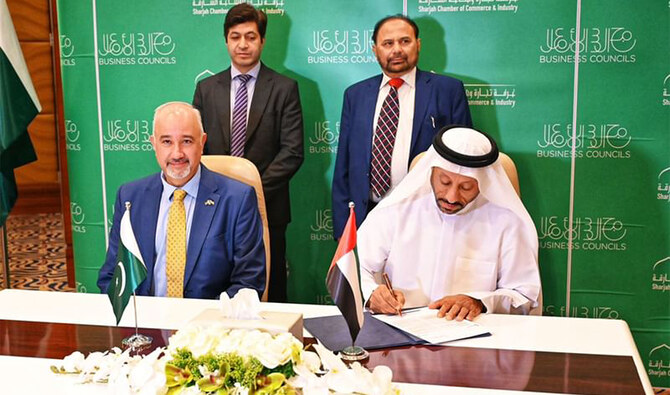

ISLAMABAD: The newly established Pakistan Business Council (PBC) at the Sharjah Chamber of Commerce and Industry aims to increase Pakistan’s bilateral trade volume with the United Arab Emirates to $40 billion within three fiscal years, the council’s head said this week.
The UAE, Pakistan’s third-largest trading partner after China and the United States, is considered an ideal export destination by Islamabad due to its geographical proximity, which reduces transportation and freight costs and facilitates commercial transactions.
According to the Pakistan mission in the UAE, the value of non-oil foreign trade between the two countries reached AED 25.7 billion ($6.97 billion) in 2022, marking a 30 percent increase from AED 19.8 billion ($5.45 billion) in 2021.
The UAE is also home to more than a million Pakistani expatriates and the second-largest source of remittances to Pakistan after Saudi Arabia.
“We aim to facilitate collaboration between the Pakistani business community and the UAE, fostering trade and development that will benefit both countries,” Syed Muhammad Tahir, chairman of the founding PBC committee, told Arab News over the phone from Sharjah on Wednesday, a day after the council was inaugurated.
“Currently, the bilateral trade volume between the UAE and Pakistan is around $7 billion, and our target is to reach $40 billion within the next three financial years.”
Tahir said the council wanted to increase bilateral trade and investment exchanges by capitalizing on available opportunities.
“We will support the Pakistani business community at both the government and private levels and organize trade visits, business-to-business meetings and exhibitions to promote and develop Pakistani exports for new markets,” he added.
The PBC chairman said there was significant potential for Pakistan to boost its exports to the UAE since the Gulf country primarily relied on imports, with limited local manufacturing.
“We can capitalize on this by leveraging our strengths in agriculture, textiles, garments, livestock and food products,” he said.
Tahir said the council also wanted to improve Pakistan’s image in the UAE, which had been effected by Pakistani expats engaging in political activities and protests in the Emirates. In recent weeks, there have been widespread media reports that the UAE is holding back visas to Pakistanis, which the consulate in Karachi has denied.
“Visa difficulties have become a significant issue for Pakistanis, and one of our core focuses will be to facilitate the business community in obtaining visas by removing obstacles through our platform,” Tahir added.
Asked about the council’s composition, he said it had 25 founding members who were all businesspeople from Pakistani based in Sharjah.
“Any businessman from Pakistan or the UAE can join the council, with an annual membership fee set at a nominal AED 1,000,” he added.
Earlier this week, during the inaugural ceremony, Pakistan’s envoy to the UAE, Faisal Niaz Tirmizi, praised the Sharjah Chamber’s pioneering efforts in launching the council along with its continuous support for entrepreneurs.
“The new council will provide an opportunity to Pakistani entrepreneurs to promote their businesses across the UAE, expand into regional markets and dive into joint ventures,” he said.