BEIRUT: Syrian journalist Bakr Al-Kassem, who works with media outlets including AFP, has been released a week after pro-Turkiye factions detained him in rebel-held northern Syria, he told AFP on Tuesday.
“I was released late Monday and I am well. I am now with my family,” said Kassem, 28.
“I will return to my work as a journalist as soon as possible.”
Local police from pro-Turkiye factions detained Kassem on August 26 in the city of Al-Bab, some 30 kilometers (20 miles) from the Turkish border.
He had been covering an event in the city with his wife Nabiha Taha, who is also a journalist.
Taha was released shortly afterwards and said their house was searched and Kassem’s computer, cameras and mobile phone were confiscated.
Kassem said he was questioned about his work as a journalist in areas controlled by Ankara-backed factions, and that no official charges were brought against him.
“We are relieved that Bakr has been freed and we thank all the colleagues and organizations that expressed their solidarity with him during his detention,” said AFP’s Global News Director Phil Chetwynd.
“We hope that he will be able to resume his work without any restrictions.”
Kassem has worked as a photographer and correspondent for AFP since 2018 covering Syria’s civil war, as well as a deadly earthquake in February 2023 in which he lost 17 family members.
He has also worked for Turkiye’s official Anadolu news agency and local Syrian media outlets.
AFP, the Committee to Protect Journalists and Reporters Without Borders (RSF) had called for his immediate release.
RSF in a statement on X welcomed “the good news” of Kassem’s release, saying it was “relieved” he was free, but noting “72 reporters remain detained or missing in Syria.”
The country is ranked second-last in the world on RSF’s press freedom index.
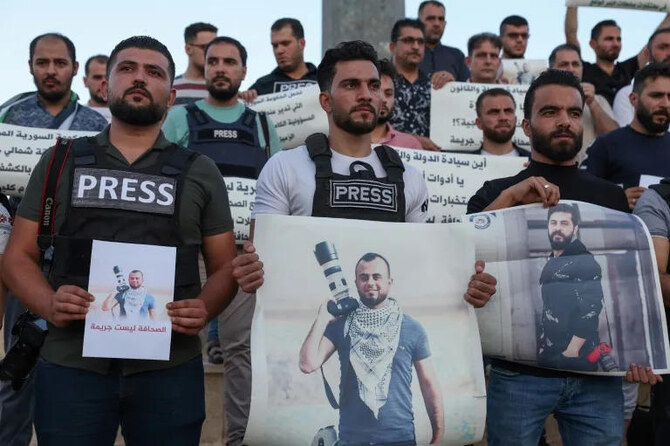
Local journalists and activists had organized sit-ins in the region demanding Kassem be freed, some holding signs reading “journalism is not a crime.”
Syria’s war began after the repression of anti-government protests in 2011 and spiralled into a complex conflict drawing in foreign armies and jihadists, killing more than 500,000 people and displacing millions.
Turkish troops and Turkiye-backed rebel factions control swathes of northern Syria, and Ankara has launched successive cross-border offensives since 2016.


Journalist working for AFP released by pro-Turkiye Syria factions
https://arab.news/nv84s
Journalist working for AFP released by pro-Turkiye Syria factions

- Bakr Al-Kassem was detained for questioning by authorities, but no official charges were filed against him


Paris exhibition marks 200 years of Le Figaro and the enduring power of the press
- The exhibition celebrated the bicentennial of Le Figaro, offering visitors a rare opportunity to step inside the newspaper’s vast historical archive
PARIS: One of France’s most influential newspapers marked a major milestone this month with a landmark exhibition beneath the soaring glass nave of the Grand Palais, tracing two centuries of journalism, literature and political debate.
Titled 1826–2026: 200 years of freedom, the exhibition celebrated the bicentennial of Le Figaro, offering visitors a rare opportunity to step inside the newspaper’s vast historical archive. Held over three days in mid-January, the free exhibition drew large crowds eager to explore how the title has both chronicled and shaped modern French history.
More than 300 original items were displayed, including historic front pages, photographs, illustrations and handwritten manuscripts. Together, they charted Le Figaro’s evolution from a 19th-century satirical publication into a leading national daily, reflecting eras of revolution, war, cultural change and technological disruption.
The exhibition unfolded across a series of thematic spaces, guiding visitors through defining moments in the paper’s past — from its literary golden age to its role in political debate and its transition into the digital era. Particular attention was paid to the newspaper’s long association with prominent writers and intellectuals, underscoring the close relationship between journalism and cultural life in France.
Beyond the displays, the program extended into live journalism. Public editorial meetings, panel discussions and film screenings invited audiences to engage directly with editors, writers and media figures, turning the exhibition into a forum for debate about the future of the press and freedom of expression.
Hosted at the Grand Palais, the setting itself reinforced the exhibition’s ambition: to place journalism firmly within the country’s cultural heritage. While the exhibition has now concluded, the bicentennial celebrations continue through special publications and broadcasts, reaffirming Le Figaro’s place in France’s public life — and the enduring relevance of a free and questioning press in an age of rapid change.