

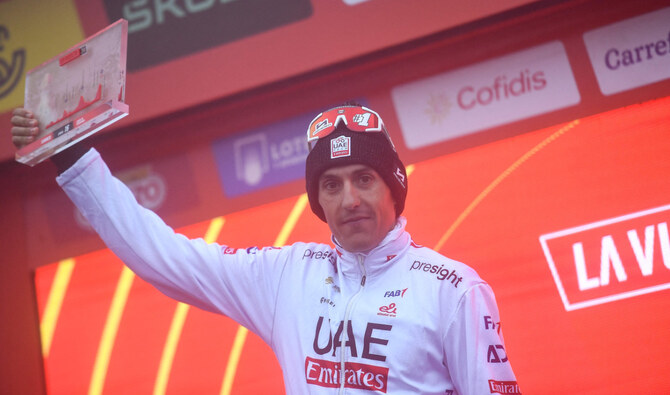
Soler climbs to Vuelta 16th stage honors, O’Connor hangs on to lead

Team UAE's Marc Soler celebrates on the podium after winning stage 16 of the Vuelta a España, a 181,5 km race between Luanco and Lagos de Covadonga, on Sept. 3, 2024. (AFP)
Short Url
Updated 04 September 2024
Follow

Soler climbs to Vuelta 16th stage honors, O’Connor hangs on to lead

  • Spain’s Soler (UAE Team Emirates) got the measure of Filippo Zana and Briton Max Poole for the stage honors
  • Roglic has put himself in a strong position to claim a record-equalling fourth Vuelta which finishes with a time-trial in Madrid on Sunday

LAKES OF COVDONGA, Spain: Marc Soler emerged from the mountain gloom to claim Tuesday’s Vuelta a Espana 16th stage summit finish, with Ben O’Connor narrowly holding on to the leader’s red jersey.

After Monday’s rest day it was back to work with a vengeance for the peloton, the day’s ride culminating with a daunting 12.8km climb up Lagos de Covadonga at 1,100m altitude.

Spain’s Soler (UAE Team Emirates) got the measure of Filippo Zana and Briton Max Poole for the stage honors.

“This is very special. I haven’t won a lot with this team and so after three years, to win at the Vuelta is special,” said Soler, finally hitting the mark after three third-place finishes in the last week.

O’Connor held on to the red jersey — for at least another day.

But three-time Vuelta winner Primoz Roglic, 11th on the day, sliced almost one minute off his lead.

The Slovenian goes into Wednesday’s 17th stage now just five seconds adrift of the Australian who crossed the line 20th.

Roglic will inevitably be ruing the 20sec penalty he picked up on Sunday for using his team car’s slipstream to help join the pack after a change of bike.

While Soler, O’Connor and Roglic all had reason to celebrate in their own right, Tuesday’s stage proved disastrous for Wout van Aert.

The Belgian, leading the sprinters’ points classification after three stage wins in this year’s race, crashed heavily with around 50km to go.

Despite getting back on his bike he pulled up shortly after, nursing his knee sitting on the bonnet of his Visma team car.

Van Aert has endured a tough 2024, suffering multiple fractures after a bone-crunching high speed fall in March in the Tour of Flanders which forced him to miss the remaining Spring one-day classics.

Roglic, meanwhile, has put himself in a strong position to claim a record-equalling fourth Vuelta which finishes with a time-trial in Madrid on Sunday.

Wednesday’s 17th stage is a 143km ride from Arnuero to Santander with a chance for the sprinters or a breakaway to take the spotlight.


Most women’s national team players earn less than $20,000, FIFPRO study shows

Updated 9 sec ago
Follow

Most women’s national team players earn less than $20,000, FIFPRO study shows

  • Some 66 percent of players earn below $20,000 annually from football
  • Nearly one-third of respondents reported earning between $0 and $4,999 from football

MANCHESTER: Two-thirds of women’s national team players earn less than $20,000 annually, according to a new FIFPRO survey that highlights persistent financial insecurity and structural gaps in the women’s game.
The global players union and affiliated national players unions surveyed 407 footballers from 41 nations who participated in the UEFA Women’s Euros, Copa America Femenina, the Women’s Africa Cup of Nations and the OFC Women’s Nations Cup.
Some 66 percent of players earn below $20,000 annually from football and nearly one-third of respondents reported earning between $0 and $4,999 from football, while only a small minority reached higher income brackets.
Professional clubs remain the main source of income, followed by national team payments, yet one in four players still rely on jobs outside football to make ends meet.
“Financial stability is a cornerstone of any career,” said FIFPRO’s Director of Women’s Football Alex Culvin. “The data is very clear: most players are earning insufficient income to ensure secure careers within the game.
“It is a risk to the sustainability of the sport because players will be inclined to leave football early to make ends meet.”
The survey, conducted between August and October, also revealed short-term contracts remain common: 33 percent of players were signed for one year or less, and 22 percent had no contract at all.
International competition schedules continue to strain players, with 58 percent saying pre-match rest was inadequate and 57 percent reporting insufficient recovery after games.
Travel conditions are also an issue, with three-quarters of players flying economy class during tournaments, with only 11 percent in premium economy or business.
While FIFPRO noted improvements since their 2022 survey – including increased prize money and a player-dedicated share at the Women’s Euros – similar reforms have not been replicated across other confederations.
Culvin said stakeholders must “continue to raise standards to support the increased professionalization of the women’s game.”