

‘Pushed to the wall’: Veteran lawmaker from Balochistan quits after deadly attacks 

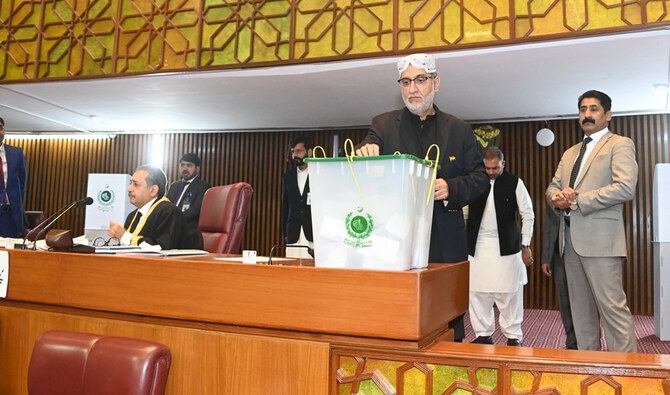
Sardar Akhtar Mengal, the leader of the Balochistan National Party (BNP), is seen casting his vote for presidential elections in the National Assembly of Pakistan in Islamabad on March 9, 2024. (@NAofPakistan/X/File)
Short Url
Updated 03 September 2024
Follow

‘Pushed to the wall’: Veteran lawmaker from Balochistan quits after deadly attacks 

  • Sardar Akhtar Mengal says people of the volatile, impoverished province “consistently marginalized” 
  • Says people of Balochistan protesting for their rights “either silenced, labeled traitors, or worse, killed”

ISLAMABAD: Veteran politician Sardar Akhtar Mengal, leader of the Balochistan National Party (BNP), announced his resignation from the National Assembly on Tuesday, saying the people of the volatile, impoverished Balochistan province had been “consistently marginalized” and “pushed to the wall.”

Mengal’s resignation comes after over 50 people were killed in Balochistan when separatist militants attacked police stations, railway lines and highways, and security forces launched retaliatory operations, late last month. The assaults were the most widespread in years by ethnic militants fighting a decades-long insurgency to win secession of the resource-rich southwestern province, home to major China-led projects such as a port and a gold and copper mine. The province is Pakistan’s largest by area but its most economically backward, lagging behind the rest of the country by nearly all social and economic indicators. 

“The prevailing situation in Balochistan has compelled me to take this step,” Mengal wrote in his resignation letter. 

“Our province has consistently been marginalized and ignored by this House. Each day, we are pushed further to the wall, leaving us with no choice but to reconsider our roles. The lack of genuine representation in this Assembly for the people of Balochistan has left voices like mine unable to bring meaningful change.”

Mengal said attempts by the people of Balochistan to speak up for their rights or protest were met with “hostility.”

“Our people are either silenced, labeled as traitors, or worse, killed,” he said. “Under such circumstances, I find it impossible to continue in this capacity, as my presence here no longer serves any purpose for the people I represent.”

The army has recently repeatedly referred to an ethnic rights movement in Balochistan being led by young people, many of them educated women, a “terrorist proxy.” The protesters have been calling for an end to what they describe as a pattern of enforced disappearances and human rights abuses by security forces, which deny the charge.

The province is home to key mining projects, including Reko Diq, run by mining giant Barrick Gold and believed to be one of the world’s largest gold and copper mines. Balochistan is an important part of China’s $65 billion investment in the China Pakistan Economic Corridor (CPEC), a wing of President Xi Jinping’s Belt and Road initiative.

The decades-old insurgency has continued to keep the mineral-rich province of some 15 million people poor and unstable and created security concerns around Pakistan’s plans to access untapped resources under Balochistan’s desert and mountainous terrain.

It is Pakistan’s smallest province by population and strategically located, bordering Iran to the west and Afghanistan to the north. Balochistan also has a long Arabian Sea coastline in the south, not far from the Gulf’s Strait of Hormuz oil shipping lane.


Pakistan seeks UK action over ‘incitement to violence’ against top military commander

Updated 7 sec ago
Follow

Pakistan seeks UK action over ‘incitement to violence’ against top military commander

  • Move follows a video that purportedly showed a PTI supporter in Bradford referencing violence against the army chief
  • Pakistan’s deputy interior minister says the government has written to the UK, saying the content breaches British law

ISLAMABAD: Pakistan’s State Minister for Interior Tallal Chaudhry said on Friday the government has written a letter to the United Kingdom to express concern over social media content circulating from British territory, which he said amounts to incitement to violence against the Pakistani state.

Speaking to a local news channel, Chaudhry said the government raised the issue after a video clip on social media purportedly showed a protester of former Prime Minister Imran Khan’s Pakistan Tehreek-e-Insaf (PTI) party criticizing Chief of Army Staff Field Marshal Asim Munir and referring to violence against him.

“This is not a political matter, nor is it a question of freedom of expression,” the minister said while speaking to Geo TV. “This is clearly a violation of international law and of Britain’s own laws, including the British Terrorism Act 2006.”

He said the material went beyond political dissent and amounted to incitement to violence, adding that Pakistan had conveyed to British authorities that states are responsible for ensuring that individuals residing on their territory — whether citizens, asylum seekers or others — do not incite rebellion or violence against another sovereign country.

“What is very dangerous is that a very specific act — a car bombing — has been referenced,” he continued. “It has not been generalized.”

A social media post by a Britain-based journalist claimed that the video was recorded during a protest outside Pakistan’s consulate in Bradford, though neither the authenticity of the footage nor the identity of the individual could be independently verified.

Chaudhry said Pakistan’s complaint to the UK was lodged under international law, British law and United Nations principles governing relations between states, stressing that the issue was one of incitement rather than protected speech.

“This is not about freedom of expression. This is about incitement and terrorism, which is against Britain’s own laws,” he said, adding that Islamabad expects British authorities to take action.

Pakistani officials have also previously voiced concerns over social media activity by PTI supporters abroad that they say fuels unrest and hostility toward state institutions.

British authorities have not publicly responded to the letter or Chaudhry’s statement.

PTI has not reacted to either of them as well.