

Pope Francis’ Asia trip marks 60 years of papal visits to the region

Priests, religious seminarians and Catechists touch the hands of Pope Francis as he leaves after meeting them at Saint Peter's Parish on the outskirts of Bangkok, Thailand, on November 22, 2019. (AP/File)
Short Url
Updated 02 September 2024
Follow

Pope Francis’ Asia trip marks 60 years of papal visits to the region

  • Papal travel is a thing of the modern era, starting with Pope Paul VI who became the first pontiff to leave Italy in more than 150 years 
  • Paul VI visited India in 1964, marking first time a pope ever visited Asia, he was first pope to fly in an airplane, first to leave Europe 

BANGKOK, Thailand: Pope Francis’ visit to Southeast Asia, the longest trip in his papacy, is the latest in decades of regular papal visits to the Asia-Pacific region.

Papal travel is a thing of the modern era, starting with Pope Paul VI, who became the first pontiff to leave Italy in more than 150 years when he made his famous pilgrimage to the Holy Land in 1964, shortly after becoming pope.

His next visit was to India later that same year, marking the first time a pope had ever visited Asia. It was one of many firsts for Paul VI, who was also the first pope to fly in an airplane, the first to leave Europe and the first to visit countries on six continents, earning him the nickname “the Pilgrim Pope.”
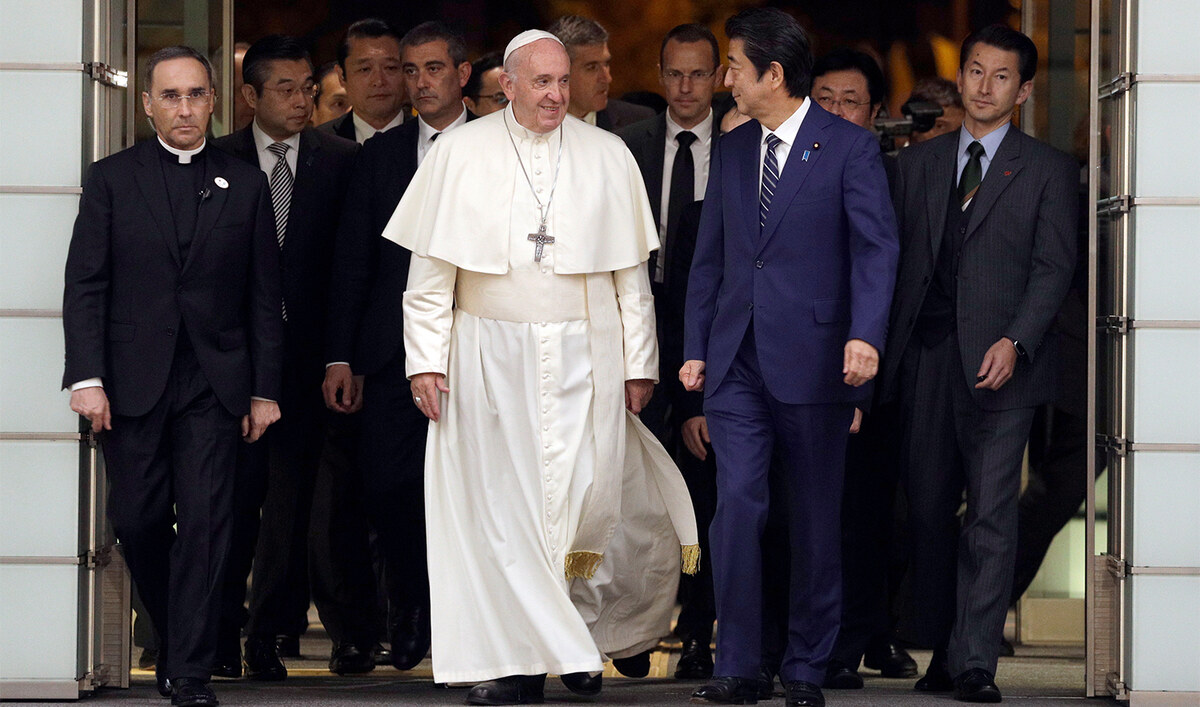


Pope Francis meets with Japanese Prime Minister Shinzo Abe at the Kantei in Tokyo, Japan, on November 25, 2019. (AP)

Others by Paul VI, according to the Vatican, included a 1970 trip with stops in Australia, Hong Kong, Indonesia, Ceylon — today Sri Lanka — and the Philippines, where a would-be assassin unsuccessfully attempted to stab him at Manila airport.

His successor, Pope John Paul I, never got the chance to travel, dying just over a month after he ascended to the papacy.

But Pope John Paul II, who followed in 1978, picked up where Paul VI left off and by the time of his death in 2005, was the most traveled pope in history; a title he holds to this day.

He made his first of two visits to the Philippines, one of Asia’s most Catholic countries, in 1981 in a trip that also took him to Pakistan, Guam, Japan and Anchorage, Alaska, according to the Vatican.

Over the years he would visit Asia many times, including trips to South Korea, Bangladesh, India, Sri Lanka, East Timor, Indonesia, Singapore and Thailand.

In a notable moment from his 1986 trip to India, he was accompanied by Mother Teresa to her home for the poor in Kolkata, meeting and blessing its residents. Reports at the time said the pope was visibly moved by the visit, and Mother Teresa later called it “the happiest day of my life.”

John Paul II also visited Australia, New Zealand, and the Pacific island nations of Fiji, Papua New Guinea and the Solomon Islands.

His successor, Benedict XVI, became pope at an advanced age and did not travel as frequently or as far afield, but did visit Australia in 2008 for World Youth Day, according to the Vatican.
Francis, who took over from Benedict after he resigned in 2013 due to declining health, has already been to the Asia-Pacific region several times, with visits to countries including South Korea, Sri Lanka, the Philippines, Bangladesh, Thailand, Japan, Kazakhstan and Mongolia.

In his 2017 visit to Myanmar, also known as Burma, Francis famously met with Nobel Peace Prize winner Aung San Suu Ky i, the democratically-elected leader who was ousted in the military in 2021, which has given rise to today’s civil war.

This time his Sept. 2-13 trip takes him to Indonesia, Papua New Guinea, East Timor and Singapore.

Of interesting historical note: the last pope to have left Italy before Paul VI was Pius VII, though he did so involuntarily.

Captured by French forces in Rome in 1809, Pius VII had been captive for three years when the French emperor, Napoleon Bonaparte, ordered him moved near Paris in 1812. As Napoleon’s empire crumbled, he was released and returned to Rome in 1814.


Modi starts Mideast-Africa tour as India-Oman free-trade pact nears completion

Updated 15 December 2025
Follow

Modi starts Mideast-Africa tour as India-Oman free-trade pact nears completion

  • Oman’s Shoura Council approved the trade deal’s draft last week
  • Modi begins trip in Amman, heading to Addis Ababa and Muscat

NEW DELHI: Prime Minister Narendra Modi left New Delhi on Monday for a tour covering Jordan, Oman and Ethiopia, as his government looks to strengthen partnerships with West Asia and Africa and finalize a free-trade deal with Muscat.

Modi’s four-day trip will start in Amman, at the invitation of King Abdullah.

“I am sure this visit will boost bilateral linkages between our nations,” Modi said on social media upon his arrival in Jordan, where he was received by Prime Minister Jafar Hassan.

On Tuesday, he is scheduled to arrive in Addis Ababa for his first state visit to Ethiopia. A day later, he will be in Muscat, where the Shoura Council last week approved the draft Comprehensive Economic Partnership Agreement with India.

“If it is signed during this visit, it will significantly deepen the economic ties between India and Oman. And it will open up a new chapter in the history of India-Oman trade and commercial relationship,” Ministry of External Affairs Secretary Arun Chatterjee told reporters ahead of Modi’s departure.

He said Modi would be accompanied by a high-level delegation for his second visit to Oman, after his last trip in February 2018. It also follows the visit of Oman’s Sultan Haitham bin Tariq to India in December 2023.

Free-trade negotiations between India and Oman began in November 2023, with the first round in New Delhi and the second in Muscat.

When the talks concluded in March 2024, Oman sought revisions on market-access terms and the final signature was postponed.

Announcements of the deal’s possible finalization have been made in the past few months by India’s Commerce and Industry Minister Piyush Goyal and the Omani ambassador to New Delhi, Issa Saleh Al-Shibani.

It would be its second with a GCC country after a 2022 trade deal with the UAE, as India has been trying to reach a similar agreement with the whole bloc.

“The framework is expected to be the same as the UAE’s, that is, a Comprehensive Economic Partnership Agreement. This is significant given that the progress on India-GCC FTA has been slow and non-consequential so far,” said Muddassir Quamar, associate professor at the School of International Studies, Jawaharlal Nehru University.

While Oman is one of Delhi’s smaller GCC trading partners — trailing behind the UAE and Saudi Arabia, with bilateral trade about $10 billion — it remains strategically important, particularly in energy and logistics.

“The FTA is likely to give a boost to India-Oman economic and trade relations, especially of goods and services. (It is) important given India has worked to enhance its trade and economic relations with the Gulf countries that are (among) the most dynamic and fast-expanding global economies,” Quamar told Arab News.

“It is also important because there is immense potential for Indian businesses and industries to partner with their Gulf and Omani partners in contributing to the diversification and economic growth plans.”