

Political stability at stake as Malaysia’s Najib awaits verdict in biggest 1MDB trial

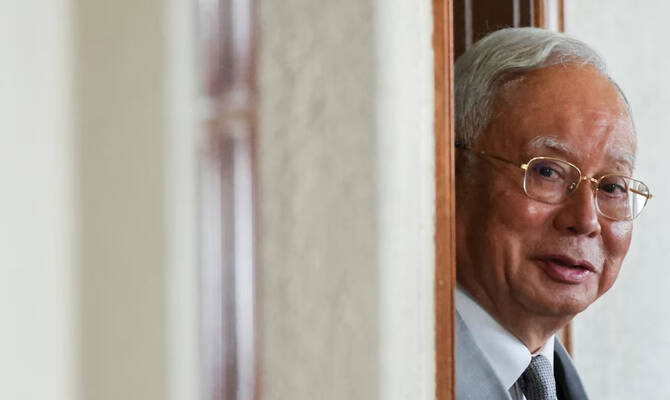
Malaysia's former Prime Minister Najib Razak, jailed for corruption in the multibillion-dollar 1MDB scandal, attends the verdict of his house arrest bid at Kuala Lumpur Courts Complex in Kuala Lumpur, Malaysia December 22, 2025. (Reuters)
Short Url
Updated 26 December 2025
Follow

Political stability at stake as Malaysia’s Najib awaits verdict in biggest 1MDB trial

  • A Malaysian high court will decide on Friday whether to convict Najib of four more charges of corruption and 21 counts of money laundering involving the illegal transfer of about 2.2 billion ringgit ($539 million) from 1MDB

KUALA LUMPUR: Jailed former Malaysian Prime Minister Najib Razak will hear a verdict ​on Friday in the biggest trial he faces over the multibillion-dollar 1MDB scandal, a ruling that could risk deepening tensions within the administration of current premier Anwar Ibrahim.
Investigators have said about $4.5 billion was allegedly stolen from 1Malaysia Development Berhad, a state fund co-founded by Najib in 2009, and that more than $1 billion allegedly made its way into his personal bank accounts. Najib, 72, last year apologized for mishandling the scandal while in office but he has consistently denied wrongdoing, saying he was misled by 1MDB officials and a fugitive ‌financier, Jho Low, on ‌the source of the funds. In 2020, Najib was ‌convicted ⁠of ​graft and ‌money laundering for illegally receiving funds from a 1MDB unit and began a 12-year prison sentence two years later after losing all his appeals. That sentence was later halved by a pardons board chaired by Malaysia’s king, with Najib due for release in 2028.
A Malaysian high court will decide on Friday whether to convict Najib of four more charges of corruption and 21 counts of money laundering involving the illegal transfer of about 2.2 billion ringgit ($539 million) from 1MDB.
If ⁠found guilty, he could face maximum jail terms of between 15 and 20 years on each charge, as ‌well as a fine of up to five times the ‍value of the alleged misappropriations.
The implementation ‍of the penalties, however, could be stayed pending further appeals.

VERDICTS TEST GOVERNMENT STABILITY

The decision ‍will be closely watched after another court this week dismissed a bid by Najib to serve the remainder of his sentence under house arrest.
That ruling reignited tensions in Anwar’s ruling administration, which includes Najib’s party, the United Malays National Organization.
UMNO campaigned against Anwar in a 2022 election but joined his coalition ​to form a government after the poll ended in a hung parliament.
Several UMNO leaders expressed disappointment with the decision to deny Najib house arrest, ⁠saying it risked diluting the powers of Malaysia’s rulers, while others were angered by social media posts by some members of Anwar’s coalition celebrating the ruling.
Anwar this week called for all parties to handle news of the verdict with patience and wisdom, adding that it was “inappropriate to muddy the atmosphere or add tension” even if there were those who chose not to sympathize with Najib and his family. A guilty verdict for Najib on Friday could strain ties further, with some UMNO leaders already calling for the party to review its pact with Anwar or withdraw from the government altogether. An acquittal, however, may weaken Anwar, who has been under pressure to uphold his credentials as an anti-graft campaigner. Anwar has been accused by critics of ‌betraying progressive voters and allies after prosecutors dropped some corruption charges against Najib and other UMNO figures. The premier has repeatedly said he does not interfere in court cases.



Rubio meets Orbán in Budapest as US and Hungary are to sign a civilian nuclear pact

Updated 8 sec ago
Follow

Rubio meets Orbán in Budapest as US and Hungary are to sign a civilian nuclear pact

  • Trump has been outspoken in his support for the nationalist Orbán in the Hungarian leader’s bid for reelection in two months

BUDAPEST, Hungary: US Secretary of State Marco Rubio was in the Hungarian capital on Monday for meetings with Prime Minister Viktor Orbán and his government during which they plan to sign a civilian-nuclear cooperation agreement heralded by US President Donald Trump.
Trump has been outspoken in his support for the nationalist Orbán in the Hungarian leader’s bid for reelection in two months. Orbán and his Fidesz party are facing their most serious challenge in the April 12 vote since the right-wing populist retook power in 2010.
The stop in Hungary’s capital follows Rubio’s visit to Slovakia on Sunday, after he previously attended the Munich Security Conference in Germany.
Led by Euroskeptic populists who oppose support for Ukraine and vocally back Trump, Slovakia and Hungary represent friendly territory for Rubio as he pushes to shore up energy agreements with both Central European countries.
Widely considered Russian President Vladimir Putin’s most reliable advocate in the European Union, Orbán has maintained warm relations with the Kremlin despite its war against Ukraine while currying favor with Trump and his MAGA — short for the 2016 Trump campaign slogan “Make America Great Again” — movement.
Many in MAGA and the broader conservative world view Hungary as a shining example of successful conservative nationalism, despite the erosion of its democratic institutions and its status as one of the EU’s poorest countries.
In a post on his Truth Social site earlier this month, Trump endorsed Orbán for the coming elections and called him a “truly strong and powerful Leader” and “a true friend, fighter, and WINNER.”
Trump has praised Orbán’s firm opposition to immigration, exemplified by a fence his government erected on Hungary’s southern border in 2015 as hundreds of thousands of refugees fled Syria and other countries in the Middle East and Africa.
Other US conservatives admire Orbán’s hostility to LGBTQ+ rights. His government last year banned the popular Budapest Pride celebration and allowed facial recognition technology to be used to identify anyone participating despite the ban. It has also effectively banned same-sex adoption and same-sex marriage, and disallowed transgender individuals from changing their sex in official documents.
Orbán has remained firmly committed to purchasing Russian energy despite efforts by the EU to wean off such supplies, and received an exemption from US sanctions on Russian energy after a November meeting in the White House with Trump.
Apparently trusting that his political and personal affinity with the US leader could pay even greater dividends, Orbán and his government have sought to woo Trump to Hungary before the pivotal April 12 elections — hoping such a high-profile visit and endorsement would push Orbán, who is trailing in most polls, over the finish line.
Budapest has hosted several annual iterations of the Conservative Political Action Conference, or CPAC, and another was hastily rescheduled this year to fall in March, just before Hungary’s elections.