


JEDDAH: Saudi Arabia’s Al-Wahbah Crater, a striking geological wonder, has earned a place among the world’s top 100 geological heritage sites for 2024.
The recognition by the International Union of Geological Sciences and UNESCO highlights the crater’s extraordinary significance not just within the Kingdom, but globally.
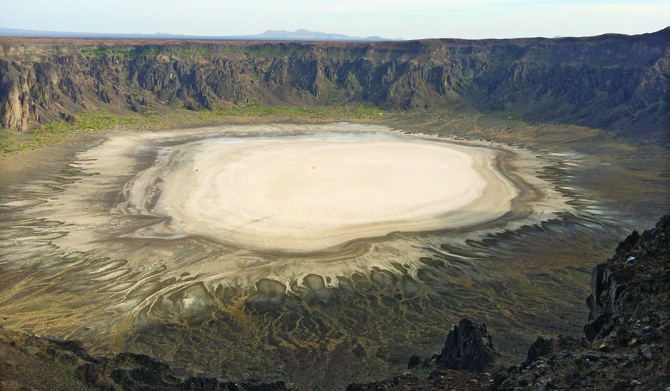
Al-Wahbah Crater, also known as Maqla Tamiyyah, is a maar crater — a type of volcanic site formed by a phreatic eruption, a violent steam explosion caused by magma interacting with groundwater.

Abdulaziz bin Laboun, Chairman of the board of directors of the Saudi Geologists Cooperative
The crater, located in the Harrat Kishb basaltic plateau about 270 km northeast of Jeddah, stands out for its immense scale and beauty.
Formed about 1.1 million years ago, it measures about 2.3 km in diameter and 250 meters in depth, making it the largest and deepest volcanic crater in Saudi Arabia. Its depth and diameter are significantly larger than the average volcanic crater, and it features a shallow salt lake formed by rainwater accumulation.
The crater is part of a larger volcanic field that includes 175 volcanic cones, dating back millions of years and spanning an area of about 6,000 sq. km, according to the Saudi Press Agency.
Geological sites like Al-Wahbah Crater offer valuable insights into the Earth’s history and processes. By highlighting such landmarks, we enhance public awareness and support the advancement of geological research.
Abdulaziz bin Laboun, Chairman of the board of directors of the Saudi Geologists Cooperative
Tariq Aba Al-Khail, spokesperson for the Saudi Geological Survey, highlighted the global significance of the Al-Wahbah Crater.
“The recognition of the Al-Wahbah Crater as one of the top 100 geological heritage sites is expected to boost its profile as a prime destination for both scientific study and tourism. This distinction emphasizes its exceptional geological features and underscores its significance on both local and global scales.”
The crater was selected from 174 nominated sites across 64 countries, including Saudi Arabia, the US, Italy, Canada, New Zealand, China, Iceland, Egypt and Finland, Al-Khail added.
The bottom of Al-Wahbah Crater is covered with white sodium phosphate crystals. While it was once believed that the crater was formed by a meteorite due to its circular shape and elevated sides, geologists now widely agree that it is a maar crater.
Abdulaziz bin Laboun, a geological expert and chairman of the board of directors of the Saudi Geologists Cooperative, said: “Publicizing natural phenomena like the Al-Wahbah Crater through the media and highlighting their scientific importance is essential for enhancing their global profile and advancing geological research.
“This recognition not only highlights the crater’s significance, but also supports the broader development of geological sciences in Saudi Arabia.”
The crater has several unique aspects, Laboun added.
“The crater’s geological features are remarkable, including its depth, which makes it the deepest crater in the Kingdom, and its diameter of 2,000 meters. The area around the crater is characterized by natural springs, trees and palm groves, making it a rare and distinctive geological site. Moreover, its location in the volcanic field mainly adds to its uniqueness,” he said.
There are at least 23 volcanic fields formed millions of years ago in Saudi Arabia, covering about 90,000 sq. km, or about 5 percent of the Kingdom.
The eruptions in these fields vary, but what sets Al-Wahbah Crater apart is its formation in an aquatic environment — a characteristic of maar craters. “The crater is a stage for imagination, often associated with local folklore, including tales of a lover named Tamia, who, according to legend, flew from this crater toward Qattan Mountain in Najd,” Laboun said.
“Geological sites like Al-Wahbah Crater offer valuable insights into the Earth’s history and processes. By highlighting such landmarks, we enhance public awareness and support the advancement of geological research.”


