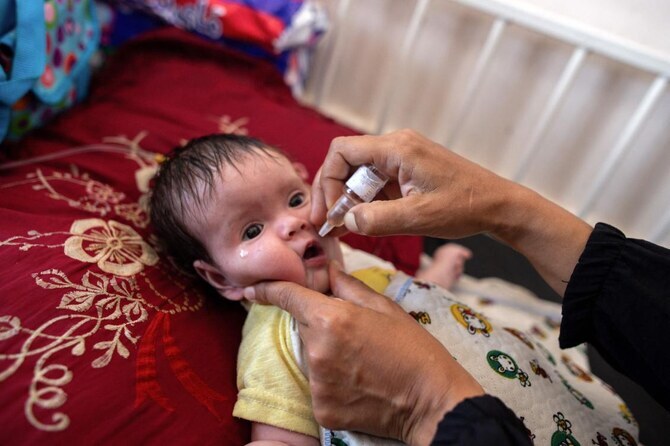
GAZA: A health official said a polio vaccination campaign had begun in Gaza on Saturday after the war-torn territory recorded its first case of the disease in a quarter of a century.
Local health officials along with the UN and NGOs “are starting today the polio vaccination campaign in the central region,” Moussa Abed, director of primary health care at the Gaza health ministry, told AFP.
The World Health Organization (WHO) said on Thursday that Israel had agreed to a series of three-day “humanitarian pauses” in Gaza to facilitate vaccinations, though officials had earlier said the campaign was expected to start on Sunday.
After beginning in central Gaza, vaccines are set to be administered in southern Gaza and then in northern Gaza.
The campaign, which involves two doses, aims to cover more than 640,000 children under 10.
Michael Ryan, WHO deputy director-general, told the UN Security Council this week that 1.26 million doses of the oral vaccine had been delivered in Gaza, with another 400,000 still to arrive
The Ramallah-based Palestinian health ministry said earlier this month that tests in Jordan had confirmed polio in an unvaccinated 10-month-old baby from central Gaza.
Poliovirus is highly infectious, and most often spread through sewage and contaminated water — an increasingly common problem in Gaza as the Israel-Hamas war drags on.
The disease mainly affects children under the age of five. It can cause deformities and paralysis, and is potentially fatal.
Bakr Deeb told AFP on Saturday that he brought his three children — all under 10 — to a vaccination point despite some initial doubts about its safety.
“I was hesitant at first and very afraid of the safety of this vaccination,” he said.
“After the assurances of its safety, and with all the families going to the vaccination points, I decided to go with my children as well, to protect them.”
Abed, the health official, stressed on Saturday that the vaccine was “100 percent safe.”
The war in Gaza was triggered by Hamas’s unprecedented attack on southern Israel on October 7 which resulted in the deaths of 1,199 people, mostly civilians, according to an AFP tally based on Israeli official figures.
Israel’s retaliatory military campaign has killed at least 40,691 people in Gaza, according to the territory’s health ministry. The UN rights office says most of the dead are women and children.
Incessant Israeli bombardment has also caused a major humanitarian crisis and devastated the health system.

Health official says polio vaccine campaign begins in war-torn Gaza
Short Url
https://arab.news/bvx8q
Health official says polio vaccine campaign begins in war-torn Gaza
- Health ministry officials in the enclave along with the UN and NGOs “are starting today the polio vaccination campaign in the central region”
- After beginning in central Gaza, vaccines are set to be administered in southern Gaza and then in northern Gaza
Sudan paramilitary advances near Ethiopia border
KHARTOUM: Sudanese paramilitary forces have advanced on army positions near the southeastern border with Ethiopia, according to the group and an eyewitness who spoke to AFP Wednesday.
Control over Sudan’s southeastern Blue Nile State, bordering both Ethiopia and South Sudan, is split between the army and a faction of the Sudan People’s Liberation Movement-North, allies of the paramilitary Rapid Support Forces.
In a statement released Tuesday, the SPLM-N, led by Abdelaziz Al-Hilu, said they had “liberated the strategic city of Deim Mansour and areas of Bashir Nuqu and Khor Al-Budi.”
Since April 2023, the Sudanese army has been at war with the RSF. In February of last year, the RSF announced a surprise alliance with the SPLM-N, securing experienced fighters, land and border access.
Deim Mansour lies between the SPLM-N stronghold Yabus, birthplace of their deputy commander Joseph Tuka, and the army-held town of Kurmuk, which hosts a large army contingent.
Babiker Khaled, who fled to Kurmuk, told AFP that SPLM-N fighters began amassing in the forests around Deim Mansour on Sunday.
“The shelling began on Monday, they entered the city on Tuesday,” he said, adding that “some people fled into Ethiopia, others arrived in Kurmuk.”
From its foothold in the southern Blue Nile, a thin strip of land jutting south between Ethiopia and South Sudan, the SPLM-N maintains reported supply lines from both countries, building on decades-old links.
Close to three years of war in Sudan have left tens of thousands dead and around 11 million displaced, creating the world’s largest hunger and displacement crises.
It has also torn the country apart, with the army holding the center, north and east of Sudan while the RSF and its allies dominate the west and parts of the south.
Sudan’s Kordofan region, where the SPLM-N has its other foothold in the Nuba Mountains, is currently the war’s fiercest battleground.
On Tuesday, the army broke a paramilitary siege on South Kordofan state capital Kadugli, days after breaking another on the nearby city of Dilling.
Control over Sudan’s southeastern Blue Nile State, bordering both Ethiopia and South Sudan, is split between the army and a faction of the Sudan People’s Liberation Movement-North, allies of the paramilitary Rapid Support Forces.
In a statement released Tuesday, the SPLM-N, led by Abdelaziz Al-Hilu, said they had “liberated the strategic city of Deim Mansour and areas of Bashir Nuqu and Khor Al-Budi.”
Since April 2023, the Sudanese army has been at war with the RSF. In February of last year, the RSF announced a surprise alliance with the SPLM-N, securing experienced fighters, land and border access.
Deim Mansour lies between the SPLM-N stronghold Yabus, birthplace of their deputy commander Joseph Tuka, and the army-held town of Kurmuk, which hosts a large army contingent.
Babiker Khaled, who fled to Kurmuk, told AFP that SPLM-N fighters began amassing in the forests around Deim Mansour on Sunday.
“The shelling began on Monday, they entered the city on Tuesday,” he said, adding that “some people fled into Ethiopia, others arrived in Kurmuk.”
From its foothold in the southern Blue Nile, a thin strip of land jutting south between Ethiopia and South Sudan, the SPLM-N maintains reported supply lines from both countries, building on decades-old links.
Close to three years of war in Sudan have left tens of thousands dead and around 11 million displaced, creating the world’s largest hunger and displacement crises.
It has also torn the country apart, with the army holding the center, north and east of Sudan while the RSF and its allies dominate the west and parts of the south.
Sudan’s Kordofan region, where the SPLM-N has its other foothold in the Nuba Mountains, is currently the war’s fiercest battleground.
On Tuesday, the army broke a paramilitary siege on South Kordofan state capital Kadugli, days after breaking another on the nearby city of Dilling.
© 2026 SAUDI RESEARCH & PUBLISHING COMPANY, All Rights Reserved And subject to Terms of Use Agreement.