

PIF’s gaming entity aims to become a global games leader by 2030

1 / 3
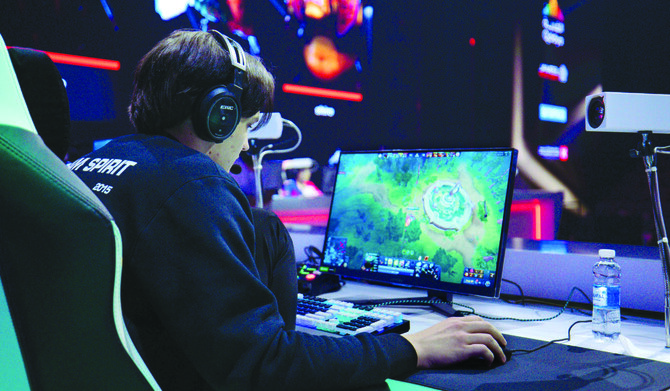
According to the 2023 annual report published by Savvy, there are more than 21 million self-identified game players in Saudi Arabia. (Ministry of Sport)
2 / 3
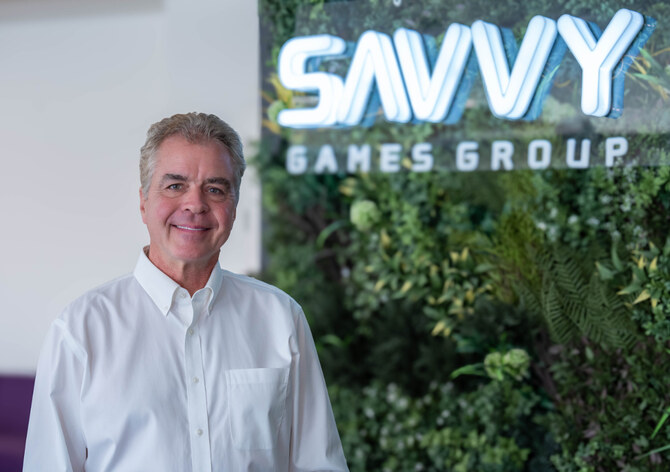
Brian Ward, Savvy Games Group CEO. (AN photo by Huda Bashatah)
3 / 3
Brian Ward, Savvy Games Group CEO. (AN photo by Huda Bashatah)
Short Url
Updated 01 September 2024
Follow

PIF’s gaming entity aims to become a global games leader by 2030

  • Savvy’s CEO Brian Ward sheds light on company’s achievements, future plans

RIYADH: The CEO of Savvy Games Group recently detailed the latest progress from its 2023 annual report and highlighted key areas of expansion in 2025.

Brian Ward told Arab News: “2025 is going to be a very exciting year for Savvy.

“First of all, on the esports side, we have the inaugural Olympic Esports Games here in Riyadh, sometime later in the second half of the year. So, a huge tournament, the first official addition to the Olympic movement since the Winter Games in 1928,” he explained.

“On the game development and publishing side, we expect to be able to announce another major investment or acquisition, hopefully in a top team or publisher that can bring another great game to our portfolio,” he said.

HIGHLIGHTS

• The company emphasized its mission and commitment to transparency through the publication of its first inaugural annual report providing key resources for understanding Savvy’s trajectory in the gaming sector.

• On creating jobs, Ward said that the team has now doubled in size within the last year.

Savvy is one of the entities responsible for positioning the Kingdom as a major global hub for the games industry, with a mission to become a world leader by 2030.

Since its launch in September 2022 by Crown Prince Mohammed bin Salman, also the chairman of the board of Savvy Games Group, the PIF-owned company has expanded its assets on multiple fronts from human capital, acquisitions, game development, and investment.
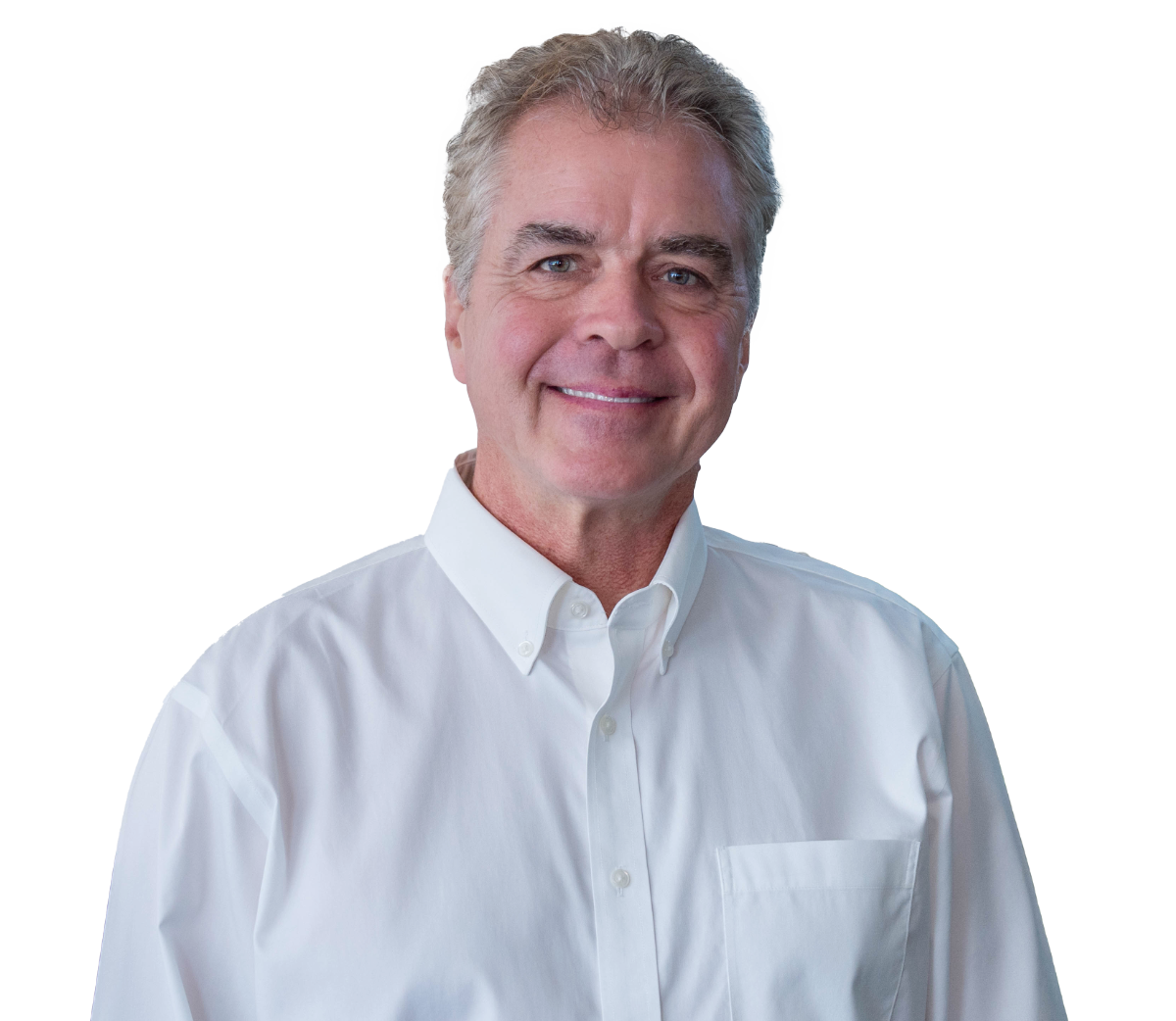


Brian Ward, Savvy Games Group CEO

“I think we’ll see a lot more collaboration amongst all the stakeholders in the Kingdom toward creating great incentives to attract foreign investment and to bring jobs to Saudi Arabia, as well as training and development programs actually kicking off to help develop skills for Saudis,” Ward said.

According to the 2023 annual report published by Savvy, there are more than 21 million self-identified game players in Saudi Arabia — 70 percent of the population — with over 48 percent of these players being women.

The company emphasized its mission and commitment to transparency through the publication of its first inaugural annual report providing key resources for understanding Savvy’s trajectory in the gaming sector.

On the game development and publishing side, we expect to be able to announce another major investment or acquisition, hopefully in a top team or publisher that can bring another great game to our portfolio.

Brian Ward, Savvy Games Group CEO

One of the major central themes of the report is Savvy’s role in delivering Saudi Arabia’s National Gaming and Esports Strategy.

In a statement released by Savvy, the CEO said: “2023 was a transformative year for Savvy. Our investments and initiatives have expanded our global footprint and contributed to exciting developments within the Kingdom of Saudi Arabia, and added significant shareholder value.

“I would like to extend my gratitude to our chairman for his wise counsel and leadership and our shareholder, the PIF, for their unwavering support and guidance.”

The annual report detailed how 2023 marked a major year of investment for Savvy, with the largest transaction being a $4.9 billion acquisition of Scopely, the rebranding of Savvy Games Studios to Steer Studios, and the launch of “MONOPOLY GO!”

On creating jobs, Ward said that the team has now doubled in size within the last year. Savy’s workforce now has over 3,500 employees across 22 countries with an emphasis on hiring people in key areas such as finance, strategy, legal, human resources, and communications.

When asked how Savvy aims to contribute to the Kingdom’s growing gaming sector, Ward said they are executing on three fronts: games development and publishing investment worldwide, esports development, and then Saudi Arabian ecosystem-building.

“On the KSA ecosystem-building front, our main mission, as we see it, is to help coalesce and drive further collaboration amongst local stakeholders to ensure that we have the right incentives, packages to attract foreign investment and jobs, training and development programs, coming to fruition to give Saudis the right skills to fill those jobs,” he explained.

Ward highlighted how Savvy’s local studio is doing “extremely well,” adding that “there’s about 85 or 90 people in that studio now. They’re in development of two mobile games, one of which is in soft launch and, hoping to kick off a console project with an important, local third party.”

Speaking on the recent New Global Sports Conference, Ward said it was very successful.

“We were remarking that I don’t think any of us had seen that number of senior executives from the games industry all in one place in many, many years, so super well-attended from that point.”


Swedish king awards American Saudi scientist, Omar Yaghi, Nobel Prize in Chemistry 2025

Nobel Prize in Chemistry 2025 laureate US-Saudi chemist Omar M. Yaghi poses with award during the award ceremony in Stockholm.
Updated 10 December 2025
Follow

Swedish king awards American Saudi scientist, Omar Yaghi, Nobel Prize in Chemistry 2025

  • Yaghi will share $1.2m prize with British Australian and Japanese scientists Richard Robson and Susumu Kitagawa
  • He is the 1st Saudi national to be awarded the Nobel Prize and 2nd Arab-born to win in the chemistry category since 1999

STOCKHOLM: King Carl XVI Gustaf of Sweden on Wednesday awarded American Saudi scientist Omar Yaghi the Nobel Prize in Chemistry for his breakthrough development of metal-organic frameworks, a sponge-like structure that could store CO2 or harvest water from the air, alongside the British Australian and Japanese scientists Richard Robson and Susumu Kitagawa.

Yaghi, Robson and Kitagawa have each contributed over the past 50 years to developing scalable, reliable MOF models that can be deployed in industry to address climate-related issues and deliver clean air and water. They will share the $1.2 million prize.

Yaghi, 60, who grew up in a refugee camp in Jordan to a Palestinian family expelled from their property by Zionist militias in 1948, is the second Arab-born laureate to be awarded the Nobel Prize in Chemistry by the Royal Swedish Academy of Sciences.

The Nobel Foundation said that MOFs, which are structures with large internal spaces, “can be used to harvest water from desert air, capture carbon dioxide, store toxic gases or catalyze chemical reactions.”

In 2015, Yaghi received the King Faisal International Prize for Chemistry, and in 2021, King Salman granted him Saudi citizenship for his scientific achievements. He holds the James and Neeltje Tretter Chair in Chemistry at UC Berkeley and is the founding director of the Berkeley Global Science Institute. In addition, Yaghi has branched into entrepreneurial activity since 2018, founding Atoco, which works on water harvesting and carbon capture, and co-founding H2MOF for hydrogen storage and WaHa Inc. for water harvesting with projects in the Middle East.

His focus on harvesting water from the air in arid conditions stems from his upbringing in Jordan, where water reached homes every 14 days. He began field tests in the Arizona desert in the 1990s to capture water from the air using the MOF-303 model he had developed.

Yaghi is the first Saudi national to be awarded the Nobel Prize and the second Arab-born to win in the chemistry category since the Egyptian American chemist and scientist Ahmed Zewail was honored in 1999.

Zewail’s model of the “femtochemistry apparatus” is on display at the Nobel Prize Museum. He used the apparatus to demonstrate the principle behind his method of studying chemical reactions using laser technology, capturing it in a femtosecond, which is to a second what a second is to 32 million years.

He is one of dozens of laureates who donated objects to the museum since its foundation in 2001 to mark the 100th anniversary of the Nobel Prize, which began in 1901, five years after the death of the Swedish chemist Alfred Nobel. Since 2001, it has become tradition that each December the winners of that year bring an item to be displayed that reflects their work, personal life or inspiration, Karl Johan, a curator at the museum, told Arab News.

“Zewail wanted to donate an object that could visualize his work and his experiment. He constructed (the interactive apparatus) specifically for the museum. As one of the first objects to be displayed after 2001, it got lots of attention,” Johan said.

The award ceremony in the Swedish capital is the latest event to wrap up Nobel Week, which, since Friday, has featured Nobel laureates in the fields of literature, chemistry, physics, medicine and economic sciences engaging in public events. The Nobel Peace Prize was awarded in the Norwegian capital of Oslo on Wednesday, where the daughter of the Venezuelan opposition leader, Maria Corina Machado, accepted it in her mother’s name after authorities prevented her from leaving early to attend the ceremony.