

Gabon marks year since ‘coup of liberation’

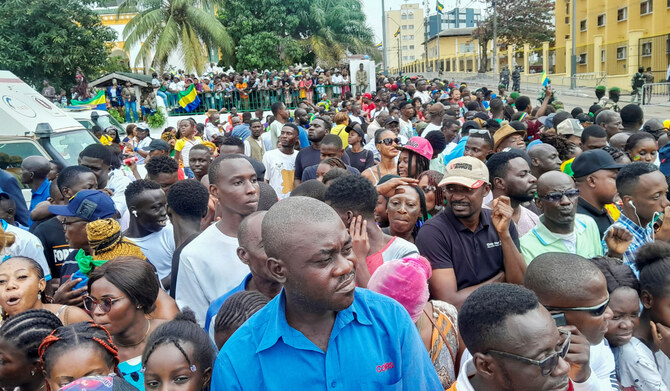
People attend the celebrations in Libreville, marking the first anniversary of the ouster of Gabon’s President Ali Bongo. (Reuters)
Short Url
Updated 31 August 2024
Follow

Gabon marks year since ‘coup of liberation’

  • One year later, the economic outlook remains uncertain, and the junta has yet to confirm a date for a promised transition to democracy via the ballot box, but supporters, including student Ulrich Yebe, said they felt cautiously optimistic

LIBREVILLE: A year since a military coup in Gabon ended the Bongo dynasty’s 56-year rule, the country marked the anniversary in a festive mood this week with celebrations and promises by the junta to step up progress on reforms.
The Gabonese broadly welcomed the military’s ouster of President Ali Bongo, whose family’s poor management of the country’s oil wealth had led to a stagnant economy and stranded a third of the population in poverty.
Hundreds gathered in the center of the capital, Libreville, for official celebrations led by interim President Gen. Brice Oligui Nguema to mark the first anniversary of what is widely referred to as the “coup of liberation” in Gabon.
“The Gabonese have cried so much. He (Nguema) came to wipe away our tears. And today we’re happy,” said civil servant Edwige Bengone, wearing a T-shirt with the coup leader’s photo on it, as brass bands played among cheering crowds.
One year later, the economic outlook remains uncertain, and the junta has yet to confirm a date for a promised transition to democracy via the ballot box, but supporters, including student Ulrich Yebe, said they felt cautiously optimistic.
“In just one year, we can’t really judge yet. But given the progress made, we can say that they’re on the right track. We’re waiting for the end of the transition to see what they’ve been able to achieve,” he said.
Gabon faces significant challenges. Despite its considerable oil wealth, infrastructure across the heavily forested country is poor, it is highly dependent on food imports, and income per capita is lower than it was in the 1970s.
The junta, which calls itself the Committee for the Transition and Restoration of Institutions, has improved transparency and budget management.
However, a brighter economic outlook will depend on authorities’ ability to pivot to a more open and inclusive model of governance, as the International Monetary Fund warned in May, saying economic diversification and correcting fiscal imbalances were vital.
The junta has not made sufficient progress in reforming the various branches of government as promised, said Geoffroy Foumboula, a prominent Bongo critic now a senior figure in the national assembly.
“After a year, the restoration of institutions is the poor relation of the transition. We’re still very slow on this front,” he told Reuters.
In a television address to the nation this week, Nguema appeared to address those concerned about the pace of progress.
“Our work together is not finished. But it is well underway. We have initiated change. And we must continue on this path,” he said.
Other criticisms of the junta include the dominance of the military in an ongoing national dialogue, lack of clarity on a timeline for presidential elections, and uncertainty over whether junta members will be eligible to run, said Remadji Hoinathy, a senior researcher at the Africa-focused Institute for Security Studies.
“On the ground, Nguema has been quite skillful,” he said, referring to the junta’s engagement with some opposition factions and civil society.
“But the reality in Gabon is that it’s very difficult, changing things overnight.”


Trump invites Colombia’s Petro to White House after earlier threat of military action

Updated 08 January 2026
Follow

Trump invites Colombia’s Petro to White House after earlier threat of military action

  • Relations between Trump and Petro have been frosty since the Republican returned to the White House in January 2025

WASHINGTON/BOGOTA: Days after threatening Colombia with military action, US ​President Donald Trump on Wednesday said arrangements were being made for the country’s President Gustavo Petro to visit the White House, following a call between the two leaders. Trump and Petro said they discussed relations between the two countries in their first call since the US president on Sunday said that a US military operation focused on Colombia’s government “sounds good” to him. That threat followed Trump ordering the US capture of the president of neighboring Venezuela, who ‌was flown to ‌the US to face drug and weapons charges.
“It ‌was ⁠a ​great honor ‌to speak with the President of Colombia, Gustavo Petro, who called to explain the situation of drugs and other disagreements that we have had. I appreciated his call and tone, and look forward to meeting him in the near future,” Trump wrote on social media.
Trump added “arrangements are being made” for a meeting in Washington between himself and Petro, Colombia’s first leftist president, but gave no specific ⁠date for a meeting.
“We have spoken by phone for the first time since he became president,” Petro ‌told supporters gathered at a rally in ‍Bogota meant to celebrate Colombia’s sovereignty, ‍adding he had requested a restart of dialogue between the two countries.
A ‍source in Petro’s office told Reuters the call was “cordial” and “respectful.”
Relations between Trump and Petro have been frosty since the Republican returned to the White House in January 2025.
Trump has repeatedly accused the administration of Petro, without evidence, of enabling a steady ​flow of cocaine into the US, imposing sanctions on the Colombian leader in October.
On Sunday Trump referred to Petro as “a sick ⁠man, who likes making cocaine and selling it to the United States.”
The US in September had revoked Petro’s visa after he joined a pro-Palestinian demonstration in New York following a meeting of the United Nations General Assembly and called on US soldiers to “disobey the orders of Trump.”
Petro, who has been a vocal opponent of Israel’s war in Gaza, had accused Trump of being “complicit in genocide” in Gaza and called for “criminal proceedings” over US missile attacks on suspected drug-running boats in Caribbean waters.
The Trump administration has carried out more than 30 strikes against suspected drug boats since September, in a campaign that has killed at least ‌110 people.