

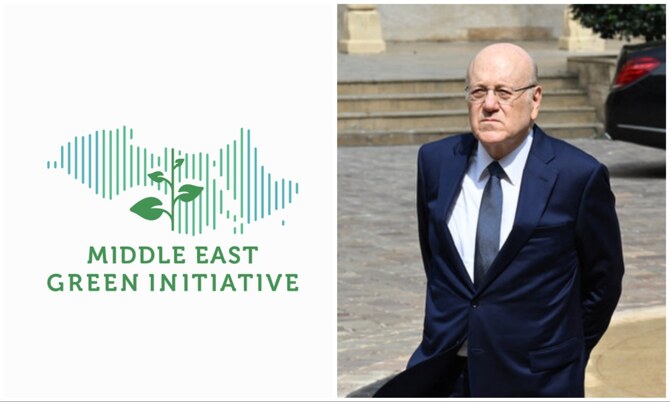

BEIRUT: Caretaker Prime Minister Najib Mikati confirmed on Friday that “Lebanon has joined the Green Middle East Initiative, launched by Saudi Arabia’s Crown Prince Mohammed bin Salman.”
Mikati described the step as “essential for Lebanon, especially as southern villages and towns have suffered significant environmental and agricultural damage, necessitating cooperation with all of Lebanon’s friends.”
Mikati told Agriculture Minister Abbas Al-Hajj Hassan, and Environment Minister Nasser Yassin about the country’s inclusion in the initiative, and Hassan said: “Israel is destroying large areas, whether agricultural lands, fruit-bearing trees, or forests.
“Approving Lebanon’s participation in the initiative is a very positive sign for us Lebanese, the government, and especially for the Agriculture and Environment Ministries.
“The timing of today’s announcement comes amid the ongoing Israeli attacks on Lebanon. We thank the Kingdom for its efforts, as it has always stood by Lebanon in the toughest of times.”
Yassin said that one of the initiative’s goals was “to plant 40 billion trees across the Middle East.”
He added: “A key part of Saudi Arabia’s initiative is to protect the region, the Gulf, and Middle Eastern countries from ongoing climate change; halt land degradation and desertification; and explore ways to adapt more effectively to potential future changes.”
Yassin thanked “Saudi Arabia for agreeing to consider Lebanon’s file and for its inclusion in this very important initiative.”
He said: “This is part of the continuous and long-standing cooperation with Saudi Arabia over the decades. This initiative is timely and will be followed up by the Ministries of Agriculture and Environment and all concerned parties through joint reserves to increase vegetation cover.”
The cost of the damage to southern Lebanese border towns during the first six months of Israeli attacks has exceeded $1.5 billion, according to government figures.
The shelling and airstrikes have damaged the livelihoods of residents in the border area and their agricultural holdings.
Satellite images show the destruction of entire neighborhoods in villages along the Blue Line and the disappearance of forested areas covering mountain slopes and valleys.
Israeli attacks have displaced more than 110,000 people from dozens of villages.
Lebanese authorities have accused Israel of using phosphorus bombs to destroy forests and crops, while the Ministry of Agriculture has been unable to conduct a final assessment of the extent of the damage due to the ongoing Israeli operation.
The Ministry of Agriculture said in July: “The Israeli bombardment with white phosphorus (has) led to 700 small and large fires. More than 2,500 dunams (617 acres) of land have been completely burned, and the area of affected land consisting of forest and agricultural lands has reached 6,000 dunams (1,482 acres), with the targeted trees being olive, pine and oak.
“The damage to forested areas home to oak, Mount Tabor oak and laurel trees amounts to 55 percent, agricultural and citrus trees to 35 percent, and grasslands to 10 percent.”
Lebanese authorities are waiting for a ceasefire to conduct a final survey of the damage, but compensation is uncertain in a country that has been affected by a severe economic crisis for nearly five years.
Israeli raids on border villages continued on Friday, including valleys and forested areas, causing extensive damage.
The Israeli military fired flares over border villages near the Blue Line in the western and central sectors, reaching the outskirts of the city of Tyre. It also dropped incendiary bombs on the outskirts of the towns of Naqoura and Alma Al-Shaab.
The Israelis claimed that its warplanes “targeted several Hezbollah rocket launchers in southern Lebanon.”


