



SRINAGAR: Residents of Indian-administered Kashmir are gearing up for their first regional election in a decade that will allow them to have their own truncated government, also known as a local assembly, instead of remaining under New Delhi’s direct rule.
Muslim-majority Kashmir is divided between nuclear-armed rivals India and Pakistan and claimed in its entirety by both. The Indian-administered part has been on edge since Prime Minister Narendra Modi’s government ended its special status in 2019 and also scrapped its statehood.
The three-phased polls will take place amid a sharp rise in rebel attacks on government forces in parts of Hindu-dominated Jammu areas that have remained relatively peaceful in the three decades of armed rebellion against Indian rule.
With campaigning picking up in the runup to the election, India’s main opposition Congress party has formed an alliance to jointly seek the vote with the National Conference, the region’s largest pro-India Kashmiri political party. Modi’s Bharatiya Janata Party has a weak political base in the Kashmir Valley, the heartland of decades of anti-India rebellion, while it is strong in Jammu.
Here is what you need to know about the coming election:
The history of disputed Kashmir
Kashmir’s future was left unresolved at the end of British colonial rule in 1947 when the Indian subcontinent was divided into predominantly Hindu India and mainly Muslim Pakistan. Pakistan has long pushed for the right to self-determination under a UN resolution passed in 1948, which called for a referendum on whether Kashmiris wanted to merge with either country.
Militants in the Indian-controlled portion of Kashmir have been fighting New Delhi’s rule since 1989, while India insists the Kashmir militancy is Pakistan-sponsored terrorism, a charge Islamabad denies. Tens of thousands of civilians, rebels and government forces have been killed in the conflict which most Kashmiri Muslims consider a legitimate struggle for freedom.
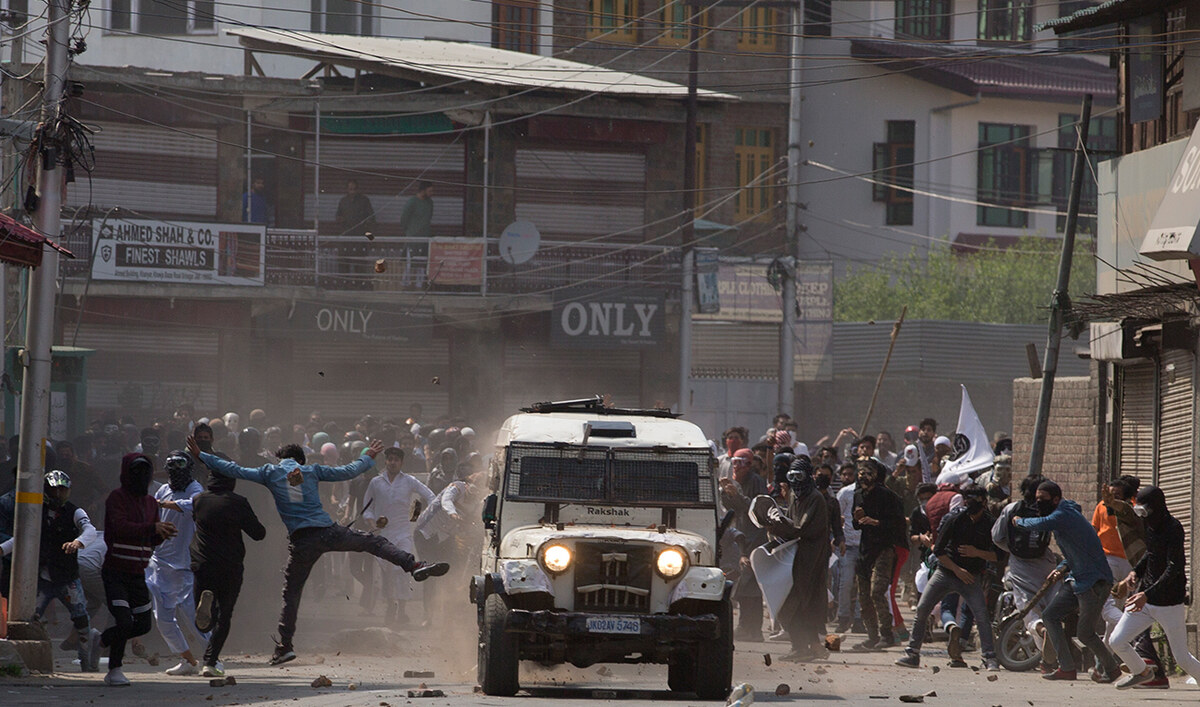
In this file photograph, taken on May 31, 2019, Kashmiri protesters throw bricks and rocks at an armored vehicle of Indian police during a protest in Srinagar, Indian-administered Kashmir. (AP/File)
What is the current status of the region?
Indian-administered Kashmir has been without a local government since 2018 when India’s ruling Bharatiya Janata Party ended its support to the local Kashmiri People’s Democratic Party, bringing down the coalition government and causing the assembly to dissolve. A year later, Modi’s government revoked the region’s semi-autonomy and downgraded it to a federally controlled territory.
As a result, Indian-held Kashmir lost its flag, criminal code, constitution and inherited protections on land and jobs. It was also divided into two federal territories, Ladakh and Jammu-Kashmir, ruled directly by New Delhi, allowing it to appoint an administrator to run it along unelected government officials.
Since then, a slew of legal and administrative changes have been installed without public input, much to the anger of the region’s people whose civil liberties have also been curbed and media intimidated.
Indian officials have repeatedly said that the move — to shape what it calls “Naya Kashmir,” or a “new Kashmir” — was necessary to tackle separatism, foster greater economic development and fully integrate the region into the country.
Even after the election, India’s federal government will still make the decisions
The election will take place between Sept. 18 and Oct. 1, and votes are set to be counted on Oct. 4.

Ashok Bhat, left, a candidate of the Bharatiya Janata Party (BJP) talks to a voter, while campaigning door-to-door ahead of the Jammu and Kashmir state assembly elections, in Srinagar, Indian-administered Kashmir on August 29, 2024. (AP)
In theory, the polls will see a transition of power from New Delhi to a newly elected local assembly with a chief minister serving as the region’s top elected official with a council of ministers, a similar setup to before 2018.
But the new polls will hardly give the new government any legislative powers as Indian-controlled Kashmir will continue to be a “Union Territory” — a region directly controlled by the federal government — with India’s parliament remaining as the region’s legislator. The elected assembly will only have nominal control over education and culture.
Kashmir’s statehood status has to be restored for the new government to have power. Even Kashmiri pro-India parties, like the National Conference and the People’s Democratic Party, have vowed to politically and legally fight for the return of Kashmir’s semi-autonomy.
How do Kashmir residents view the upcoming election?
Many are indifferent, while some believe their vote could be a way to express deep resentment of Modi’s party. Most Muslim residents of the region want independence from India or unification with Pakistan.
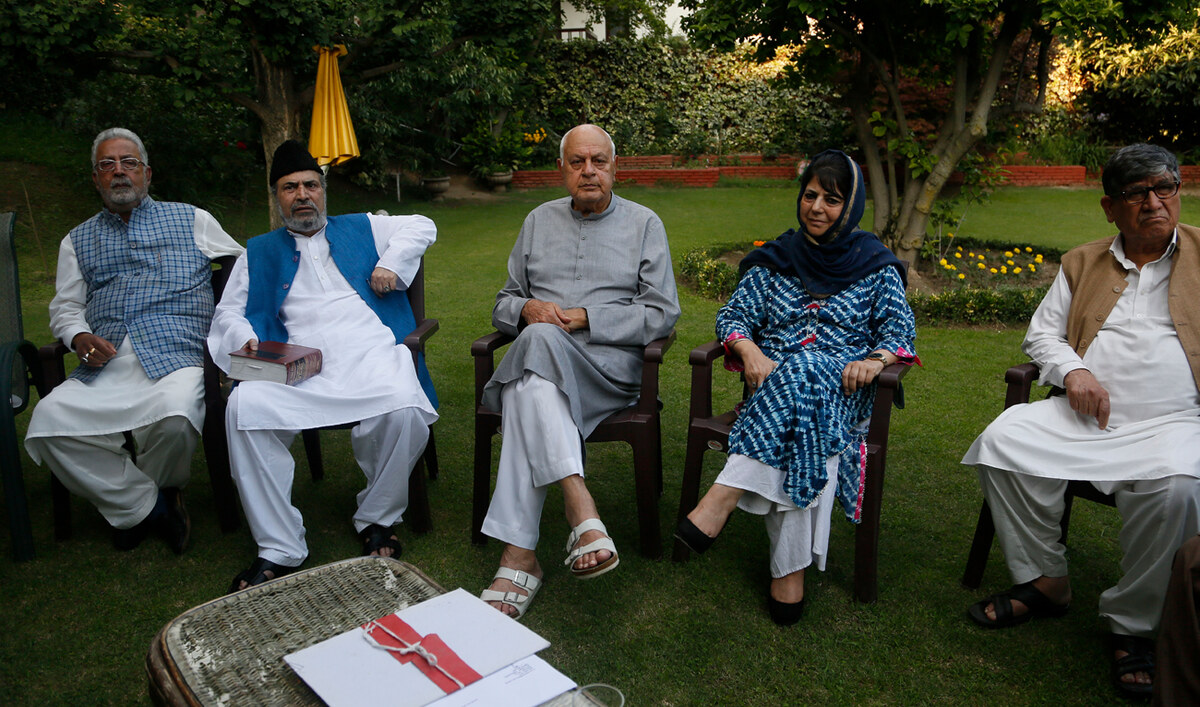
National Conference (NC) President Farooq Abdullah, center, Peoples Democratic Party (PDP) leader Mehbooba Mufti, second right, and other leaders sit during an all parties meeting on restoration of the special status that was stripped last year from Indian-administered Kashmir, in Srinagar. (AP)
However, Kashmir’s pro-India political elite, many of whom have been jailed for allegedly disrupting peace and slapped with corruption cases in 2019, see an opportunity in these elections to politically oppose the changes by India’s ruling party.
Historically, elections in Indian-held Kashmir have remained a sensitive issue, with many believing that they have been rigged multiple times in favor of the region’s pro-India politicians.
Previous elections have seen Kashmiri Muslim separatist leaders who challenge India’s sovereignty over the region call for a boycott of the vote, calling it an illegitimate exercise under military occupation.


