


RIYADH: The forthcoming joint summit of the European Union and Gulf Cooperation Council will deepen bilateral political engagement, enhance trade and investment, and strengthen cooperation on pressing foreign policy issues, Charles Michel, president of the European Council, has said.
In an exclusive interview with Arab News, Michel discussed the upcoming EU-GCC summit, taking place on Oct. 16 in Brussels, where leaders of the two blocs are expected to discuss a broad range of issues, from the crisis in the Middle East to Russia’s war with Ukraine.
“I am very optimistic that this summit can be an important political moment because, together with the Gulf countries in the EU leaders, we want to upgrade our relationship to a more strategic level,” said Michel.
“We want this relationship to be sustainable, to be a long term, a long term relationship.”
Michel arrived in Riyadh on Wednesday, where he met with Saudi Crown Prince and Prime Minister Mohammed bin Salman. The two leaders discussed relations and ways of enhancing cooperation between the Kingdom and the EU.
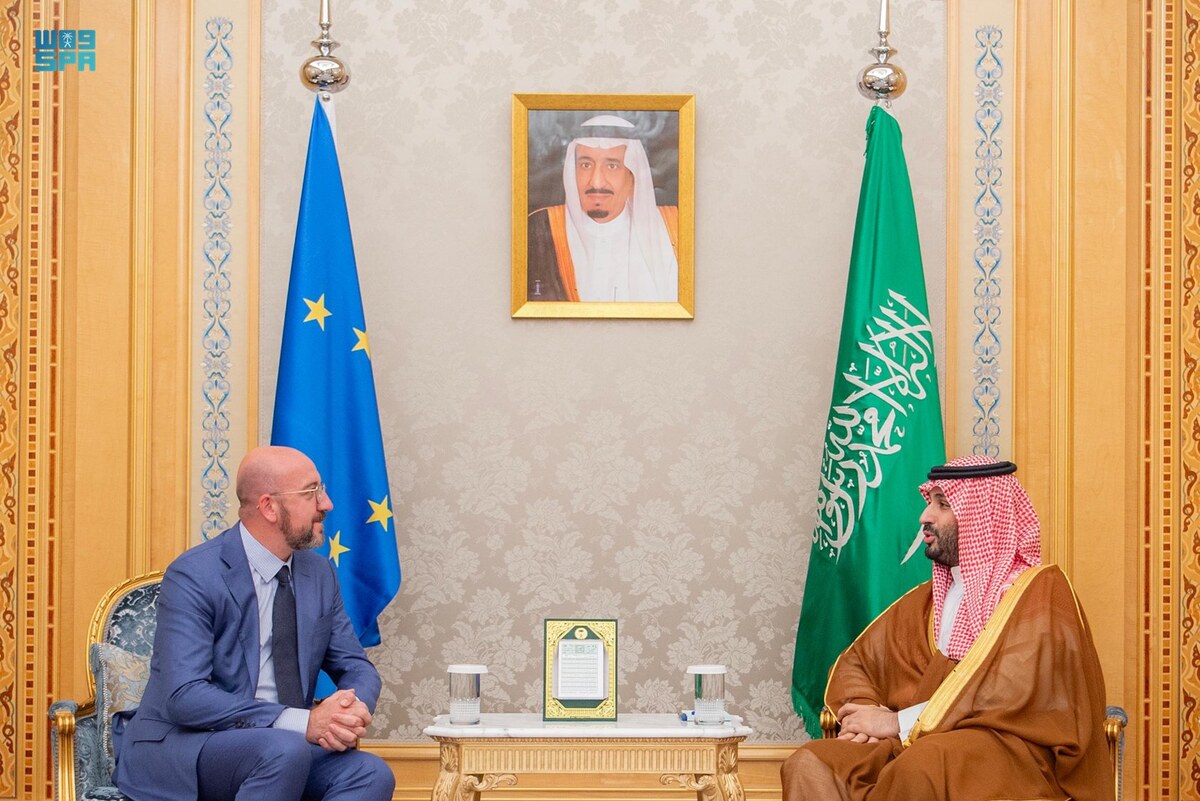
Charles Michel meeting with Crown Prince Mohammed bin Salman in Riyadh on Wednesday on arrival in the Saudi capital. (SPA)
He was also scheduled to meet with Jasem Al-Budaiwi, the secretary general of the GCC. At the top of the agenda was the upcoming EU-GCC summit.
“We are working to prepare for the summit that will take place in Brussels in October between the GCC — the Gulf countries — and the EU,” said Michel. “This will be a historic moment and we would like the summit to be a successful one.
“That’s why it was important for me to meet with the crown prince to hear directly from him what the expectations in Saudi Arabia are for the summit so that we can prepare very well. My main goal is to make this summit an effective meeting.”
Michel underlined the potential outcomes of the summit, including the furthering of political cooperation on various issues between the GCC and the EU.
“First, political engagement — political at the highest level,” he said. “And this common opinion we have, the GCC and the EU, that there is a lot to gain if we work more closely together from a political point of view.”
Michel also underlined that the EU-GCC joint summit will “send a signal to the EU, into the private sector, that there’s a vast potential for more economic cooperation” with the Kingdom thanks to the opportunities presented by Saudi Vision 2030.
Bilateral relations between Saudi Arabia and the EU have been rapidly evolving in many areas.
“In recent years, we have worked a lot to strengthen the ties to improve relationships in various fields, for instance, climate change, energy, all those topics are very important for all of us in the future,” said Michel.
There is, however, scope to develop ties further between Saudi Arabia and the EU in fields such as trade, investment, and hydrogen power. “In all those sectors there is a lot that we can do together,” he added.
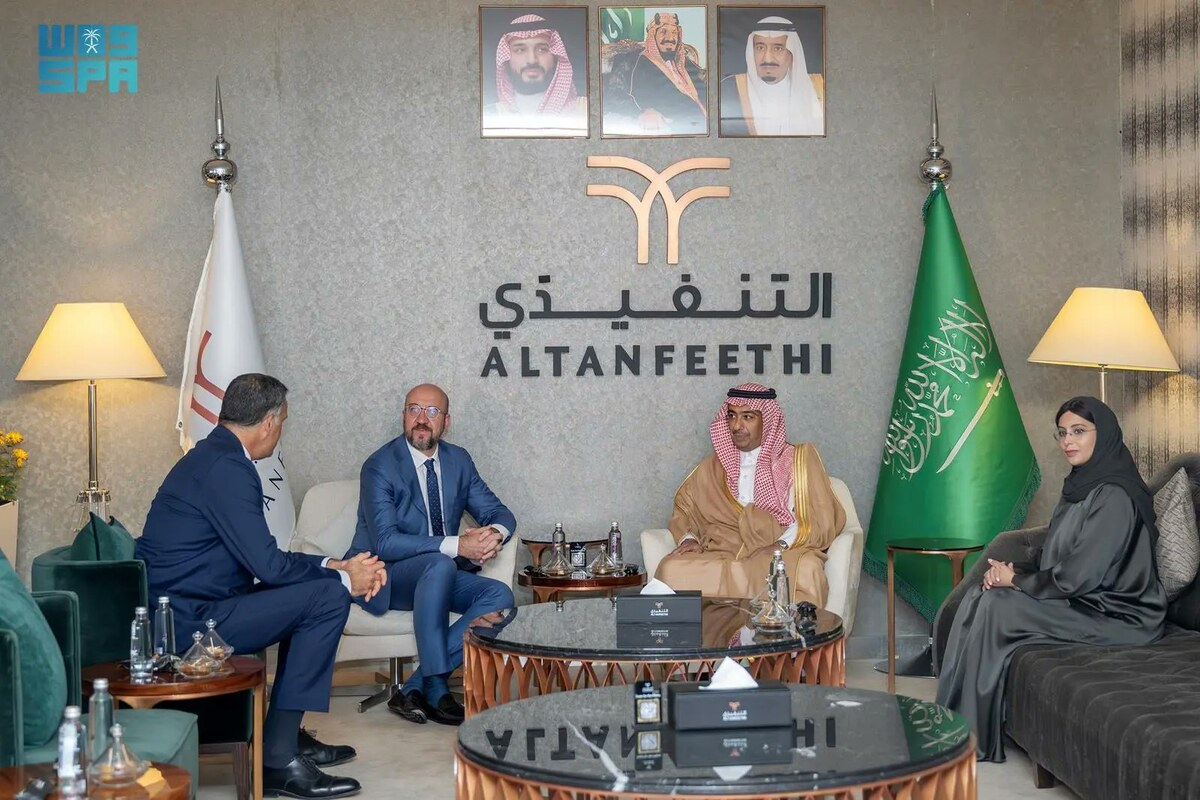
Michel with undersecretary at Ministry of Foreign Affairs Abdulmajeed bin Rashid Al-Samari and head of Saudi Arabia’s mission to the EU and the European Atomic Energy Community Haifa Al-Jedea. (SPA)
Describing the “vast potential” for economic cooperation that could result from the EU-GCC summit, Michel said the EU is ready to contribute to the goals of Saudi Arabia’s Vision 2030 reform and economic diversification agenda.
“We are ready to be a loyal partner, to support those efforts in line with this 2030 vision for the transformation of the country, and with this purpose to diversify the economy of the country,” he said.
However, opportunities for cooperation extend far beyond trade and investment into common security and foreign policy areas.
“In terms of geopolitical challenges, we need to cooperate,” said Michel. “We need to coordinate. The war in Gaza, the situation in the Middle East, the war launched by Russia against Ukraine.
“We think that more cooperation between the EU and Gulf countries could play a useful role in the future.”
Both Saudi Arabia and the EU have called for a ceasefire in Gaza, where the 10-month conflict between Israel and the Palestinian militant group Hamas has created a major humanitarian emergency. Michel outlined the EU’s stance on the conflict.
“First, it is extremely urgent, we need to get a ceasefire and the release of hostages,” he said. “And we support all the efforts of those who are working very hard to make it happen and to make it possible.
“For instance, I had a conversation two weeks ago with (Israeli Prime Minister) Benjamin Netanyahu. We passed on a very clear message that we want a ceasefire, we want the release of hostages, we want the de-escalation.
“We want the two-state solution … the EU is a strong supporter of the two-state solution. You know that some EU member states recently, a few months ago, decided to recognize Palestine and we want to work with all our partners.”
Michel said “peace would be, and will be, the best security guarantee.”
Asked what steps are required to bring about the two-state solution, Michel said: “I think it is important to encourage the Palestinian people, to organize themselves with legitimate authorities, probably reforms also are needed.
“And we need to support all those invested in the community who are working to make those reforms possible.”
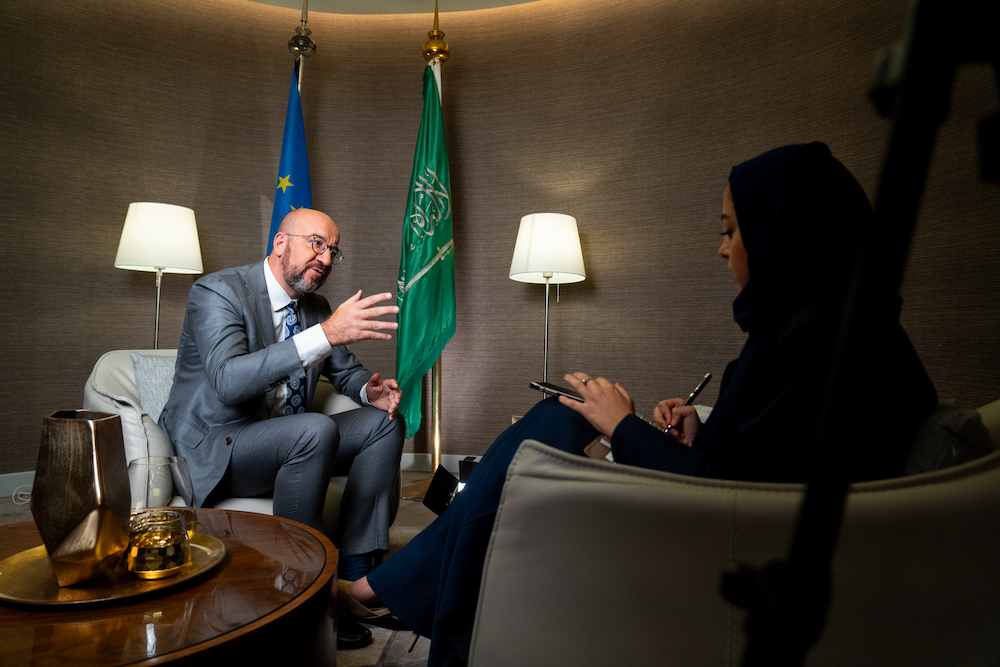
Michel speaking to Arab News reporter Lama Alhamawi, right, in Riyadh. (AN Photo)
Michel called the crisis in Gaza “a humanitarian catastrophe,” adding that it is “extremely important, in the short term, to provide humanitarian assistance to the people in need.”
“That’s why the EU, together with the member states, have decided to mobilize a lot of support, a lot of money and a lot of support to provide this aid and this assistance to the people in Gaza and in the West Bank.”
In relation to the escalating tit-for-tat between Israel and the Iran-backed Hezbollah militia in Lebanon, Michel said the normalization of diplomatic relationships across the region was more urgent than ever.
“This is important to encourage more stability and to encourage a country like Iran not to play games that have an impact in terms of instability in the region using proxies,” he said.
“We are on the side of the people of Lebanon because they are the first victims of all those difficulties in the country.”
He added: “Despite the differences we have, Iran and the EU, we have decided to engage with Iran, to engage with the new president of Iran, to discuss our differences, and to see how we can try to make some progress, including regarding the nuclear challenge.”
Asked about Saudi Arabia’s bid to host the FIFA World Cup in 2034, Michel lauded the power of sport to bring disparate cultures together.
“We know that the Olympics or football — sport in general — is a way to bring people together and people with different languages, culture,” he said. “We are all together when we participate in sporting events.”


