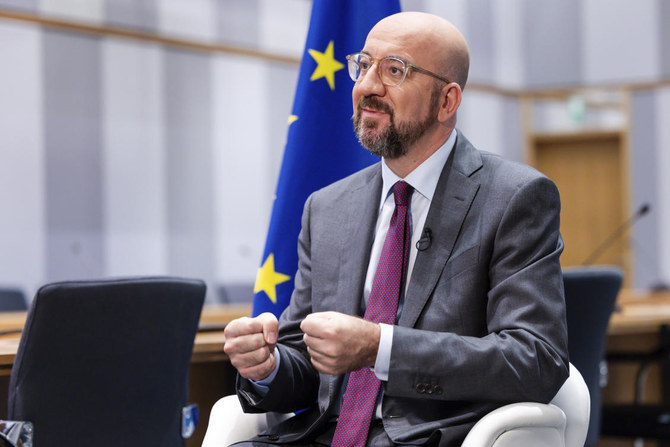
BRUSSELS: European Union leader Charles Michel on Friday warned that the Israel-Hamas war could create a surge in refugees heading for Europe, raising the risk of spurring on anti-migrant forces, deepening divisions and inflaming tensions between supporters of Israel and the Palestinians.
“Look, if there would be more difficulties at the regional level, we would have immediately huge difficulties on the European soil because of the refugees,” EU Council President Michel said in an interview with The Associated Press.
“And we know how it can be used by some political groups within the EU to fuel some controversies and to make the EU more fragmented,” he said, adding it could increase polarization on one of the most contentious issues in many European nations.
“We know that in our societies across the EU, there are also different feelings, emotions among our citizens, and this is very important not to import within the EU the tragic conflict,” he said. "This is not the time to have more difficulty because we will import in the EU conflicts.”
One week ahead of the EU-US summit in Washington with President Biden, the two longstanding trans-Atlantic partners have been caught up in the increasingly frantic diplomatic efforts to prevent the war from escalating.
On Friday, Israel warned civilians living in the northern part of Gaza, which has a population of more than 1 million people, to leave the area, ahead of an expected ground offensive by the Israeli military, in response to a shocking and brutal attack by Hamas nearly a week ago.
To have an immediate impact as the battle around Gaza intensifies, Michel called for increased immediate outreach to nations like Egypt, which would be a natural point of reception for those fleeing neighboring Gaza.
It would mean that international aid would have to increase.
However, Egypt says it already hosts millions of refugees and has signaled its reluctance to take many more from Gaza.
“You can imagine for such a country with some financial and economic challenges what it means. It means that we need to engage with those countries to see what we can do in order to support the initiatives taken by some leaders in the region, taken by some in United Nations to allow some corridor, humanitarian corridor,” he said.
By September, the most recent EU figures showed 194,269 migrants had arrived by irregular routes in 2023. The bloc is already deeply divided on how to deal with the new arrivals, between those that support Brussels’ initiatives focused on distributing migrants between members in an act of solidarity and those, like Hungary or Poland, whose far-right governments flatly refuse any shared responsibility for migrants arriving in other member states.
Michel also called for diplomats and government officials to fan out across the region in an effort to contain the crisis.
“It’s so important to engage with the countries in the region to make sure that despite all the differences on many topics. We try to do our best to make sure that we will not face a regional escalation, which would be a tragedy first for the region, for the people in the region, but also for the world,” he said.
In this, the EU wants to be in perfect lockstep with the United States. Having expressed its full support for Israel after the Hamas attacks, the EU is now also calling on Jerusalem to ensure any military actions in and around Gaza remain within the bounds of international law.
“The common position is making very clear that we believe in international law. We believe in this idea that the fundamental principles that must be respected, respected, including when there is such a tragedy,” he said.
Michel said he fully understood the passions involved when people are on the receiving end of an attack like the one from Hamas. He referred back to his time as prime minister of Belgium when it was hit by terror attacks in 2016 which killed 33 people in joint airport and subway bombings.
He said it was no different for France around that time when it was also attacked by Islamic State militants, leaving more than 200 dead.
“I remember very well that it was extremely difficult because we were shocked, extremely shocked. At the same time, I understood very quickly it was important never to forget that we are a democratic country and we must defend and protect the security of our citizens with democratic tools,” he said, indicating that Israel now faces the same challenge.
Michel and EU Commission President Ursula von der Leyen will be discussing the same issues at a trans-Atlantic summit in Washington next Friday, when continued support for Ukraine will also be high on the agenda.
Questions have been raised whether the trans-Atlantic partners, especially the United States, will be able to maintain the same intensity of support now that Israel is another ally in dire need.
Michel insisted that certainly for the EU, it was beyond doubt. “You can count on me personally, but also on the European leadership to be very clear: we are with Ukraine for as long as it takes, because this is fundamental for our common future.”


![]()

EU President Michel warns about spillover of Israel-Hamas war into Europe
Short Url
https://arab.news/nt6r3
EU President Michel warns about spillover of Israel-Hamas war into Europe
- “If there would be more difficulties at the regional level, we would have immediately huge difficulties on the European soil because of the refugees,” EU Council President Michel said
- "This is not the time to have more difficulty because we will import in the EU conflicts”


Latest updates


© 2026 SAUDI RESEARCH & PUBLISHING COMPANY, All Rights Reserved And subject to Terms of Use Agreement.