

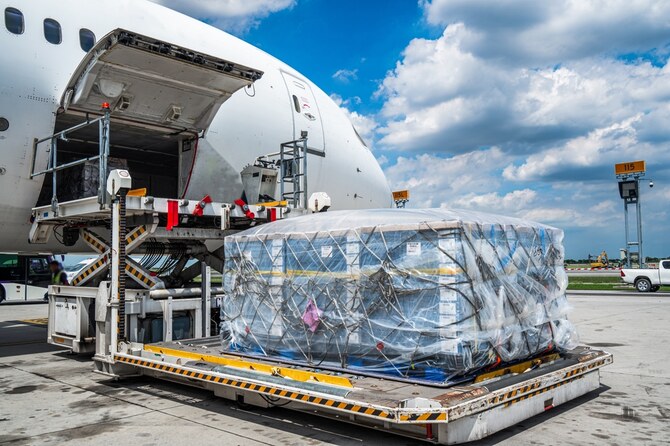

RIYADH: Maritime tensions and an e-commerce boom helped fuel a 14.7 percent year-on-year increase in air cargo demand for Middle East carriers in July, a new report showed.
According to the International Air Transport Association, airlines in the region handled 13.5 percent of global cargo over the period, unchanged from the previous month.
Globally, total demand – measured in cargo tonne-kilometer – soared by 13.6 percent in July compared to the same month of 2023.
The increase in delivery of freight by air comes amid attacks on maritime vessels in the Red Sea, which saw the number of ships using the Suez Canal drop 22 percent in 2023-24 compared to the previous year.
Several shipping companies diverted their vessels around the Cape of Good Hope – a move which increases delivery times by 10 days or more on average.
Willie Walsh, director-general of IATA, said: “Air cargo demand hit record highs year-to-date in July with strong growth across all regions. The air cargo business continues to benefit from growth in global trade, booming e-commerce and capacity constraints on maritime shipping.”
He added: “With the peak season still to come, it is shaping to be a very strong year for air cargo. And airlines have proven adept at navigating political and economic uncertainties to flexibly meet emerging demand trends.”
The report further noted that Middle Eastern carriers’ air cargo capacity expanded by 4.4 percent in July compared to the same month last year.
The Middle East–Europe trade lane performed well, with a 32.2 percent year-on-year growth, while demand on the Middle East-Asia route increased by 15.9 percent.
Strengthening the aviation sector is vital for countries like Saudi Arabia as they diversify their economies away from oil dependency.
The Kingdom’s National Aviation Strategy aims to handle 4.5 million tons of cargo annually by 2030 and establish over 250 direct destinations from the Kingdom’s airports to global locations.
Global outlook
The global figure for July marks the eighth consecutive month of double-digit year-on-year growth, with overall levels reaching heights not seen since the record peaks of 2021.
The capacity of air cargo also rose by 8.3 percent year on year in July.
“The rise in ACTK (available cargo tonne-kilometers) was largely related to the growth in international belly capacity, which rose 12.8 percent on the strength of passenger markets and balancing the 6.9 percent growth of international freighter capacity,” said the report.
In aviation, belly capacity refers to the storage space in the underside, or belly, of a passenger aircraft, and the report noted that this increase was the lowest in 40 months, whereas the growth in freighter capacity is the highest since an exceptional jump was recorded in January.
“With global passenger belly capacity fully recovered to 2019 values, the question emerges as to whether this impressive growth in the international passenger market will normalize and how this will impact the use of dedicated freighters,” noted IATA.
Asia-Pacific region
According to the report, airlines from the Asia-Pacific region witnessed a cargo demand growth of 17.6 percent year on year in July, while the capacity of these carriers rose by 11.3 percent during the same period.
APAC airlines handled 33.3 percent of global air cargo in July.
European carriers experienced a 13.7 percent year-on-year demand growth in July, with capacity rising by 7.6 percent. Latin American airlines saw an 11.1 percent surge in demand, handling 2.8 percent of global air cargo.
African airlines saw 6.2 percent year-on-year demand growth for air cargo in July — the lowest of all regions and their lowest recorded figure in 2024.
The capacity of air carriers in Africa also rose by 10.5 percent in July, compared to the same month of the previous year.
North American carriers saw 8.7 percent year-on-year demand growth for air cargo in July, while the capacity of these airlines also rose by 7 percent during the same period.
“Growth in North America was hampered in part by flight cancellations and airport closures in the US and the Caribbean in relation to Hurricane Beryl,” added IATA.
Future outlook
The report noted that the sharp reduction in relative air cargo rates over container shipping continues to ensure that air services remain substantially more competitive than they were pre-pandemic.
“In the long term, however, the question remains whether certain shippers might start considering slower and lower-cost transport modes to ensure the financial sustainability of their supply chain,” IATA concluded.


