

EU Red Sea mission escorts 300 vessels in region

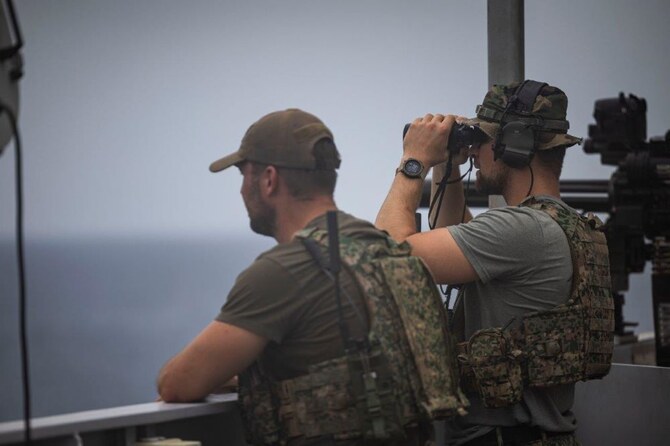
Dutch marines, aboard the HNLMS Karel Doorman, scan the Red Sea as part of Operation Aspides. (X/@EUNAVFORASPIDES)
Short Url
Updated 20 August 2024
Follow

EU Red Sea mission escorts 300 vessels in region

  • Bloc’s ships have destroyed 22 Houthi drones and missiles
  • Houthi military spokesman Yahya Sarea has not claimed credit for fresh assaults on any ships since Aug. 7

AL-MUKALLA: The EU naval mission in the Red Sea has said that its warships have provided security to 300 ships while traveling in commerce routes off Yemen and have destroyed 22 drones, drone boats, and ballistic missiles launched by the Yemeni militia during the past six months.

No new assaults on ships have been claimed by the Houthis in the last two weeks, indicating another pause in their campaign.

On Monday the EU naval mission, known as EUNAVFOR ASPIDES, said in a post on X: “As we reach the six-month milestone since the initiation of the operation, we remain committed to our mission and the core values of the European Union.”

The EU announced it was launching a naval mission based in the Red Sea on Feb. 19 to safeguard ships traveling through the important maritime channel from Houthi drone, missile, and drone boat strikes.

Since November, the Houthis have seized one commercial ship, sunk two others, and fired hundreds of drones, ballistic missiles, and remotely controlled boats at ships in the Red Sea, Gulf of Aden, and Indian Ocean in a campaign that the Yemeni militia claims is intended to put pressure on Israel to end its war in the Gaza Strip.

Despite the Houthis’ continuous threats of vengeance, assaults on ships have significantly decreased since July 20, when Israel launched airstrikes on Houthi targets in Yemen’s western province of Hodeidah for the first time. 

Houthi military spokesman Yahya Sarea has not claimed credit for fresh assaults on any ships since Aug. 7.

The Yemeni militia claimed that they postponed their response to the Israeli operation in Hodeidah in order to make it “more effective.”

This comes as Rashad Al-Alimi, head of the internationally recognized Yemeni government’s Presidential Leadership Council, accused the Houthis on Tuesday of undermining efforts to end the war on the country and attempting to bankrupt his government. 

Speaking in the southern city of Aden after accepting foreign ambassador-designate credentials to Yemen, Al-Alimi urged the international community to punish the Houthis for attacking ships in the Red Sea and elsewhere, cracking down on civil society and aid organizations, and impeding peace talks.

“The peace process has remained stalled because of the militia’s intransigence and its preference of the interests of its supporters over the interests of the Yemeni people,” he said. 

Meanwhile, 14 people were killed by lightning in Yemen’s northern province of Hajjah, as the National Center of Meteorology warned on Tuesday of severe weather in the following 24 hours.

According to the Houthi-run Saba news agency, lightning killed three people in Abbes, three more in Kuhlan Affar, and eight more in other regions of Hajjah over the past several days.

Heavy rains caused flash floods in Hodeidah, Ibb, Hajjah, Sanaa, Marib, and other Yemen provinces, killing over 100 people and displacing hundreds more since late last month.


Second US aircraft carrier is being sent to the Middle East, AP source says

Updated 3 sec ago
Follow

Second US aircraft carrier is being sent to the Middle East, AP source says

  • Move by the USS Gerald R. Ford, first reported by The New York Times, will put two carriers and their accompanying warships in the region
  • Trump told Axios earlier this week that he was considering sending a second carrier strike group to the Middle East
WASHINGTON: The world’s largest aircraft carrier has been ordered to sail from the Caribbean Sea to the Middle East, a person familiar with the plans said Thursday, as US President Donald Trump considers whether to take possible military action against Iran.
The move by the USS Gerald R. Ford, first reported by The New York Times, will put two carriers and their accompanying warships in the region as Trump increases pressure on Iran to make a deal over its nuclear program. The person spoke on condition of anonymity to discuss military movements.
The USS Abraham Lincoln aircraft carrier and three guided-missile destroyers arrived in the Middle East more than two weeks ago.
It marks a quick turnaround for the USS Ford, which Trump sent from the Mediterranean Sea to the Caribbean last October as the administration build up a huge military presence in the leadup to the surprise raid last month that captured then-Venezuelan President Nicolas Maduro.
It also appears to be at odds with Trump’s national security strategy, which put an emphasis on the Western Hemisphere over other parts of the world.
Trump on Thursday warned Iran that failure to reach a deal with his administration would be “very traumatic.” Iran and the United States held indirect talks in Oman last week.
“I guess over the next month, something like that,” Trump said in response to a question about his timeline for striking a deal with Iran on its nuclear program. “It should happen quickly. They should agree very quickly.”
Trump told Axios earlier this week that he was considering sending a second carrier strike group to the Middle East.
Trump held lengthy talks with Israeli Prime Minister Benjamin Netanyahu on Wednesday and said he insisted to Israel’s leader that negotiations with Iran needed to continue. Netanyahu is urging the administration to press Tehran to scale back its ballistic missile program and end its support for militant groups such as Hamas and Hezbollah as part of any deal.
The USS Ford set out on deployment in late June 2025, which means the crew will have been deployed for eight months in two weeks time. While it is unclear how long the ship will remain in the Middle East, the move sets the crew up for an usually long deployment.
The White House didn’t immediately respond to a request for comment.