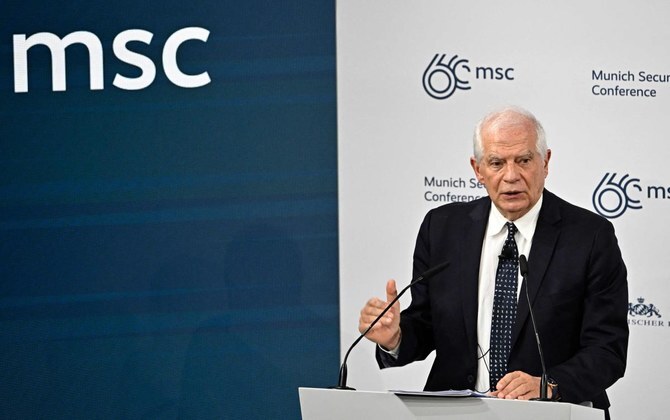
BRUSSELS: European Union foreign policy chief Josep Borrell said on Thursday he has asked the bloc’s members if they want to impose sanctions on some Israeli ministers for “hate messages” against Palestinians that he said broke international law.
He did not name any of the Israeli ministers to whom he was referring or specify which messages he had in mind.
But in recent weeks he has publicly criticized Security Minister Itamar Ben-Gvir and Finance Minister Bezalel Smotrich for statements he has described as “sinister” and “an incitement to war crimes.”
“I initiated the procedure to ask the member states if they consider (it) appropriate to include in our list of sanctions some Israeli ministers (who) have been launching unacceptable hate messages against the Palestinians, and proposing things that clearly go against international law,” he told reporters on arrival at a meeting of EU foreign ministers in Brussels.
Diplomats say it is unlikely the EU would find the necessary unanimous agreement among its 27 members to impose sanctions on Israeli government ministers.
But Borrell’s decision to float such a proposal indicates the level of anger among some European officials about some Israeli ministers.
Israel’s foreign minister Israel Katz accused Borrell of targeting him with false claims that he had called for Palestinians to be displaced from the West Bank. “I oppose the displacement of any population from their homes,” he said.
Ireland, one of the EU’s most pro-Palestinian members, said on Thursday it backed Borrell’s suggestion.
“We will be supporting Josep Borrell’s recommendation for sanctions in respect of settler organizations in the West Bank who are facilitating (the) expansion of settlements, and also to Israeli ministers,” Irish Foreign Minister Micheal Martin told reporters as he arrived at the Brussels meeting.


![]()

Borrell asks EU members about possible sanctions on some Israeli ministers
Short Url
https://arab.news/8t2gv
Borrell asks EU members about possible sanctions on some Israeli ministers
- He did not name any of the Israeli ministers to whom he was referring or specify which messages he had in mind

Latest updates


© 2026 SAUDI RESEARCH & PUBLISHING COMPANY, All Rights Reserved And subject to Terms of Use Agreement.