

Red Sea Film Foundation movies to light up Venice Film Festival

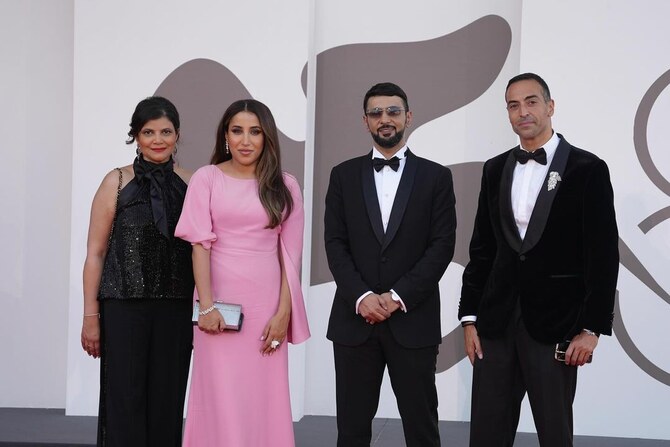
Shivani Pandya, managing director, left, Jomana Alrashid, chairwoman of the Red Sea Film Foundation, Mohammed Asseri, CEO, and producer Mohammed Al-Turki, right. (Instagram)
Short Url
Updated 30 August 2024
Follow

Red Sea Film Foundation movies to light up Venice Film Festival

  • 4 Red Sea Fund-supported films to screen at Venice festival
  • Fund backed over 250 movie projects in Mideast, Africa, Asia

VENICE: The Red Sea Film Foundation will light up this year’s Venice Film Festival with four Red Sea Fund-supported productions selected for screening.

The RSFF-backed films “Aïcha” and “Seeking Haven for Mr. Rambo” will screen in the Orizzonti and Orizzonti Extra selections respectively.

This is alongside two titles in the Venice Production Bridge’s Final Cut initiative supported by the Red Sea Fund: “Aisha Can’t Fly Away Anymore” and “In This Darkness I See You.”

Also screening in Venice’s Giornate degli Autori sidebar are two films supported by the Red Sea Fund: Hind Meddeb’s documentary “Sudan, Remember Us,” and from Northeast Asia “To Kill a Mongolian Horse” by Chinese director Xiaoxuan Jiang.

Mehdi Barsaoui’s “Aïcha” is a Tunisian drama feature which won a Red Sea Souk development prize at the 2021 edition of the Red Sea International Film Festival and will now screen in the prestigious Orizzonti section.

The production, “Seeking Haven for Mr. Rambo,” is a drama feature by Egyptian director Khaled Mansour that was selected for the Red Sea Lodge development program in 2021.

It gained support from the Red Sea Fund in 2023 and premieres in the Orizzonti Extra section — marking the return of Egyptian cinema to the festival after a decade-long hiatus.

For the third consecutive year, the RSFF is partnering with the Final Cut program in Venice, offering a €5,000 prize ($5.538) for a winning film in its post-production phase.

The projects supported through the Final Cut program are Egyptian director Morad Mostafa’s “Aisha Can’t Fly Away Anymore,” which won a Red Sea Souk Production Award in 2022 at the Red Sea International Film Festival; and the Lebanese thriller “In This Darkness I See You,” directed by Nadim Tabet.

The RSFF will be continuing its support of the Venice Film Festival amfAR Gala as the presenting sponsor for the fourth consecutive year.


Jomana Alrashid, Chairwoman of the Red Sea Film Foundation and Giuseppe Tornatore, Red Sea International Film Festival 21 jury president. (Instagram)

Jomana Al-Rashid, chairwoman of the RSFF, will chair the gala.

Among the industry leaders and celebrities expected to attend are Achille Boroli, Willem Dafoe, Matteo Fantacchiotti, Alejandra Gere, Andrei Gillott, Harry Goodwins, T. Ryan Greenawalt and Lucien Laviscount.

In addition, Julian Lennon, Tony Mancilla, Kevin Mcclatchy, Catherine O’Hara, Vin Roberti, Caroline Scheufele, David Tait, Emir Uryar and Jon Watts will be present.

Al-Rashid said: “This year in Venice, the Foundation is supporting four films that demonstrate the importance and power of Arab, Asian and African cinema and encapsulate the pillars of the Foundation — creativity, diversity and cultural exchange.

“We’re honored to have played a part in their journey to the festival, as well as to be continuing our partnership with the influential Final Cut program with two incredible projects from talented filmmakers from across the region.

“At this year’s festival we are also notably underscoring our expansion to Asia with our support of Chinese director Xiaoxuan Jiang, which marks our first project from the country.”

The Final Cut in Venice program has been providing support since 2013 for films from African countries. It has also backed productions from five Middle East nations: Iraq, Jordan, Lebanon, Palestine and Syria.

This is one of the projects launched by the Venice Production Bridge of the 81st Venice International Film Festival, which runs from Aug. 28 to Sept. 7, directed by Alberto Barbera and organized by La Biennale di Venezia.

The program offers the opportunity to present films still in the production phase to international professionals, in order to facilitate post-production and market access.

The program consists of three days of activities (Sept. 1 to 3) on the Venice Lido, in which the working copies of a maximum of four selected films are presented to producers, buyers, distributors and festival programmers.

The Red Sea Film Foundation is a contributing partner in the initiative.

Since its inception in 2021, the Red Sea Fund has backed more than 250 film projects across the Arab world, Africa and Asia, while also spearheading numerous initiatives aimed at enhancing storytelling and filmmaking in the region.

The third edition of the Red Sea International Film Festival will run in Jeddah from Dec. 5 to 14.


Sotheby’s ‘Origins II’: Local heroes go under the hammer 

Updated 7 sec ago
Follow

Sotheby’s ‘Origins II’: Local heroes go under the hammer 

  • Regional highlights from Sotheby’s ‘Origins II’ auction, which takes place Jan. 31 in Diriyah 

DUBAI: Here are some of the regional highlights from Sotheby’s ‘Origins II’ auction, which takes place Jan. 31 in Diriyah.

Mohamed Siam 

‘Untitled (Camel Race)’ 

Siam is described by Sotheby’s as “one of the most significant voices of the Kingdom’s second generation of modern artists.” His “highly discernible visual aesthetic,” the auction catalogue states, references European cubists and Italian Futurism, using “multiple overlapping planes to create an endless sense of movement” — an approach that “fragments visual reality, enabling the viewer to experience multiple viewpoints simultaneously.” This work from the late 1980s “shrewdly captures through a fractured, shifting perspective two camel riders in an enthralling, head-to-head race.” It marks Siam’s auction debut and is expected to fetch between $70,000 and $90,000.  


Abdulhalim Radwi 

‘Untitled (Hajj Arafah)’ 

The Makkah-born artist is one of Saudi modernism’s most significant figures. His “multifaceted practice was shaped by a profound engagement with regional heritage and the evolving aesthetic currents of the 20th century,” the catalogue notes. This 1967 oil painting is hailed by Sotheby’s as “a vibrant example of Radwi’s practice (at the time), depicting a bustling arrangement of tented structures rendered in his characteristic Cubist-inflected idiom. The tightly interlocking forms, rhythmic repetitions, and cool, airy palette evoke the temporal architecture of the Hajj pilgrimage, distilled into a kaleidoscopic composition that celebrates the textures and visual poetry of life in Makkah.” 


Mohammed Al-Saleem 

‘Untitled’ 

Another of the Kingdom’s modern-art pioneers, Al-Saleem was born in 1939 in Al-Marat province. His work, Sotheby’s says, “is celebrated for its distinct visual language, a style which the artist coined ‘Horizonism.’ Drawing inspiration from the shifting sands and gradating skyline of Riyadh as seen from the desert, as well as the intensity of the Saudi sun, Al-Saleem reimagined his beloved landscape through the prism of abstraction.” In works such as this 1989 oil painting, he “replaced the traditional horizon line with stylized forms resembling organic forms and Arabic calligraphy … a fusion of modernist abstraction and cultural identity.” 


Taha Al-Sabban  

‘Untitled’ 

This mixed-media-on-canvas work from 2005 typifies the Makkah-born artist’s modernist approach, which, Sotheby’s states “has been described as both an act of conservation and a homage to the nature and culture of his homeland.” The artist “used expressive color and form to preserve local memory — palm groves, open waters, and traditional architecture — while transforming the traditional cityscape into ascending, abstracted rhythms.” His work is often described as “nostalgic,” but the Al-Sabban is quoted by the Al-Mansouria Foundation as saying: “Although I am acutely aware of the passage of time, my aim is not nostalgia; instead I seek to capture the moment and reveal the life in the world.” 


Zeinab Abd El-Hamid 


‘Untitled (Shisha Shop)’ 

This 1987 watercolor is the work of one of Egypt’s most significant female artists of the modern era who belonged, Sotheby’s says “to a generation of artists who came of age during the cultural reawakening that followed Egypt’s independence.” Abd El-Hamid, the catalogue states, “painted with a refined sensibility, grounded in her belief in humanity’s ability to transcend hardship. She did not seek to romanticize the past, but to distill its forms and emotions into something enduring. Her work carries a sense of nostalgia for a rhythm of life rooted in shared dignity and poetic structure … rooftops, cafés, and courtyards become vessels of memory, harmony, and inner light.” 


Samia Halaby 

‘Copper’ 

Central to the Palestinian artist’s practice was the belief that “abstraction, like any visual language, is shaped by social forces and reflects the movements of working people and revolutionary ideas,” Sotheby’s states. This 1976 oil painting combines Halaby’s exploration of the diagonal as “a dynamic formal element” and of the reflective properties of metals. The work “eschews traditional linear perspective in favor of a compositional strategy that flattens and destabilizes the viewer’s gaze. Halaby achieves a sense of spatial infinity — not through illusion, but through repetition and variation.” 


Mahmoud Sabri 

‘Demonstration’ 

The Iraqi painter’s career, Sotheby’s says, was unique among his peers in his homeland. “He simultaneously explored Arab and European cultures, studied the history of painting, and created his own unique art language and style.” That language arrived after this particular oil painting from the early Sixties, a time in which “Sabri often returned to the subject of revolutionary martyrdom and probably referring to the events of the 1963 coup d’état.” In the foreground, a group of women surround a bereaved mother, who is weeping for her murdered son.