

Swifties harness their power for Kamala Harris

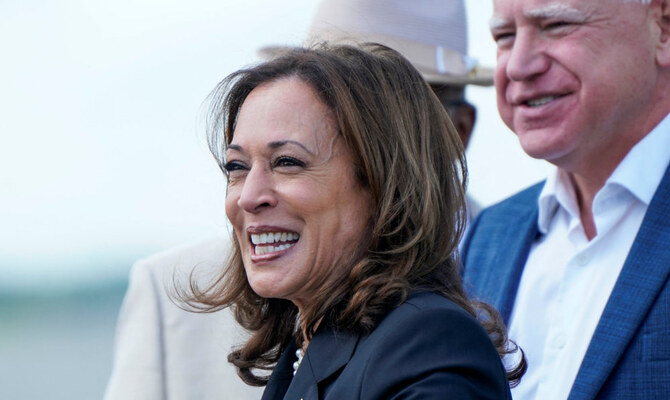
Democratic presidential nominee and US Vice President Kamala Harris and vice presidential nominee Tim Walz react at Savannah/Hilton Head International Airport in Savannah, Georgia, US, August 28, 2024. (Reuters)
Short Url
Updated 29 August 2024
Follow

Swifties harness their power for Kamala Harris

  • Swifties For Kamala began as a social media initiative founded by social media user

NEW YORK: Taylor Swift has yet to weigh in on the US presidential race, but some of her superfans are already stumping for Kamala Harris.
As of Wednesday midday “Swifties for Kamala” had raised more than $140,000 in favor of the Democratic White House hopeful.
They held an inaugural fundraising call the evening prior that was joined by some 27,000 viewers, launching the effort aimed at “turning our swiftie power into political power,” as the group’s political director put it during the meeting.
Stars like Carole King along with Senators Elizabeth Warren and Kirsten Gillibrand appeared in the virtual meeting.
“I am a swiftie, and Taylor and I are actually friends,” King, the legendary singer-songwriter behind hits including “I Feel The Earth Move” and “You’ve Got A Friend” said on the call.
“I’ve been a political activist for years. I’ve been a volunteer, I’ve been a door knocker, even as a famous person,” King continued.
“I’m telling you all this because if any of you are thinking of volunteering to be door knockers or phone callers, but you’re a little nervous about what you might say, please believe me: there is nothing to lose and everything to gain.”
Swifties For Kamala began as a social media initiative founded by social media user and swiftie Emerald Medrano in the hours after President Joe Biden dropped out of the race.
The effort blossomed across platforms, and with accounts that currently have more than 72,000 subscribers on X, and nearly 50,000 on Instagram.
Swift herself is not personally affiliated with the group.
“We’re a coalition of Taylor Swift fans committed to protecting the United States of America’s historical democracy by working together to help progressive candidates in local and national elections, including Vice President Kamala Harris for our country’s next president,” reads the group’s mission statement on their website.
The group has a policy platform section on their website urging the protection of LGBTQIA+ rights and reproductive freedom, as well as support for new immigrants and taking climate change seriously.
They also list “a permanent ceasefire between Israel and Hamas” as a priority.
Along with collecting donations they’re encouraging swifties to register to vote, and selling merchandise including shirts that say “In My Voting Era.”

A global megastar with hundreds of millions of social media followers and a wildly loyal — and chronically online — fan base, Swift can move any needle with the tiniest of efforts.
The right and the left have long wanted to count the “Blank Space” singer as their own — but for years Swift stayed conspicuously out of politics, including in 2016 when Donald Trump won the presidency.
Speculation abounded that the superstar was a closet Republican, until 2018, when she broke both her silence and the Internet by endorsing the Democratic opponent of far-right politician Marsha Blackburn in Tennessee.
Blackburn won anyway, but it ushered in a new chapter for Swift: she later explained handlers had urged her against wading into politics, telling her it could damage her career — particularly in the country music industry, which despite its complexities is often associated with conservatism.
Swift endorsed Joe Biden in 2020 and has conveyed pro-LGBTQ+ messages through her songs and music videos.
She also condemned the Supreme Court’s reversal of the federal right to abortion, and has encouraged droves of her fans to register to vote.
But Swift’s massive popularity has also meant she’s a regular target for political misinformation and right-wing conspiracy theories, often fueled by AI and amplified by the likes of Donald Trump.
Nabbing a Swift endorsement for Harris isn’t the goal of her organizing fans, they say.
“We are not waiting on Taylor to show her support for Kamala Harris. We are doing this outside of her, using the platform of swifties as a way to get people involved in the election,” Rohan Reagan, among the group’s social media managers, told Cosmopolitan recently.
Democratic Senator Ed Markey, who also joined the kickoff call, told swifties that “I am in awe of the community you have created online to share not just your love for Taylor Swift, but your commitment to building a better world.”
“This is the time, this is the place,” he continued. “The swifties are the leaders for us to win this election.”


Mystery of CIA’s lost nuclear device haunts Himalayan villagers 60 years on

Updated 56 min 44 sec ago
Follow

Mystery of CIA’s lost nuclear device haunts Himalayan villagers 60 years on

  • Plutonium-fueled spy system was meant to monitor China’s nuclear activity after 1964 atomic tests
  • Porter who took part in Nanda Devi mission warned family of ‘danger buried in snow’

NEW DELHI: Porters who helped American intelligence officers carry a nuclear spy system up the precarious slopes of Nanda Devi, India’s second-highest peak, returned home with stories that sent shockwaves through nearby villages, leaving many in fear that still holds six decades later.

A CIA team, working with India’s Intelligence Bureau, planned to install the device in the remote part of the Himalayas to monitor China, but a blizzard forced them to abandon the system before reaching the summit.

When they returned, the device was gone.

The spy system contained a large quantity of highly radioactive plutonium-238 — roughly a third of the amount used in the atomic bomb dropped by the US on the Japanese city of Nagasaki in the closing stages of the Second World War.

“The workers and porters who went with the CIA team in 1965 would tell the story of the nuclear device, and the villagers have been living in fear ever since,” said Narendra Rana from the Lata village near Nanda Devi’s peak.

His father, Dhan Singh Rana, was one of the porters who carried the device during the CIA’s mission in 1965.

“He told me there was a danger buried in the snow,” Rana said. “The villagers fear that as long as the device is buried in the snow, they are safe, but if it bursts, it will contaminate the air and water, and no one will be safe after that.”

During the Sino-Indian tensions in the 1960s, India cooperated with the US in surveillance after China conducted its first nuclear tests in 1964. The Nanda Devi mission was part of this cooperation and was classified for years. It only came under public scrutiny in 1978, when the story was broken by Outsider magazine.

The article caused an uproar in India, with lawmakers demanding the location of the nuclear device be revealed and calling for political accountability. The same year, then Prime Minister Morarji Desai set up a committee to assess whether nuclear material in the area near Nanda Devi could pollute the Ganges River, which originates there.

The Ganges is one of the world’s most crucial freshwater sources, with about 655 million people in India, Nepal, and Bangladesh depending on it for their essential needs.

The committee, chaired by prominent scientists, submitted its report a few months later, dismissing any cause for concerns, and establishing that even in the worst-case scenario of the device’s rupture, the river’s water would not be contaminated.

But for the villagers, the fear that the shell containing radioactive plutonium could break apart never goes away, and peace may only come once it is found.

Many believe the device, trapped within the glacier’s shifting ice, may have moved downhill over time.

Rana’s father told him that the device felt hot when it was carried, and he believed it might have melted its way into the glacier, remaining buried deep inside.

An imposing mass of rock and ice, Nanda Devi at 7,816 m is the second-highest mountain in India after Kangchenjunga. 

When a glacier near the mountain burst in 2021, claiming over 200 lives, scientists explained that the disaster was due to global warming, but in nearby villages the incident was initially blamed on a nuclear explosion.

“They feared the device had burst. Those rescuing people were afraid they might die from radiation,” Rana said. “If any noise is heard, if any smoke appears in the sky, we start fearing a leak from the nuclear device.”

The latent fear surfaces whenever natural disasters strike or media coverage puts the missing device back in the spotlight. Most recently, a New York Times article on the CIA mission’s 60th anniversary reignited the unease.

“The apprehensions are genuine. After 1965, Americans came twice to search for the device. The villagers accompanied them, but it could not be found, which remains a concern for the local community,” said Atul Soti, an environmentalist in Joshimath, Uttarakhand, about 50 km from Nanda Devi.

“People are worried. They have repeatedly sought answers from the government, but no clear response has been provided so far. Periodically, the villagers voice their concerns, and they need a definitive government statement on this issue.”

Despite repeated queries whenever media attention arises, Indian officials have not released detailed updates since the Desai-appointed committee submitted its findings.

“The government should issue a white paper to address people’s concerns. The white paper will make it clear about the status of the device, and whether leakage from the device could pollute the Ganges River,” Soti told Arab News.

“The government should be clear. If the government is not reacting, then it further reinforces the fear.”