

Saudi tourism launches travel roadshow in Malaysia

The Saudi Tourism Authority launches a travel roadshow at the IOI Mall in Putrajaya, Malaysia’s administrative capital, on Aug. 28, 2024. (AN Photo)
Short Url
Updated 28 August 2024
Follow

Saudi tourism launches travel roadshow in Malaysia

  • 5-day event spotlights Kingdom’s main heritage and cultural sites
  • Tens of thousands of Malaysians visit Saudi Arabia every year for Hajj and Umrah

PUTRAJAYA: The Saudi Tourism Authority launched a travel roadshow in Malaysia on Wednesday, inviting visitors to explore the Kingdom’s top heritage destinations and thriving sports and entertainment scene.

The Saudi tourism sector has been thriving under Vision 2030, as the Kingdom positions itself as a dynamic, diverse, year-round tourism destination and market that will contribute 10 percent to gross domestic product by 2030.

The STA’s event, which will run through Sunday, is being held at the IOI Mall in Putrajaya, Malaysia’s administrative capital, where more than a dozen cubicles and booths present different tourist and cultural attractions.

“We are here to send a message to all the Malaysian people ... to welcome them to come to Saudi (Arabia),” Alhasan Aldabbagh, STA president for Asia-Pacific markets, said during the exhibition’s launch.

Touting the Kingdom as one of the fastest-growing tourism destinations, he said that Malaysia was one of the countries whose citizens could easily apply for an electronic visa to enter Saudi Arabia.

“Malaysians can go online by themselves and get the e-visa within minutes,” he said.
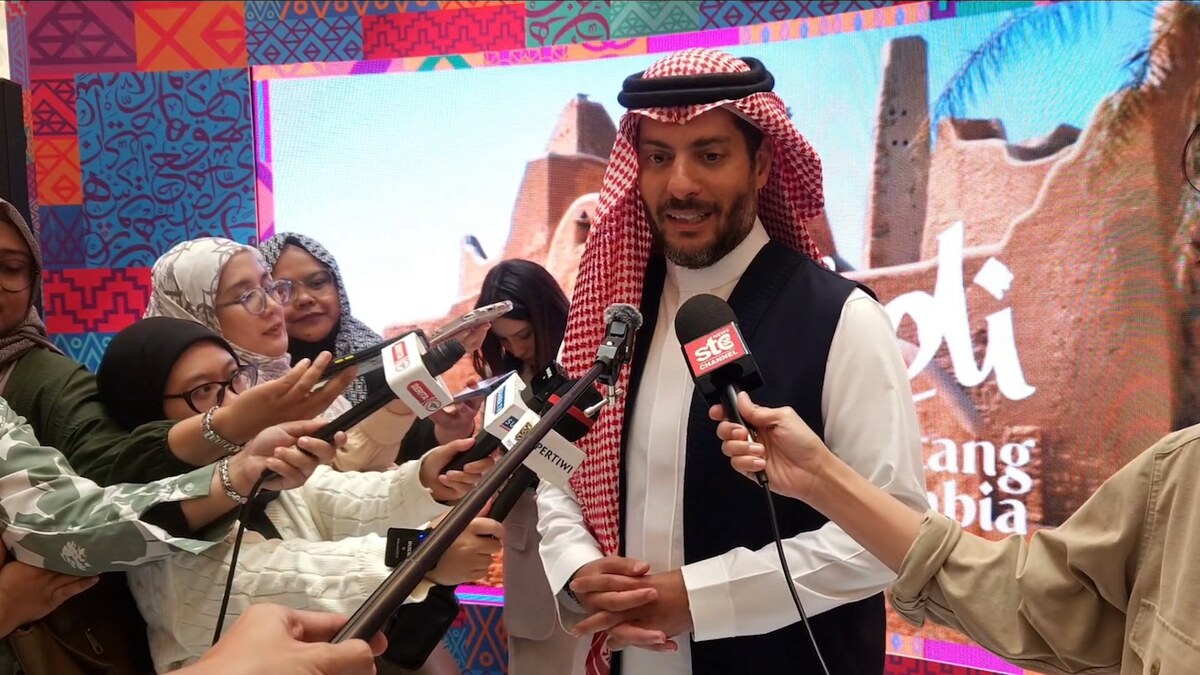


Alhasan Aldabbagh, STA president for Asia-Pacific markets, speaks to Malaysian reporters in Putrajaya on Aug. 28, 2024. (AN Photo)

Tourists from Southeast Asia have made a beeline for the Kingdom, with more than 1.5 million people from across the region visiting Saudi Arabia every year.

Tens of thousands of visitors from Malaysia travel to the Kingdom every year to perform the Hajj and Umrah pilgrimage.

Many curious Malaysians who stopped by the exhibition were greeted with dates and gahwa, the traditional Arabic coffee. They were invited to also explore the Kingdom’s heritage sites and numerous sports and entertainment events.

“There is a lot that Saudi is offering today. Saudi is very rich in culture and heritage,” Aldabbagh said, adding that there were a lot of attractions to go with Riyadh Season — a series of entertainment, cultural and sporting events that run in the Saudi capital throughout the winter months, starting in October.

“In March 2025, we will also host Formula One.”

The Malaysia roadshow follows similar events held by the STA in other Asian countries over the past few years.

In May, it launched its first show exhibition in Indonesia, and in June signed an agreement with a leading Saudi investment company to develop an integrated residential ecosystem with accommodation offerings tailored to visitors from China.

Since early 2023, the STA has also intensified promotional activity in India, which is expected to become the Kingdom’s top tourism source market by 2030.


Bangladesh backtracks on initial interest to join Trump’s Gaza stabilization force

Updated 5 sec ago
Follow

Bangladesh backtracks on initial interest to join Trump’s Gaza stabilization force

  • Bangladesh currently faces various pressures from US, former ambassador says
  • Main parties contesting upcoming election distance themselves from government’s decisions

DHAKA: Facing domestic backlash, Bangladesh has backtracked on its initial interest in joining the US-planned military force in Gaza, with the interim administration saying it would leave the decision to the government appointed after next month’s polls.

The possibility of Bangladesh joining the International Stabilization Force — a part of US President Donald Trump’s controversial Gaza peace plan — was floated by National Security Adviser Khalilur Rahman last week, during his visit to Washington D.C., where he said he had “expressed Bangladesh’s interest in principle” to join it.

The announcement was immediately met with criticism from civil society at home, where any move perceived as undermining Bangladesh’s support for the Palestinians is unlikely to be popular.

Following the pushback, the country’s top diplomat, Foreign Affairs Adviser Touhid Hossain, told reporters on Wednesday that “no decision has yet been made” and that the caretaker Cabinet — which is overseeing Bangladesh until new leadership takes office after the February vote — “will not do anything … that the next government would need to completely reverse.”

Bangladesh will hold general elections on Feb. 12, and the main two parties contesting it — the Bangladesh Nationalist Party and Bangladesh Jamaat-e-Islami — have already distanced themselves from the caretaker government’s decisions.

“We will not blindly adhere to any policy that has been adopted by this interim government,” Nawshad Zamir, BNP’s international affairs secretary, told Arab News, while Jamaat’s spokesperson, Ahsanul Mahboob Zubair, said the party would “not take any such steps that violate the UN and existing international laws and stand in contrast to our people’s aspirations.”

While the UN’s approach to Trump’s plan is equivocal, the international force has been rejected by Palestinian groups in Gaza as a “form of deep international partnership in the war of extermination waged by the (Israeli) occupation against our people.”

More than 71,400 Palestinians have been killed and 171,000 wounded as a result of Israeli attacks since the start of its war on Gaza in October 2023, according to Gaza’s Ministry of Health. The true death toll is feared to be much higher, as many people have died due to injury and lack of access to healthcare and food  — caused by the Israeli military’s destruction of Gaza’s infrastructure, and the blocking of medical aid and food.

Most of the Muslim countries which took part in a US-organized Gaza summit in Sharm El-Sheikh in October and initially considered joining Trump’s stabilization force have either pulled out of the plan or postponed announcing their decision.

Bangladesh’s sudden expression of interest came as a surprise as it had neither been part of the Sharm El-Sheikh meeting nor historically involved in Middle Eastern politics.

Humayun Kabir, former Bangladeshi ambassador to the US, linked it to the current pressures Bangladesh was facing from the Trump administration, including increased taxation of remittances and visa restrictions.

“In this context, I think Bangladesh has expressed its interest to join the US-led Gaza force in a bid to neutralize these pressures to some extent,” Kabir told Arab News.

But the political cost of actually following through could be too high for those who would decide to implement it.

“The people of Bangladesh have unconditional support for Palestine,” Kabir said. “In this backdrop it would be politically difficult for the government to go for anything that goes against the interests of the Palestinians.”

For political scientist Prof. Amena Mohsin, Bangladesh’s involvement in the force would be against its longstanding position of solidarity.

“We can’t go against our long-held positions regarding Palestine. We shouldn’t get involved in any controversy initiated by the Western powers,” she said.

“I don’t think any decision of this kind would be popular or get people’s support in Bangladesh.”

Shahidul Alam, a prominent photographer and Time Magazine Person of the Year 2018, said it would be “betrayal.”

Alam, who last year represented Bangladesh in the Freedom Flotilla Coalition to break Israel’s illegal siege of Gaza, said that he understood there was geopolitical pressure on Bangladesh but participating in “this sham of a peacekeeping force” would be a shameful act that Bangladeshis would never live down.

“This so-called stabilization force is not about peace,” he said. “It is about disarming resistance. It is about legitimizing occupation. It is about finishing what bombs could not: the complete subjugation of a people who refuse to surrender their right to exist in dignity.”