

China’s Wang warns US official over support to Philippines in sea dispute: state media

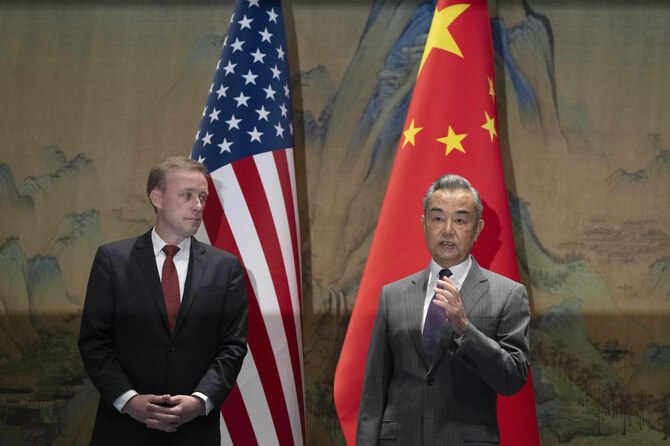
Wang Yi, right, the director of the Communist Party’s Central Foreign Affairs Commission Office, with White House national security adviser Jake Sullivan at Yanqi lake in Beijing on Aug. 27, 2024. (AP)
Short Url
Updated 28 August 2024
Follow

China’s Wang warns US official over support to Philippines in sea dispute: state media

  • ‘The US must not use bilateral treaties as an excuse to undermine China’s sovereignty and territorial integrity’

BEIJING: China’s top diplomat Wang Yi on Wednesday warned visiting US National Security Adviser Jake Sullivan over supporting the Philippines in the disputed South China Sea, state media reported.

“The United States must not use bilateral treaties as an excuse to undermine China’s sovereignty and territorial integrity, nor should it support or condone the Philippines’s actions of infringement,” Wang told Sullivan, according to state broadcaster CCTV.

Sullivan landed in the Chinese capital on Tuesday for a three-day trip, saying on arrival he looked forward to “a very productive round of conversations” with foreign minister Wang.

Washington’s allies Japan and the Philippines have blamed China in the past week for raising regional tensions, with Tokyo accusing Beijing of violating its airspace and Manila calling it the “biggest disrupter” of peace in Southeast Asia.

According to CCTV, Wang emphasized to Sullivan that “China is firmly committed to safeguarding its territorial sovereignty and maritime rights over the South China Sea islands.”

Sullivan and Wang have met five times over the past year-and-a-half — in Washington, Vienna, Malta and Bangkok, as well as alongside US President Joe Biden and Chinese leader Xi Jinping at a November 2023 summit in California.


China’s Xi urges ‘central role’ of UN in call with Brazil’s Lula

Updated 6 sec ago
Follow

China’s Xi urges ‘central role’ of UN in call with Brazil’s Lula

BEIJING: Chinese President Xi Jinping called on countries to protect the “central role” of the United Nations in international affairs, urging his Brazilian counterpart on Friday to help safeguard international norms, state media reported.
The comments come after US President Donald Trump unveiled plans for his new “Board of Peace” at the World Economic Forum.
Although originally meant to oversee Gaza’s rebuilding, the board’s charter does not seem to limit its role to the Palestinian territory and has sparked concerns Trump wants to rival the United Nations.
While China and Brazil have both been invited to join Trump’s new grouping, neither has confirmed participation.
Xi told President Luiz Inacio Lula da Silva during their Friday morning phone call that in the current “tumultuous” international situation, China and Brazil “are constructive forces in maintaining world peace and stability,” according to a readout published by state broadcaster CCTV.
“They should stand firmly on the right side of history... and jointly uphold the central role of the United Nations and international fairness and justice,” Xi said.
European leaders have expressed doubts over Trump’s norm-busting proposal, with some viewing it as an attempt to potentially sideline or even replace the United Nations.
While in Davos, Switzerland, Trump said that once complete, the board “can do pretty much whatever we want,” while adding that “we’ll do it in conjunction with the United Nations.”
Beijing’s foreign ministry said on Wednesday that “no matter how the international situation changes, China firmly upholds the international system with the United Nations at its core.”
Brazil has also expressed skepticism about the Board of Peace, saying it could represent “a revocation” of the United Nations.
Lula’s special adviser Celso Amorim told Brazilian media that “we cannot consider a reform of the UN made by one country.”
During Trump’s global tariff onslaught last year, China and Brazil sought to present their countries as staunch defenders of the multilateral trading system.
Xi told Lula in August they could set an example of “self-reliance” for emerging powers.
China, a permanent member of the UN Security Council, engages with the international body even as it has objected to what it terms internal interference.
Advocacy groups like Human Rights Watch have accused China of seeking to undermine the United Nations by reducing contributions to the organization’s rights budgets, establishing an alternative international mediation body and blocking activists from UN events.