China’s Xi urges ‘central role’ of UN in call with Brazil’s Lula

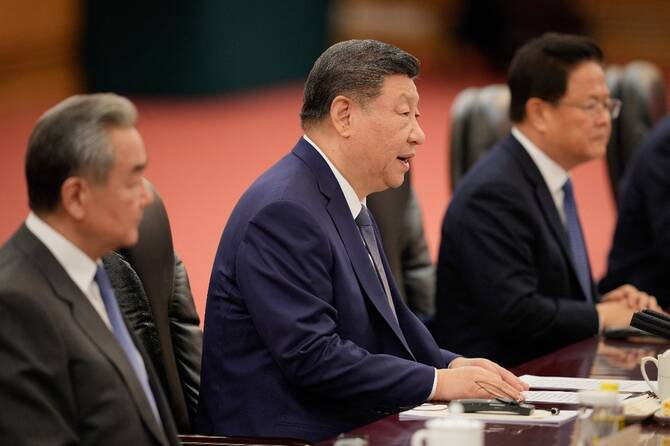
Chinese President Xi Jinping at a meeting with Canada's Prime Minister Mark Carney at the Great Hall of the People in Beijing, China. (AFP)
Short Url
Updated 23 January 2026
Follow

China’s Xi urges ‘central role’ of UN in call with Brazil’s Lula

  • The comments come after US President Donald Trump unveiled plans for his new “Board of Peace” at the World Economic Forum

BEIJING: Chinese President Xi Jinping called on countries to protect the “central role” of the United Nations in international affairs, urging his Brazilian counterpart on Friday to help safeguard international norms, state media reported.
The comments come after US President Donald Trump unveiled plans for his new “Board of Peace” at the World Economic Forum.
Although originally meant to oversee Gaza’s rebuilding, the board’s charter does not seem to limit its role to the Palestinian territory and has sparked concerns Trump wants to rival the United Nations.
While China and Brazil have both been invited to join Trump’s new grouping, neither has confirmed participation.
Xi told President Luiz Inacio Lula da Silva during their Friday morning phone call that in the current “tumultuous” international situation, China and Brazil “are constructive forces in maintaining world peace and stability,” according to a readout published by state broadcaster CCTV.
“They should stand firmly on the right side of history... and jointly uphold the central role of the United Nations and international fairness and justice,” Xi said.
European leaders have expressed doubts over Trump’s norm-busting proposal, with some viewing it as an attempt to potentially sideline or even replace the United Nations.
While in Davos, Switzerland, Trump said that once complete, the board “can do pretty much whatever we want,” while adding that “we’ll do it in conjunction with the United Nations.”
Beijing’s foreign ministry said on Wednesday that “no matter how the international situation changes, China firmly upholds the international system with the United Nations at its core.”
Brazil has also expressed skepticism about the Board of Peace, saying it could represent “a revocation” of the United Nations.
Lula’s special adviser Celso Amorim told Brazilian media that “we cannot consider a reform of the UN made by one country.”
During Trump’s global tariff onslaught last year, China and Brazil sought to present their countries as staunch defenders of the multilateral trading system.
Xi told Lula in August they could set an example of “self-reliance” for emerging powers.
China, a permanent member of the UN Security Council, engages with the international body even as it has objected to what it terms internal interference.
Advocacy groups like Human Rights Watch have accused China of seeking to undermine the United Nations by reducing contributions to the organization’s rights budgets, establishing an alternative international mediation body and blocking activists from UN events.


US military boards sanctioned oil tanker in Indian Ocean

Updated 55 min 16 sec ago
Follow

US military boards sanctioned oil tanker in Indian Ocean

  • Tanker tracking website says Aquila II departed the Venezuelan coast after US forces captured then-President Nicolás Maduro
  • Pentagon says it 'hunted' the vessel all the way from the Caribbean to the Indian Ocean

WASHINGTON: US military forces boarded a sanctioned oil tanker in the Indian Ocean after tracking the ship from the Caribbean Sea, the Pentagon said Monday.
The Pentagon’s statement on social media did not say whether the ship was connected to Venezuela, which faces US sanctions on its oil and relies on a shadow fleet of falsely flagged tankers to smuggle crude into global supply chains.
However, the Aquila II was one of at least 16 tankers that departed the Venezuelan coast last month after US forces captured then-President Nicolás Maduro, said Samir Madani, co-founder of TankerTrackers.com. He said his organization used satellite imagery and surface-level photos to document the ship’s movements.
According to data transmitted from the ship on Monday, it is not currently laden with a cargo of crude oil.


The Aquila II is a Panamanian-flagged tanker under US sanctions related to the shipment of illicit Russian oil. Owned by a company with a listed address in Hong Kong, ship tracking data shows it has spent much of the last year with its radio transponder turned off, a practice known as “running dark” commonly employed by smugglers to hide their location.
US Southern Command, which oversees Latin America, said in an email that it had nothing to add to the Pentagon’s post on X. The post said the military “conducted a right-of-visit, maritime interdiction” on the ship.
“The Aquila II was operating in defiance of President Trump’s established quarantine of sanctioned vessels in the Caribbean,” the Pentagon said. “It ran, and we followed.”
The US did not say it had seized the ship, which the US has done previously with at least seven other sanctioned oil tankers linked to Venezuela.
A Navy official, who spoke on condition of anonymity to discuss military operations, would not say what forces were used in the operation but confirmed the destroyers USS Pinckney and USS John Finn as well as the mobile base ship USS Miguel Keith were operating in the Indian Ocean.
In videos the Pentagon posted to social media, uniformed forces can be seen boarding a Navy helicopter that takes off from a ship that matches the profile of the Miguel Keith. Video and photos of the tanker shot from inside a helicopter also show a Navy destroyer sailing alongside the ship.
Since the US ouster of Maduro in a surprise nighttime raid on Jan. 3, the Trump administration has set out to control the production, refining and global distribution of Venezuela’s petroleum products. Officials in President Donald Trump’s Republican administration have made it clear they see seizing the tankers as a way to generate cash as they seek to rebuild Venezuela’s battered oil industry and restore its economy.
Trump also has been trying to restrict the flow of oil to Cuba, which faces strict economic sanctions by the US and relies heavily on oil shipments from allies like Mexico, Russia and Venezuela.
Since the Venezuela operation, Trump has said no more Venezuelan oil will go to Cuba and that the Cuban government is ready to fall. Trump also recently signed an executive order that would impose a tariff on any goods from countries that sell or provide oil to Cuba, primarily pressuring Mexico because it has acted as an oil lifeline for Cuba.