Pakistan braces for more downpours as nearly 250 killed in rain disasters since July 

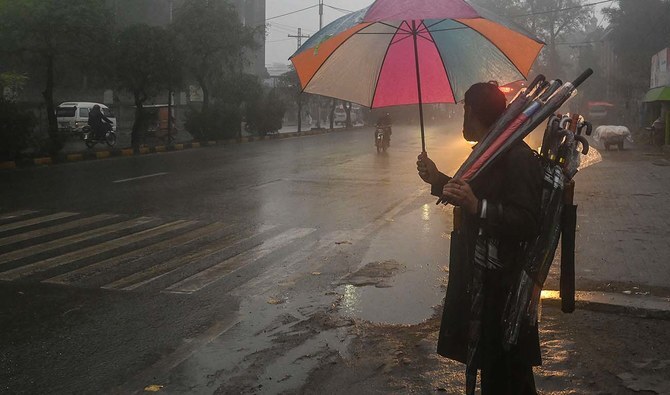
A street vendor carries umbrellas as he waits for customers along a road during a rain shower in Lahore on January 19, 2022. (AFP/File)
Short Url
Updated 27 August 2024
Follow

Pakistan braces for more downpours as nearly 250 killed in rain disasters since July 

  • Punjab provincial disaster authority says heavy rains to lash province from Aug 27-31
  • Pakistan recognized as one of the most vulnerable countries to climate change effects

ISLAMABAD: Pakistan’s Punjab on Tuesday warned of heavy rains across the province till August 31, urging the public to exercise caution, with nearly 250 people killed nationwide in rain disasters this monsoon season.

Heavy rains since July have triggered floods and landslides in many parts of the country, most notably the eastern province of Punjab and northwestern Khyber Pakhtunkhwa (KP).

Since July 1, Punjab has reported 92 deaths from rain disasters, while KP has reported 74 and the southern Sindh and southwestern Balochistan provinces have reported 47 and 24 deaths respectively.

“An alert for heavy monsoon rains across the province has been issued,” the Provincial Disaster Management Authority (PDMA) for Punjab said on Tuesday. “The new spell of monsoon rains will start this evening [Tuesday] till August 31.”

PDMA said rains were expected in the cities of Rawalpindi, Murree, Galiyat, Attock, Chakwal, Talagang, Jhelum, Gujranwala, Sahiwal, Jhang, Toba Tek Singh, Nankana Sahib, Chiniot, Faisalabad, Kasur, Khushab, Sargodha and Mianwali, Bhakkar, Layyah, Dera Ghazi Khan, Rajanpur, Multan, Khanewal, Lodhran, Muzaffargarh, Kot Addu, Bahawalpur, Bahawalnagar, Khanpur and Rahim Yar Khan.

Due to heavy rains in the Koh Sulaiman range, there was a fear of flash floods in the mountains, the PDMA said, directing commissioners, deputy commissioners, the Water and Sanitation Agency, irrigation department, rescue officials, civil defense and other concerned departments to remain alert. 

Punjab PDMA Director General Irfan Ali Kathia said there was a risk of flash floods in the Dera Ghazi Khan, Multan and Bahawalpur divisions. 

“Tourists, travelers and farmers should arrange their affairs keeping in view the weather conditions,” he said. “Stay in safe places to protect old buildings from poles and lightning and in case of an emergency call PDMA helpline 1129.”

Pakistan is recognized as one of the world’s most vulnerable countries to climate change effects. This year, the South Asian country recorded its “wettest April since 1961,” with 59.3 millimeters of rainfall while some areas of the country faced a deadly heat wave in May and June.

In 2022, unusually heavy rains triggered flash floods in many parts of the country, killing over 1,700 people, inflicting economic losses of around $30 billion, and affecting at least 30 million people.


Pakistan, China to sign multiple MoUs at major agriculture investment conference today

Updated 18 January 2026
Follow

Pakistan, China to sign multiple MoUs at major agriculture investment conference today

  • Hundreds of Chinese and Pakistani firms to attend Islamabad event
  • Conference seen as part of expanding CPEC ties into agriculture, trade

KARACHI: Islamabad and Beijing are set to sign multiple memorandums of understanding (MoUs) to boost agricultural investment and cooperation at a major conference taking place in the capital today, Monday, with hundreds of Chinese and Pakistani companies expected to participate.

The conference is being billed by Pakistan’s Ministry of National Food Security and Research as a platform for deepening bilateral agricultural ties and supporting broader economic engagement between the two countries.

“Multiple memorandums of understanding will be signed at the Pakistan–China Agricultural Conference,” the Ministry of National Food Security said in a statement. “115 Chinese and 165 Pakistani companies will participate.”

The conference reflects a growing emphasis on expanding Pakistan-China economic cooperation beyond the transport and energy foundations of the flagship China-Pakistan Economic Corridor (CPEC) into agriculture, industry and technology.

Under its first phase launched in 2015, CPEC, a core component of China’s Belt and Road Initiative, focused primarily on transportation infrastructure, energy generation and connectivity projects linking western China to the Arabian Sea via Pakistan. That phase included motorways, power plants and the development of the Gwadar Port in the country's southwest, aimed at helping Pakistan address chronic power shortages and enhance transport connectivity.

In recent years, both governments have formally moved toward a “CPEC 2.0” phase aimed at diversifying the corridor’s impact into areas such as special economic zones, innovation, digital cooperation and agriculture. Second-phase discussions have highlighted Pakistan’s goal of modernizing its agricultural sector, attracting Chinese technology and investment, and boosting export potential, with high-level talks taking place between planning officials and investors in Beijing.

Agri-sector cooperation has also seen practical collaboration, with joint initiatives examining technology transfer, export protocols and value-chain development, including partnerships in livestock, mechanization and horticulture.

Organizers say the Islamabad conference will bring together government policymakers, private sector investors, industry associations and multinational agribusiness firms from both nations. Discussions will center on investment opportunities, technology adoption, export expansion and building linkages with global buyers within the framework of Pakistan-China economic cooperation.