

New era unveiled as NGSC Riyadh highlights synergy between traditional sports, esports

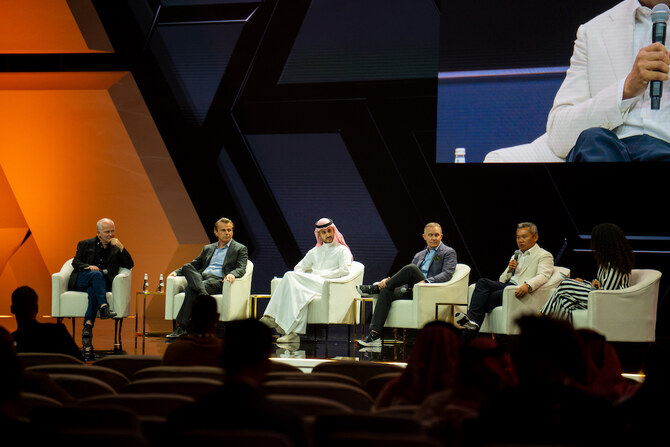
Traditional sports and esports are converging, with new technologies enhancing fan engagement in both arenas, the second day of the Next Generation Sports Conference in Riyadh was told. (AN Photo/Abdulrahman bin Shulhub)
Short Url
Updated 25 August 2024
Follow

New era unveiled as NGSC Riyadh highlights synergy between traditional sports, esports

  • Top athletes such as Neymar are playing a pivotal role in leading traditional fans to esports, panel discussion told
  • Virtual reality and other immersive technologies ‘bridging the gap between physical and digital experiences,’ panelist says

RIYADH: Traditional sports and esports are converging, with new technologies enhancing fan engagement in both arenas, the second day of the Next Generation Sports Conference in Riyadh was told.

A panel discussion, titled “Bridging the Gap Between Traditional Sports and Esports,” examined how these two realms are influencing each other, and what the future holds for their convergence.

The panel featured Andrew Chen, a general partner at Andreessen Horowitz; Eric Shanks, CEO and executive producer of Fox Sports; Faisal bin Homran, chief product officer of the Esports World Cup Foundation; Michael Metzger, managing partner of Drake Star; and Peter Hutton, board director at the Saudi Pro League.

It kicked off with a look at the historical evolution of traditional sports media, and how digital technologies have transformed traditional sports, from the early days of radio broadcasts to today’s sophisticated streaming services. In parallel, esports have seen meteoric growth, with live-streaming platforms and social media playing a pivotal role in its rise.

Chen set the stage by addressing the financial dynamics reshaping the esports sector. He highlighted a significant transformation in funding patterns, where the world is witnessing a pivotal shift from investing heavily in esports teams to focusing on broader components such as game studios and creator tools.

This change, he said, comes in response to the challenges faced by team-based investments and the increasing importance of new technologies like AI and VR in enhancing fan engagement.

Shanks provided a glimpse into how traditional sports broadcasting is evolving to integrate esports elements. He stressed the importance of blending esports aesthetics with traditional sports coverage.

He also discussed the challenge of creating a “connective tissue” that links traditional sports fandom with esports. He said that the goal is to forge a deeper, more personal connection for fans through virtual reality and other immersive technologies, bridging the gap between physical and digital experiences.

Meanwhile, Metzger addressed the shifting investment landscape in gaming and esports. He noted a reduction in valuations and deal flow following the COVID-19 pandemic, but highlighted the current resurgence in investment activity. He pointed to an increase in funding for early-stage companies and esports infrastructure, as well as significant investments from local athletes and international tech giants.

Metzger added that with a growing interest in VR and AI, and recent high-profile IPOs, the future looks promising for investors in this space.

Speakers also discussed the impact of technology on enhancing competitiveness and fan engagement in sports. They stressed the importance of learning from esports to improve traditional sports’ appeal, adding that esports teaches how to create multiple narrative perspectives and interactive experiences, which are essential for engaging today’s younger audiences.

Innovations like customizable VR experiences and real-time stats integration were praised by the panel for offering fans a more personalized viewing experience. They argued that these technologies could be adapted to traditional sports to create a more dynamic and engaging spectator experience.

The panel concluded with a discussion on how traditional sports can learn from esports in terms of fan engagement and content delivery, with bin Homran highlighting the potential for integrating in-game customizations and real-time highlights to attract younger audiences. He stressed the importance of creating engaging, interactive experiences that cater to the digital-native generation.

“I think the integration of the in-game customizations is really important. I think one of the most important things that esports fans love to customize things in their games. They like to have a specific skin. They like to have a specific NBA item that they love to be recognized with,” he said.

He added: “At this moment, we have a lot of sports figures that are involved more in esports, like Neymar, or the other athletes that are investing more in esports, and they are leading the traditional fans to all esports.”


Riyadh 2026: The gateway to LIV’s most global season yet

Updated 27 January 2026
Follow

Riyadh 2026: The gateway to LIV’s most global season yet

  • We are the world’s golf league, says LIV Golf CEO Scott O’Neil
  • Riyadh will host the LIV Golf League season opener for the second consecutive season

RIYADH: Under the lights of Riyadh Golf Club, LIV Golf begins its campaign from February 4 to 7 in the Kingdom’s capital, opening what is the most international season to date. With 14 events scheduled across 10 countries and five continents, LIV has doubled down on its ambition to position itself as golf’s leading global circuit outside the United States.

For LIV Golf CEO Scott O’Neil, that identity is no longer about staging tournaments in different timezones, but also about aligning more closely with the sport’s tradition. One of the league’s headline shifts for 2026 has been the switch from 54-hole events to 72 holes.

“The move to 72 holes was much talked about,” O’Neil said at the pre-season press conference. “For us, that was relatively simple. We want to make sure that our players are best prepared for the majors, that it’s not as much of a sprint, that our teams have a chance to recover after a tough day one.”

He added that the decision was also driven by the league’s commercial and broadcast momentum across several markets.

“With the overwhelming support we have seen in several of our markets, quite frankly, more content is better. More fans come in, more broadcast content social hospitality checks check,” O’Neil said.

Launched in 2022 after a great deal of fanfare, LIV Golf had initially differentiated itself from other golf tours with a shorter, more entertainment-led event model. This includes team competition, alongside individual scoring, concert programming and fan-focused activations. 

After four campaigns with 54-holes, the shift back to 72 signals an attempt to preserve the golf identity while answering longstanding questions about competitive comparability with golf’s established tours.

Riyadh will now host the LIV Golf League season opener for the second consecutive season, following its debut under the night lights in February 2025. As the individual fund rises from $20 million to $22 million, and the team purse increases from $5 million to $8 million, LIV Golf is not backing down on its bid to showcase confidence and continuity as it enters its fifth season.

For the Kingdom, the role goes beyond simply hosting the opening event. Positioned at the crossroads of continents, Riyadh has become LIV’s gateway city — the place where the league sets its tone before exporting it across various locations across the world.

“Players from 26 countries? Think about that being even possible 10 years ago, 15 years ago, 20 years ago,” O’Neil said. “That there would be players from 26 countries good enough to play at an elite level globally, and there is no elite platform outside the U.S.”

The departure of Brooks Koepka from LIV and his return to the PGA Tour has inevitably raised questions around player movement and long-term sustainability. O’Neil, however, framed the decision as a matter of fit rather than fallout.

“If you are a global citizen and you believe in growing the game, that means getting on a plane and flying 20 hours,” he said. “That’s not for everybody. It isn’t.”

Despite the separation, O’Neil insisted there was no animosity.

“I love Brooks. I root for Brooks. I am hoping the best for him and his family,” he emphasised.

Attention now turns to the players who have reaffirmed their commitment to LIV Golf, including Bryson DeChambeau, Jon Rahm and Cam Smith. Amid continued tensions with the DP World Tour and the sport’s traditional power centres, O’Neil insists the league’s focus remains inward.

“There is no holy war, at least from our side. We are about LIV Golf and growing the game globally,” he said.

From Riyadh to Adelaide, from Hong Kong to South Africa, LIV Golf’s 2026 calendar stretches further ever than before. As debate continues over the league’s place within the sport, LIV is preparing to show that its challenge to golf’s established order is not, as some doubters suggest, fading.

 With the spotlight firmly on its fifth season, Riyadh will provide the first impression — the opening statement from which LIV Golf intends to show the world where it stands.