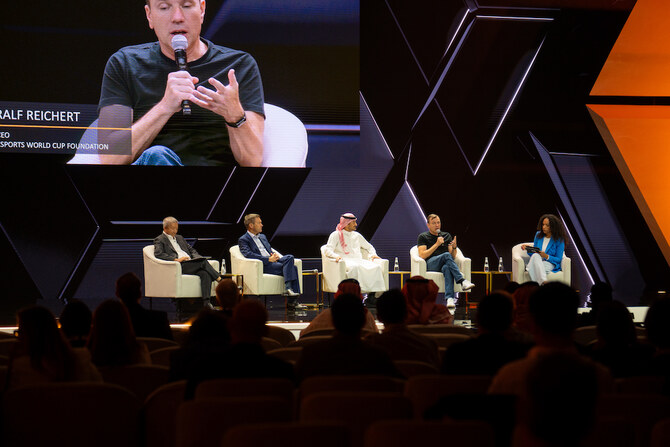

RIYADH: With gaming continuing to gain momentum on a global scale, industry experts and leaders at the New Global Sports Conference in Riyadh explored integrating esports within the Olympics framework, suggesting possible benefits of a merger range from enhanced governance and structure to broader global participation and technological innovation.
“There is a massive growth in esports globally, and I believe that its integration with the Olympic framework will provide esports with governance and structure to flourish,” said Abdulaziz Baeshen, CEO and secretary-general of the Saudi Olympic and Paralympic Committee.
Baeshen made his remarks during a panel discussion titled “How Esports is Shaping the Next Chapter of Olympic History” at the conference on Saturday.
He said that competitive gaming tournaments involve skilled professional players and teams. Esports, like traditional sports, follow familiar formats that include leagues, teams, and individual athletes.
“Such a rise in esports signals to partners and companies that want to invest into esports, as I believe that sustainable growth and investment will happen across all continents, and this is probably an important piece if we want the work of esports to continue globally,” Baeshen added.
Growing interest will encourage international sports federations to explore new avenues for participation and innovation in esports, he said.
Saudi Arabia’s Vision 2030 aligns closely with the goals of the Esports World Cup, focusing on unlocking new opportunities and shaping the next generation of professional gamers.
Ng Ser Miang, vice president of the International Olympic Committee, highlighted recent developments, saying: “The creation of the Olympic Esports Games was approved during our 142nd session earlier this year.”
He announced that the IOC has partnered with Saudi Arabia to host the inaugural Olympic Esports Games in the Kingdom.
“The crossover and the merger between both traditional sports and esports titles opens a room of possibilities and something to explore,” he added.
Ralf Reichert, CEO of the Esports World Cup Foundation, discussed the evolution of esports and the next steps for its integration into the Olympic Games.

David Lappartient, chair of the IOC Esports and Gaming Liaison Group and president of Union Cycliste Internationale, said that there are 3.4 billion gamers worldwide. (AN Photo/Abdulrahman Shalhoub)
“Since 2010, the industry absolutely changed with the advent of free-to-play games, democratizing the sport and increasing its accessibility,” Reichert said.
Esports have grown organically, evolving from informal competitions into a global phenomenon, he said.
“The traditional sports world’s engagement with esports began in 2018, leading to the current integration with the Olympic framework,” Reichert added, saying that the enthusiasm of fans and packed stadiums played a crucial role in the widespread recognition of esports.
David Lappartient, chair of the IOC Esports and Gaming Liaison Group and president of Union Cycliste Internationale, addressed the challenges and opportunities of expanding global participation in esports, particularly in regions where competitive gaming is still in its infancy.
“We have 3.4 billion gamers worldwide, and we believe we can continue to expand that, and more specifically, territories of countries where esports presence is not popular,” Lappartient said.
He highlighted the potential of new technologies such as cloud gaming to provide equitable access and enable regional tournaments.
“The Olympic Esports Games will help bring all countries into the journey, with a focus on regional competitions,” he added.
Key initiatives supporting the Olympic Esports Games include offering significant prize money, creating sustainable support programs for clubs, featuring top games, and transforming Riyadh into a global destination for esports.