

Industry leaders discuss integrating esports into Olympic framework

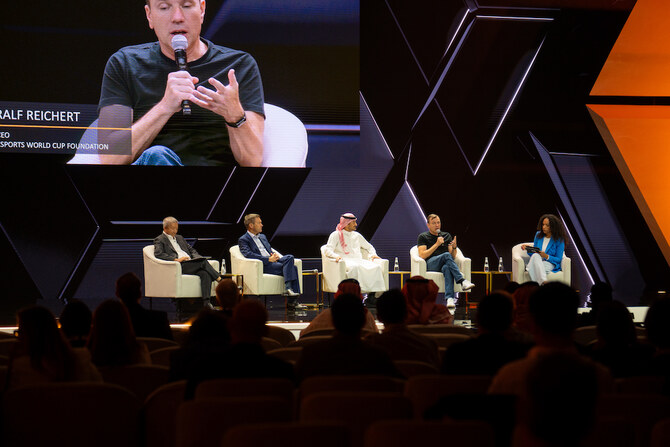
Integrating Esports aims to legitimize it among sports by fostering global participation and leveraging innovative technologies for equitable access. (AN Photo/Abdulrahman Shalhoub)
Short Url
Updated 24 August 2024
Follow

Industry leaders discuss integrating esports into Olympic framework

  • Merger will open new avenues for participation and innovation, says Abdulaziz Baeshen, CEO and secretary-general of the Saudi Olympic and Paralympic Committee 

RIYADH: With gaming continuing to gain momentum on a global scale, industry experts and leaders at the New Global Sports Conference in Riyadh explored integrating esports within the Olympics framework, suggesting possible benefits of a merger range from enhanced governance and structure to broader global participation and technological innovation.

“There is a massive growth in esports globally, and I believe that its integration with the Olympic framework will provide esports with governance and structure to flourish,” said Abdulaziz Baeshen, CEO and secretary-general of the Saudi Olympic and Paralympic Committee.

Baeshen made his remarks during a panel discussion titled “How Esports is Shaping the Next Chapter of Olympic History” at the conference on Saturday.

He said that competitive gaming tournaments involve skilled professional players and teams. Esports, like traditional sports, follow familiar formats that include leagues, teams, and individual athletes.

“Such a rise in esports signals to partners and companies that want to invest into esports, as I believe that sustainable growth and investment will happen across all continents, and this is probably an important piece if we want the work of esports to continue globally,” Baeshen added.

Growing interest will encourage international sports federations to explore new avenues for participation and innovation in esports, he said.

Saudi Arabia’s Vision 2030 aligns closely with the goals of the Esports World Cup, focusing on unlocking new opportunities and shaping the next generation of professional gamers.

Ng Ser Miang, vice president of the International Olympic Committee, highlighted recent developments, saying: “The creation of the Olympic Esports Games was approved during our 142nd session earlier this year.”

He announced that the IOC has partnered with Saudi Arabia to host the inaugural Olympic Esports Games in the Kingdom.

“The crossover and the merger between both traditional sports and esports titles opens a room of possibilities and something to explore,” he added.

Ralf Reichert, CEO of the Esports World Cup Foundation, discussed the evolution of esports and the next steps for its integration into the Olympic Games.


David Lappartient, chair of the IOC Esports and Gaming Liaison Group and president of Union Cycliste Internationale, said that there are 3.4 billion gamers worldwide. (AN Photo/Abdulrahman Shalhoub)

“Since 2010, the industry absolutely changed with the advent of free-to-play games, democratizing the sport and increasing its accessibility,” Reichert said.

Esports have grown organically, evolving from informal competitions into a global phenomenon, he said.

“The traditional sports world’s engagement with esports began in 2018, leading to the current integration with the Olympic framework,” Reichert added, saying that the enthusiasm of fans and packed stadiums played a crucial role in the widespread recognition of esports.

David Lappartient, chair of the IOC Esports and Gaming Liaison Group and president of Union Cycliste Internationale, addressed the challenges and opportunities of expanding global participation in esports, particularly in regions where competitive gaming is still in its infancy.

“We have 3.4 billion gamers worldwide, and we believe we can continue to expand that, and more specifically, territories of countries where esports presence is not popular,” Lappartient said.

He highlighted the potential of new technologies such as cloud gaming to provide equitable access and enable regional tournaments.

“The Olympic Esports Games will help bring all countries into the journey, with a focus on regional competitions,” he added.

Key initiatives supporting the Olympic Esports Games include offering significant prize money, creating sustainable support programs for clubs, featuring top games, and transforming Riyadh into a global destination for esports.


Hosts Morocco cruise, South Africa advance into Cup of Nations last 16

Updated 8 sec ago
Follow

Hosts Morocco cruise, South Africa advance into Cup of Nations last 16

  • Olympiakos striker El Kaabi nodded in an early opener and scored an overhead kick shortly after halftime, with both of his goals set up by the outstanding Azzedine Ounahi
  • Mali go through in second place after a 0-0 draw with Comoros in Casablanca
  • Egypt, who rested stars like captain Salah with first place already assured, topped Group B with seven points after their draw against Angola in Agadir

RABAT: Ayoub El Kaabi’s brace helped Morocco to a 3-0 win over Zambia on Monday as the Africa Cup of Nations hosts cruised into the last 16 while South Africa beat Zimbabwe 3-2 to also secure a berth in the knockout phase.

African player of the year Achraf Hakimi made his comeback from almost two months out injured for Morocco as Mali also qualified for the next round and Mohamed Salah was rested for Egypt’s 0-0 draw against Angola.

Morocco are the tournament favorites as the host nation and Africa’s top-ranked team but they were booed off by supporters following a 1-1 draw against Mali in their last outing.

Nevertheless, Walid Regragui’s team knew a win against Zambia at the Prince Moulay Abdellah Stadium in capital Rabat would guarantee their progress to the next round in first place in Group A and they outclassed their opponents.

Olympiakos striker El Kaabi nodded in an early opener and scored an overhead kick shortly after halftime, with both of his goals set up by the outstanding Azzedine Ounahi.

In between, Real Madrid attacking midfielder Brahim Diaz swept home Morocco’s second goal on 27 minutes at the end of a fine team move, again involving Ounahi.

Diaz has found the net in all three of Morocco’s games so far and he and El Kaabi join Algeria captain Riyad Mahrez on three goals at the top of the Cup of Nations scoring charts.

Captain Hakimi came off the bench in the 64th minute for his first appearance since suffering an ankle injury in action for Paris Saint-Germain at the beginning of November.

Morocco will stay in Rabat for a last-16 tie in the same stadium on Sunday against one of the best third-place finishers.

“Scoring early on changes everything,” said Regragui. “We need to continue like this but not get carried away and keep our feet on the ground.”

Zambia go out and have now failed to win any of their 12 AFCON matches across four tournament appearances since lifting the trophy in 2012.

Mali go through in second place after a 0-0 draw with Comoros in Casablanca, a game they ended with 10 men after Amadou Haidara was sent off.

It was a third stalemate in as many matches for the Eagles, who will remain in Morocco’s largest city for a last-16 tie on Saturday.

Salah rested by Egypt

Earlier, Oswin Appollis converted a late penalty to give South Africa victory against Zimbabwe in Marrakech as Bafana Bafana qualified for the knockout stage.

Rising star Tshepang Moremi gave South Africa an early lead with a deflected effort.

However, falling behind motivated Zimbabwe and they deservedly levelled on 19 minutes thanks to the individual brilliance of Tawanda Maswanhise from Scottish Premiership club Motherwell.

Maswanhise gained possession inside the South African half, dribbled past two opponents and fired the ball wide of goalkeeper Ronwen Williams into the far corner.

South Africa began the second period aggressively and regained the lead on 50 minutes through Burnley striker Lyle Foster, for whom it was a second goal of the tournament.

Zimbabwe brought it back to 2-2 on 73 minutes when Aubrey Modiba conceded an own goal, but Appollis then netted from an 82nd-minute penalty to give Bafana the lead for the third time, which they retained.

“Once again we fell asleep after a good start. We continuously lost possession,” said 73-year-old South Africa coach Hugo Broos.

“Our passing was bad at times and we should have concentrated on retaining possession in the closing minutes instead of seeking a fourth goal. We have to work on controlling games.”

Egypt, who rested stars like captain Salah with first place already assured, topped Group B with seven points after their draw against Angola in Agadir. South Africa finished with six points, Angola two and Zimbabwe one.

The last round of group games continues on Tuesday, with Tanzania playing Tunisia and Nigeria facing Uganda in Group C. Senegal take on Benin and the Democratic Republic of Congo play Botswana in Group D.