

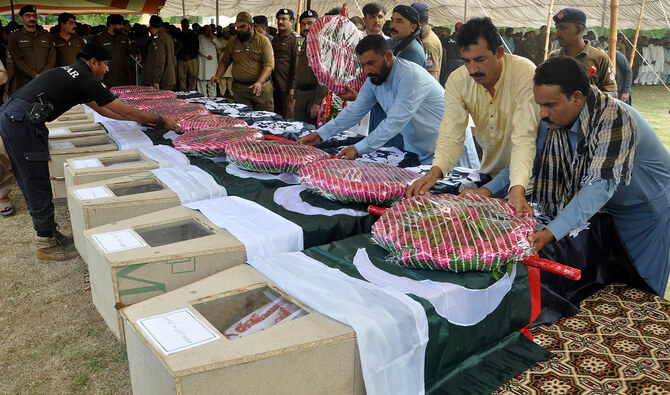
Mourners in southern Pakistan attend funerals for 28 Shiite pilgrims killed in a bus crash in Iran

People place wreath on the caskets of police officers, who were killed in the gunmen ambushed on a police convoy in a deserted area, during a funeral prayer, in Rahim Yar Khan, Pakistan, on August 23, 2024. (AP)
Short Url
Updated 24 August 2024
Follow

Mourners in southern Pakistan attend funerals for 28 Shiite pilgrims killed in a bus crash in Iran

  • The funerals took place hours after a military aircraft brought home the bodies, injured
  • The victims of the crash were later buried in various graveyards in the Sindh province

MULTAN: Hundreds of mourners in various parts of southern Pakistan attended funerals for 28 Shiite pilgrims who were killed in a bus crash in Iran this week while heading to Iraq, community leaders and officials said.

The victims of the crash were later buried in various graveyards in the Sindh province, local Shiite leader Jaafar Hussain said.

The funerals took place hours after a military aircraft brought home the bodies and the injured on orders from Prime Minister Shehbaz Sharif. All the victims were from Sindh province, where the plane landed.

Authorities have not announced the cause of the crash near the city of Taft, some 500 kilometers (310 miles) southeast of the Iranian capital, Tehran.

In southern Pakistan, Zawaar Javed, the father of a man who died, said his son minutes before the crash sent him a message on WhatsApp, saying the brakes of bus had failed, and later he heard news about the accident.

In a state TV report, Mohammad Ali Malekzadeh, a local Iranian emergency official, also blamed the crash on the bus brakes failing and a lack of attention by the driver.

The Pakistani pilgrims had been on their way to Iraq’s holy city of Karbala, to commemorate Arbaeen — Arabic for the number 40 — marking the end of the annual 40-day mourning period after the date of the seventh century death of the Prophet Muhammad’s grandson, Hussein, a central figure in Shiite Islam.

Hussein died at the hands of the Muslim Umayyad forces in the Battle of Karbala, during the tumultuous first century of Islam’s history.



Pakistan, Malaysia discuss halal food, energy and tourism to boost cooperation

Updated 47 min 44 sec ago
Follow

Pakistan, Malaysia discuss halal food, energy and tourism to boost cooperation

  • Bilateral trade between both countries stands at about $1.4 billion a year
  • In Oct., both countries announced a new $200 million halal meat trade quota

ISLAMABAD: Pakistan and Malaysian officials have held talks on halal food, green energy and tourism sectors as part of renewed efforts to expand ties between the two Muslim-majority nations, the Pakistani High Commission in Malaysia on Monday.

The discussions took place during a meeting between Pakistan’s High Commissioner to Malaysia, Syed Ahsan Raza Shah and Tun Pehin Sri Dr. Wan Junaidi Tuanku Jaafar, governor of Malaysia’s Sarawak state.

Bilateral trade between the two countries stands at about $1.4 billion a year, according to official data from both governments. In Oct., both countries announced a new $200 million halal meat trade quota.

“Constructive talks on Pakistan-Malaysia ties in halal [food], palm oil, green energy, rice, labor, tourism, culture & sustainable development,” the Pakistani High Commission in Malaysia said on X.

Malaysia’s exports to Pakistan are led by palm oil and other vegetable fats, followed by machinery, rubber products and organic chemicals. Pakistan’s main exports to Malaysia include rice, textiles, seafood and minerals.

The two countries have also traded under the Malaysia-Pakistan Closer Economic Partnership Agreement since 2008, which provides preferential market access for goods and services.

Pakistan has been rapidly growing its green energy, halal food, and tourism sectors. Its halal food industry is attracting global buyers with Shariah-compliant products, while tourism is leveraging the country’s natural beauty, heritage sites and cultural attractions to draw international visitors.