


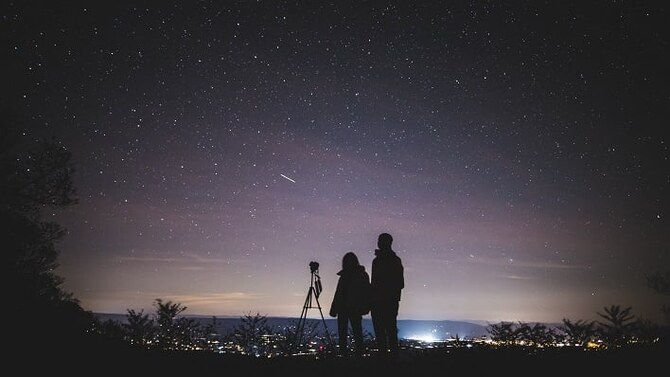
Suhail: A star that heralds the end of scorching summer

1 / 2
Suhail, a star Arabs look forward to sighting, as it marks the end of Summer heat. (SPA)
2 / 2
Astronomers sighting Suhail star that marks the end of searing heat in Arab countries. (Supplied)
Short Url
Updated 25 August 2024
Follow

Suhail: A star that heralds the end of scorching summer

  • Sighting the Suhail star is said to coincide with the approach of cooler weather in the Arabian Peninsula

RIYADH: Arabs are on the lookout for Suhail, a star whose sighting is said to herald in cooler weather, as temperatures hit 50 degrees Celsius amid this summer’s searing heat.

Historically, the star signaled the onset of cooler days in the desert. According to Arab folklore, the night “cools down” when “Suhail rises.”

Abouazza Elmhamdi, in the Physics and Astronomy department at King Saud University, told Arab News: “Suhail is one of the most important stars for the people of the Arabian Peninsula. Throughout history, it has attracted the interest of astronomers, as well as the region’s residents and farmers. It is associated with a noticeable drop in temperatures after a long period of searing heat. It is also associated with the season of some local crops in the region (such as palm trees).”

Listed in the International Astronomical Union catalog of star names under the Latin name Canopus, Suhail is located around 310 lightyears from the sun. Its luminosity is over 10,000 times that of the sun, while its mass is around eight times greater. It appears to be the brightest star in the southern constellation of Carina and the second-brightest star in the night sky after the famous Sirius star, Elmhamdi explained.

“This year, Suhail will rise in the Arabian Peninsula around Aug. 24, although the exact time can vary slightly depending on a person’s location within the region,” he said.

Suhail can be spotted next to Sirius from the constellation Canis Major and can be observed with the naked eye in the southern half of the Arabian Peninsula. It becomes visible in Jazan on Aug. 7, the center of Saudi Arabia on Aug. 24, and the north of the Kingdom on Sept. 8.

The Suhail season lasts for 52 days. The weather becomes pleasant at night while remaining hot during the early part of the day.

By the end of the season, daytime temperatures become more comfortable.

The UAE’s Al-Sadeem Astronomy, an observatory based in the capital Abu Dhabi, posted on X that the Suhail star was a reliable navigation tool for early Arabs, especially sailors and travelers.

In Emirati culture, the appearance of Suhail symbolized abundance, which is why many fishermen, pearl hunters and farmers based their activities on its presence.

One of the signs coinciding with Suhail’s emergence is the decline in the angle of the sun’s rays. The days get gradually shorter and cool down significantly toward the end of the night.

With the effects of climate change, the drop in temperature may not be as immediately perceptible as in the past, but the weather will become more bearable, especially around October when the rainy season starts and temperatures settle around 30 C.

Decoder

What's Suhail?

Suhail is one of the most important stars for the people of the Arabian Peninsula, according to Abouazza Elmhamdi, an associate professor on astrophysics at King Saud University in Riyadh. He said that the sighting of Suhail, whose luminosity is over 10,000 times that of the sun, is associated with a noticeable drop in temperatures after a long period of searing heat. The star became visible on Aug. 24 in the center of Saudi Arabia. The Suhail season lasts for 52 days, with the weather becoming pleasant at night while remaining hot during the early part of the day. By the end of the season, daytime temperatures become more comfortable.


Historic Bab Al-Bunt in Jeddah reborn as Red Sea Museum

Updated 6 sec ago
Follow

Historic Bab Al-Bunt in Jeddah reborn as Red Sea Museum

  • From manuscripts to contemporary art, the museum takes visitors on a journey through seven galleries celebrating the Red Sea’s heritage

JEDDAH: The recently renovated Bab Al-Bunt building in Historic Jeddah, known as Al-Balad, opened on Saturday night as the Red Sea Museum, giving visitors a first glimpse of a space celebrating the region’s cultural and natural heritage.

The exclusive preview marked the culmination of years of meticulous restoration, preserving one of Jeddah’s most historic landmarks while creating a space that bridges past and present.

The event was attended by Prince Saud bin Mishaal bin Abdulaziz, the deputy governor of Makkah, and Prince Badr bin Abdullah bin Farhan, minister of culture and chairman of the Museums Commission.

Prince Badr said that the Red Sea Museum provides a broad space for creativity and provides a comprehensive cultural platform that fosters dialogue between civilizations and encourages cultural and intellectual exchange.

He noted that the museum reflects the Kingdom’s commitment to preserving its cultural and natural heritage and is a key part of the effort to revive Historic Jeddah. Supported by the Kingdom’s leadership, this initiative contributes to building a vibrant cultural future where diverse forms of culture and the arts can flourish.

Eman Zidan, director of the Red Sea Museum, said: “Red Sea Museum is a revival of Bab Al-Bunt, originally built in 1866. It once served as a bustling port for travelers, pilgrims, and adventurers arriving by sea, and now it opens its doors to visitors, retelling the stories of the Red Sea. It is a cultural anchor that celebrates the legacy, heritage, and rich diversity of the people of the Red Sea."

Zidan detailed the care taken in the restoration, noting the use of original materials such as coral stone and concrete to return the building to its original form.

“This was achieved through a thorough study by experts — architects and heritage specialists — who were able to restore Bab Al-Bunt to its origins. Now the museum speaks to the people and the community, telling the stories of pilgrimage, biodiversity, maritime exchange, and the open dialogue between the countries on the Red Sea,” she added.

Zidan also emphasized the museum’s commitment to providing an enriching visitor experience through diverse programs, from archaeological objects and historical artifacts to modern and contemporary artworks.

Collaborations with local artisans and artists, including Ahmad Angawi, founder of Zawiya97, have produced Red Sea-inspired projects, while the Red Sea Symphony, featuring children’s choirs, is organized with the Tariq Abdulhakim Museum to celebrate the region’s musical traditions.

“Composing a symphony of seven movements representing the countries of the Red Sea, with the participation of the children’s choir, adds a lot, because this is the kind of rebirth of music that unites people and connects them from everywhere,” Zidan said.

Ibrahim Alsanousi, CEO of the Museums Commission, said: “What makes this museum unique is that we rehabilitated and revitalized a historic building with a powerful story to tell, transforming it into the Red Sea Museum, which is now a public space, just as it was before as a port building.”

Alsanousi added that the museum not only displays artifacts from the Red Sea region but also integrates contemporary art to create a dialogue between past and present.

“We hope first and foremost that it is an open and accessible museum, a living space where people feel welcome and a sense of belonging. This is a place for them to come, learn, create, and discover,” he said.

“We also hope that, in the future, there will be more museums reflecting Jeddah’s historic district. While nothing specific is planned yet, several excavations have uncovered numerous objects, some of which will be exhibited here. There may even be potential for a museum dedicated entirely to the district’s artifacts.”

Tayeb Altayeb, acting director of the Tariq Abdulhakim Museum, said: “The Red Sea Museum is one of the unique additions to the historic district. It is a great addition to the city of Jeddah and a testament to how we view experiences through museology — in a modern way, while preserving heritage.”

Speaking about the Silk Road Symphony, Altayeb emphasized the museum’s focus on connecting the Red Sea’s seven countries through music. He highlighted the extensive research and collaboration that went into composing the seven-movement symphony, which draws inspiration from the traditional music, soundscapes, and coastal cultures of Saudi Arabia, Yemen, Jordan, Egypt, Sudan, Eritrea, and Djibouti.

The symphony was performed by the acclaimed Silk Road Ensemble during the opening ceremony, accompanied by a children’s choir, bringing the region’s diverse musical heritage to life. “The idea is communication through the universal language that is music,” he said.

Angawi also highlighted his collaboration with the museum, creating works inspired by the Red Sea’s natural and cultural heritage.

“I was inspired by the sea, its waves, and sea creatures like fish. In my work with the Mangurs, I have been documenting this for many years and innovating new units and openings. With the Red Sea Museum, I developed the idea of the wave, designing pieces that align with the sea view and the beautiful directional geometry.

“Each design works with the museum team to develop a full story and narrative,” he said, noting that this project is just the beginning of ongoing collaborations to produce Red Sea-inspired objects and products.

The museum offers visitors a journey through seven thematic sections that span 23 galleries, displaying more than 1,000 artifacts and artworks. From manuscripts and maps to coral reef specimens and contemporary art, it celebrates the Red Sea’s tangible and intangible heritage.

Temporary exhibitions, such as The Gate of Gates by Saudi photographer Moath Alofi, along with workshops, talks, and special events such as Music of the Red Sea, complement the permanent displays, inviting visitors of all ages to engage with the region’s cultural and natural legacy.