

How a cutting-edge AI model developed in Saudi Arabia is reshaping medical diagnostics

1 / 2
2 / 2
Short Url
Updated 22 August 2024
Follow

How a cutting-edge AI model developed in Saudi Arabia is reshaping medical diagnostics

  • MiniGPT-Med is transforming diagnostics by enhancing accuracy and efficiency in disease detection
  • Developed by KAUST and SDAIA, it leverages advanced vision-interfaced technology to interpret medical scans

RIYADH: Artificial intelligence in healthcare is revolutionizing medical diagnostics, from streamlining patient care to enhancing the speed and accuracy of disease detection.

Saudi Arabia is at the forefront of this revolution with the development of an innovative AI model called MiniGPT-Med, which promises to reshape how medical professionals approach diagnostics.

With the ability to analyze vast amounts of data and identify patterns that might be missed by the human eye, AI is fast becoming an indispensable healthcare tool.

Whether detecting early signs of diseases, interpreting medical scans or helping plan treatment, AI’s role in medicine is expanding rapidly, reducing costs and improving patient outcomes.

Enter MiniGPT-Med, a cutting-edge, vision-interfaced AI model developed in Saudi Arabia by the King Abdullah University of Science and Technology in collaboration with the Saudi Data and Artificial Intelligence Authority.
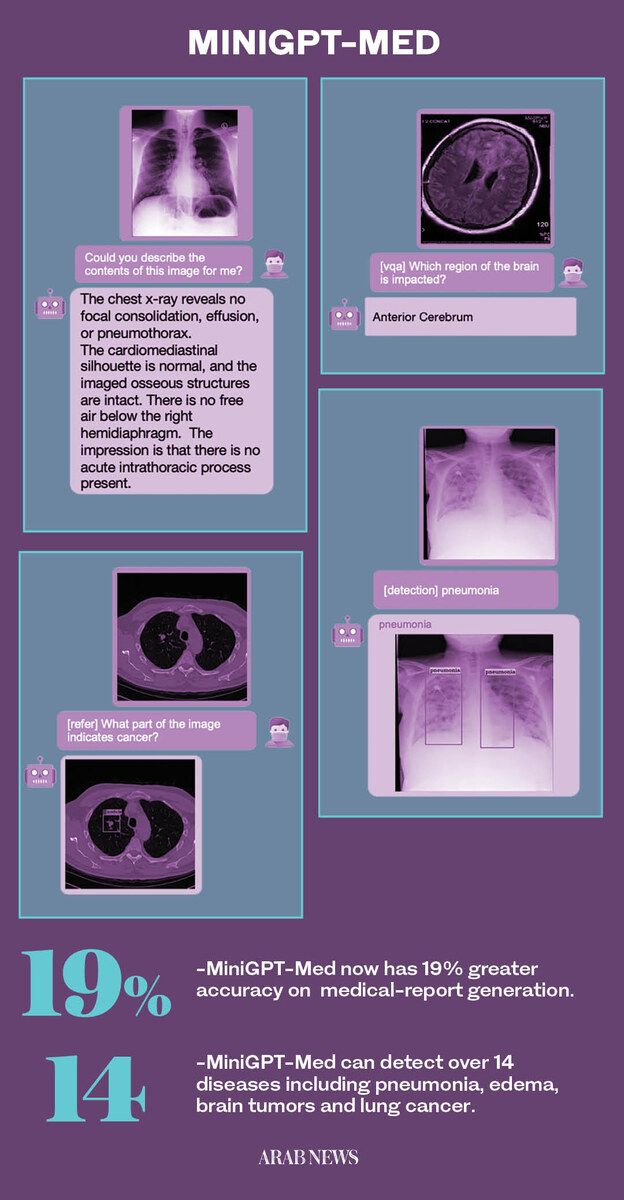
Launched in July, this advanced tool is designed to enhance the accuracy of medical diagnostics by integrating image analysis with textual clinical data, significantly improving the detection of conditions such as pneumonia, edema, brain tumors and lung cancer.

“MiniGPT-Med aids doctors by improving diagnostic accuracy through integrated processing of both image and textual clinical data,” Mohamed Elhoseiny, assistant professor of computer science at the Visual Computing Center at KAUST, told Arab News.

“It can be thought of as giving a large language model medical eyesight by carefully integrating vision into the language model and preparing the necessary data to learn these skills, including the localization of issues in medical images.”

MiniGPT-Med builds on the existing architecture of large language models — or LLMs — like OpenAI’s ChatGPT, which have already demonstrated exceptional medical knowledge.

Opinion

This section contains relevant reference points, placed in (Opinion field)

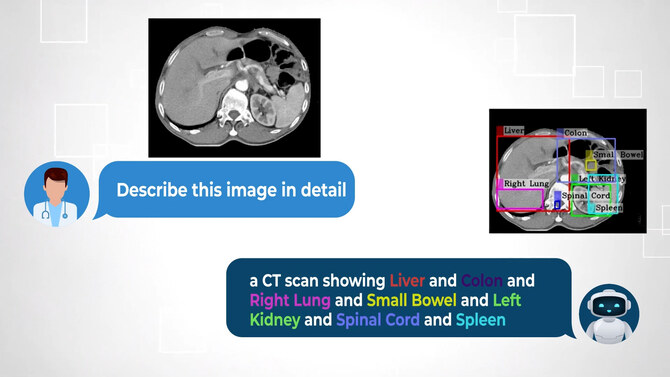
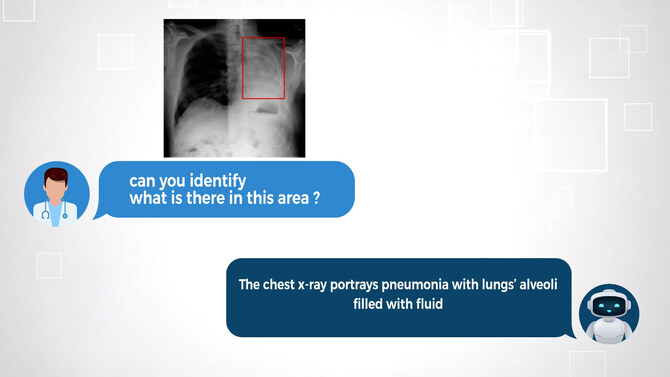
One of the key features that sets MiniGPT-Med apart from other AI models is its ability to localize abnormalities within medical images.

Doctors interact with it using simple, predefined queries such as “Could you describe the contents of this image for me?” or “Where is the abnormality?”

The AI then provides immediate, accurate results, such as identifying pneumonia in a chest X-ray or pinpointing the exact region of a brain tumor in an MRI scan.

In initial trials, it has already surpassed the accuracy of previous models by as much as 19 percent.

Trained on diverse medical datasets, MiniGPT-Med leverages millions of cases to back up its diagnoses, drawing reasoned conclusions by comparing images to similar cases in its database.

DID YOUKNOW?

• MiniGPT-Med enhances diagnostic accuracy by integrating image analysis with clinical data.

The AI model identifies diseases such as pneumonia, edema, brain tumors, and lung cancer.

• It localizes abnormalities in medical images, helping doctors to make precise diagnoses.

• Developed by KAUST and SDAIA, it is part of Saudi Arabia’s drive to lead in AI healthcare.

The model sources its information from five comprehensive medical datasets, including MIMIC-CXR (chest X-ray images and reports), NLST (low-dose CT scans for lung cancer detection), SLAKE (radiology images), RSNA (pneumonia detection), and RadVQA (radiology images).

Despite its accuracy, Elhoseiny is keen to emphasize that MiniGPT-Med is designed to complement, not replace, healthcare professionals.

“The new diagnostics method introduced by models like MiniGPT-Med aims to assist, not replace, physicians and radiologists, enabling them to do more with less,” he said.

Instead, by enhancing diagnostic accuracy and efficiency, the AI tool is intended to help doctors deliver better care, especially in under-resourced areas.

Looking to the future, the development team at KAUST and SDAIA plans to incorporate more diverse datasets, improve the model’s understanding of complex medical terminology, and enhance its reliability.

Extensive clinical validation studies are also planned to ensure that MiniGPT-Med is safe and effective in real world healthcare environments.

The collaboration between KAUST and SDAIA represents a significant step forward in the application of AI in healthcare.

Elhoseiny says the partnership is aligned with the broader goals of the new GenAI Center of Excellence at KAUST, where further innovations in AI are expected to emerge.

With technologies like MiniGPT-Med, Saudi Arabia is not only advancing its healthcare capabilities but also positioning itself as a leader in the global AI landscape.

As these technologies continue to evolve, they hold the promise of transforming healthcare practices worldwide, offering hope for more accurate diagnoses and better patient outcomes.


The secret keepers of desert balance in Saudi Arabia

Updated 27 December 2025
Follow

The secret keepers of desert balance in Saudi Arabia

  • How the Kingdom’s wildcats control pests, protect public health, and sustain the ecosystem

RIYADH: During the summer of 2024, two desert lynx kittens were born in Taif as part of Saudi Arabia’s efforts to protect and increase the population of caracals in the country.

Although caracals are critically endangered, wildcats in general play a significant ecological role in the Kingdom. They act as natural pest control, and Saudi Arabia is committed to conserving these species while increasing their populations to support a thriving ecosystem.

Despite the Kingdom’s harsh, arid climate, conditions are suitable for wildcats not only to survive but also to flourish. Among the terrestrial species inhabiting Saudi Arabia are sand cats, Arabian wildcats, and the desert lynx.

Felis margarita, or sand cats, are small — around 40-60 cm — with pale sandy fur that allows them to blend into the desert. They have a broad head, large ears, and long hair on the bottom of their feet to walk on hot sand.

Sand cats have long hair on the bottom of their feet, allowing them to walk on hot sand and prevent them from sinking into the sand. (SPA/Visitsaudi)

“It is small in size and does not mate with other cats. It is the only cat species in the world with hair on the soles of its feet instead of skin to prevent it from sinking into the sand,” said Obaid Alouni, a Saudi environmentalist.

Alouni explained that one defensive technique sand cats use is to lie flat on the ground to avoid detection.
“It lies flat on the ground when it senses danger to avoid being noticed by other animals.”

These cats primarily feed on rodents and small reptiles, occasionally large insects, obtaining their water from their prey. Sand cats are native to West Asia and help regulate rodent and insect populations, preventing outbreaks and reducing disease spread.

Opinion

This section contains relevant reference points, placed in (Opinion field)

Interestingly, raising sand cats as domestic pets is becoming more popular, Alouni said. But he emphasized that adoption is easier when they are kittens, as they remain wild animals. Although widely distributed across the Kingdom, exact population numbers are difficult to determine due to their elusive nature. They are currently listed as “least concern” by the International Union for Conservation of Nature.

Similar to sand cats, Arabian wildcats (Felis lybica) are found across the Arabian Peninsula and play a vital role in environmental health.

“They are wild cats that live independently without human intervention,” Alouni told Arab News.

An Arabian wildcat at Olomouc Zoo in the Czech Republic. (Wikimedia Commons: Michal Maňas)

Arabian wildcats resemble domestic cats but have thicker, sandy to grey-brown coats with faint stripes or spots and ringed tails with blunt tips. Like sand cats, they feed on rodents, birds, reptiles, and insects and are listed as “least concern” by the IUCN.

However, Alouni warned that pure populations of Arabian wildcats in Saudi Arabia could be threatened by hybridization with domestic cats.

“Currently, wild cats face the problem of interbreeding with domestic cats. This weakens their immune systems and makes them more susceptible to diseases from other cats,” he said.

“This contributes to the extinction of the purebred lineage and, consequently, the disappearance of their wild instincts,” he added.

DID YOU KNOW?

• Sand cats are the only cat species with hair on the soles of their feet, allowing them to walk on hot sand without sinking.

• Caracals, locally known as Al-Washaq, are native and endangered, capable of jumping 3 to 4 meters in a single leap.

• Pure populations of the Arabian wildcat are at risk due to hybridization with domestic cats.

While both species are desert dwellers, sand cats are harder to spot as they avoid heavily trafficked areas. They are mainly found in the Ad Dahna desert and the Empty Quarter, where sand dunes dominate the landscape. Arabian wildcats, however, inhabit rocky or mountainous areas such as the Tuwaiq Mountains, valleys, and farms with abundant small prey.

“Wild cats come around towns and villages, and unfortunately, begin mating with domesticated cats that people release outside,” Alouni explained. He stressed the importance of keeping domestic cats away from wildcat habitats, including deserts and camping sites.

The third wildcat species native to Saudi Arabia, the caracal or desert lynx, is critically endangered. “The lynx is classified in size between large and small, and is distinguished by its jump, which can reach 3 meters or even 4 meters in the sky,” Alouni described.

This combination of photos released by the Saudi National Center for Wildlife (NCW) last year shows a female Caracal and its cub at the Prince Saud Al-Faisal Wildlife Research Center in Taif. (SPA file)

Locally known as Al-Washaq, desert lynx have reddish-tan coats, long legs, and black-tufted ears. They feed on birds, rodents, and sometimes small antelopes. Thankfully, these cats are protected under Saudi law due to their critically endangered status.

Hunting any sand cats, Arabian wildcats, or desert lynx can result in fines of approximately $20,000, according to the Saudi Ministry of Environment, Water, and Agriculture.
“There is a very severe financial penalty in Saudi Arabia for anyone who hunts it,” Alouni added.

The Kingdom has strict regulations to protect endangered animals, criminalizing not only hunting or killing but also trade. Violators could face penalties of up to $8 million, up to 10 years in prison, or both.

Overall, sand cats, Al-Washaq, and Arabian wildcats are essential to maintaining a healthy environment in Saudi Arabia. By controlling rodent populations, they help prevent outbreaks that could threaten agriculture and public health.