

Pakistan invites investment from UAE banks as it looks for external financing avenues 

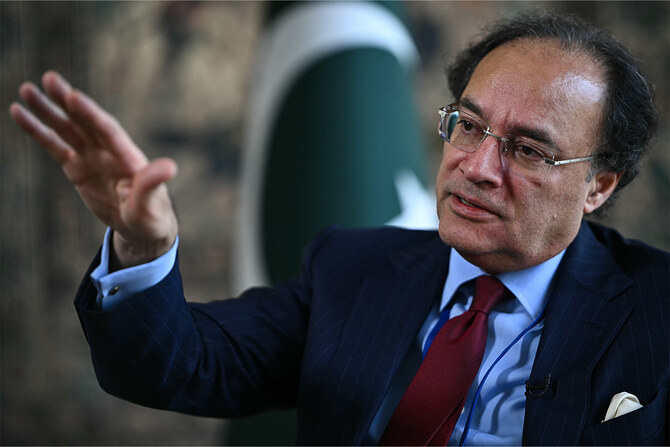
Pakistan's Finance Minister Muhammad Aurangzeb speaks during an interview with AFP at the Embassy of Pakistan in Washington, DC on April 15, 2024. (AFP/File)
Short Url
Updated 23 August 2024
Follow

Pakistan invites investment from UAE banks as it looks for external financing avenues 

  • Pakistan last month reached a bailout loan deal with the IMF which is pending approval from the lender’s executive board
  • Approval dependent on “timely confirmation of necessary financing assurances from Pakistan’s development and bilateral partners”

ISLAMABAD: Finance minister Muhammad Aurangzeb this week invited Dubai Islamic Bank and Mashreq Bank to enhance investments in Pakistan as the South Asian country struggles to meet external financial needs as part of a $7 billion bailout loan that is pending approval by the International Monetary Fund (IMF) executive board.

Last month, Aurangzeb said Pakistan will focus on meeting its external financing needs by speaking with foreign governments and lenders to draw foreign investment as well as seeking loan rollovers. The government is also seeking to focus on more sustainable forms of external financing such as direct investment and climate financing.

Pakistan and the IMF reached an agreement for the 37-month loan program last month. The IMF has said the program is subject to approval from its executive board and obtaining “timely confirmation of necessary financing assurances from Pakistan’s development and bilateral partners.”

On Thursday, Aurangzeb had a virtual meeting with Dr. Adnan Chilwan, Group CEO of Dubai Islamic Bank, a day after a similar interaction was held with Mashreq Bank President and GCEO Ahmed Abdelaal. Both meetings were arranged to “discuss the economic outlook and explore investment opportunities in Pakistan.”

“During the meeting, while exploring the potential areas for investment in Pakistan, the Minister invited the Dubai Islamic Bank to enhance its investment in the country and reaffirmed the government’s dedication to maintaining a stable macroeconomic environment and ensuring that all necessary measures are in place to facilitate foreign investment,” the finance ministry said in a statement after the virtual meeting between Aurangzeb’s team and the Dubai Islamic Bank official.

The minister also provided an in-depth overview of Pakistan’s current economic situation, emphasizing progress made in stabilizing the economy and fostering a conducive environment for business and investment. 

“He highlighted key initiatives taken by the government such as broadening the tax base, enhancing the ease of doing business, the digitalization of the Federal Board of Revenue (FBR), and ongoing reforms and restructuring in state-owned enterprises (SOEs) and privatization,” the statement said. 

“Aurangzeb expressed gratitude for Dubai Islamic Bank’s continuous engagement with Pakistan’s financial sector … He highlighted the government’s commitment to strengthening economic ties with international partners, particularly in Islamic banking, and expressed optimism about future collaborations with Dubai Islamic Bank.”

According to the finance ministry statement, Chilwan expressed “appreciation” for Pakistan’s economic policies and initiatives, and said Pakistan remained a “strategically important market” for Dubai Islamic Bank, reiterating the bank’s interest in playing a “larger role in the country’s financial growth, particularly in sectors such as Islamic banking, infrastructure, and SME development.”

Pakistan is in talks with Saudi Arabia, the United Arab Emirates and China to meet gross financing needs under the IMF program, Aurangzeb said in July following a trip to China to seek energy sector debt reprofiling.

Rollovers or disbursements on loans from Pakistan’s long-time allies, in addition to financing from the IMF, have helped Pakistan meet its external financing needs in the past.

Tough conditionalities placed by the IMF, such as raising tax on agricultural incomes and lifting electricity prices, have prompted concerns about poor and middle class Pakistanis grappling with rising inflation and the prospect of higher taxes.


PCB sets Feb. 11 as date for player auction for Pakistan Super League 11th edition

Updated 25 January 2026
Follow

PCB sets Feb. 11 as date for player auction for Pakistan Super League 11th edition

  • The squad composition would be a minimum of 16 players and a maximum of 20
  • The number of foreign players would be five to seven depending on the squad size

ISLAMABAD: The Pakistan Cricket Board (PCB) on Sunday announced that the player auction for the 11th edition of the Pakistan Super League (PSL) will be held on Feb. 11, setting the stage for franchises to begin assembling squads for the country’s premier Twenty20 tournament.

The development came after a workshop regarding PSL player auction at the Qaddafi Stadium, which was presided over by PCB Chairman Mohsin Naqvi and PSL CEO Salman Naseer.

The workshop was attended by PSL officials, all eight franchise representatives, members of Pakistan’s T20 World Cup squad, PCB officials and other capped players.

“The HBL PSL management shared a detailed presentation on the mechanics of the retention and the auction process and consulted with all the participants,” the PCB said.

“It was agreed that the HBL PSL player auction will take place on Wednesday, 11 February.”

The squad composition would be a minimum of 16 players and maximum of 20 players per franchise. The number of foreign players would be five to seven depending on the squad size, according to the PCB.

It would be mandatory for the franchises to play minimum of three and maximum of four foreign players in the playing XI. The teams are also required to have minimum of two uncapped Under 23 players in the squad and one in the playing XI.

Players either retained or picked in the auction will be engaged for two-year contracts with their respective franchise teams, the board said, adding that franchise teams will be able to retain a maximum of seven players for the 12th edition of the tournament.

“I’m delighted that a consultative and productive session was held between the franchises, players and management today resulting in informed and strategic decisions which will pave the way for bright future for the HBL PSL,” Naqvi said.

“The Player Auction model is a landmark step for the HBL PSL, offering players better financial opportunities through an increased salary purse and a transparent acquisition process, while making the league more competitive and attractive.”

PSL CEO Naseer said the player auction system modernizes player recruitment by promoting fairness, transparency, and market-driven value, strengthening the PSL’s appeal for both players and franchises.

“Today’s workshop saw all views being taken into consideration and this rich feedback will be reflected in our execution of a successful player auction scheduled next month,” he said.

PSL has become a key pillar of the country’s cricket economy, providing financial stability to the PCB and serving as a talent pipeline for the national team. The 11th edition of the league is set to begin from Mar. 26 while the final is expected to be played on May 3, as per the PCB’s schedule.