

Quit the ‘cult’, anti-Trump Republicans plead at DNC

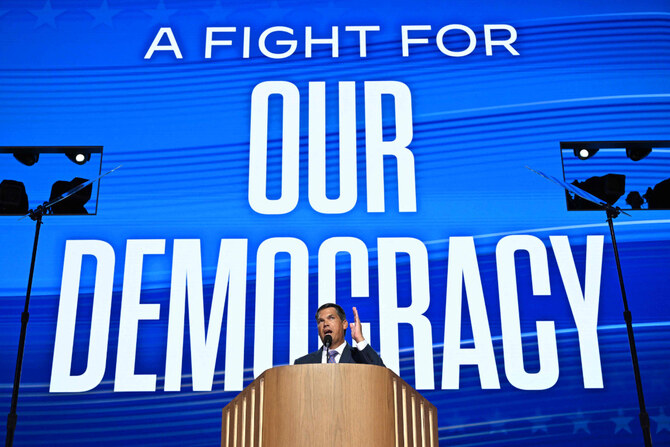
​ Republican Geoff Duncan, former lieutenant governor of Georgia state, speaks on the third day of the Democratic National Convention at the United Center in Chicago, Illinois, on August 21, 2024. (AFP)
Short Url
Updated 23 August 2024
Follow

Quit the ‘cult’, anti-Trump Republicans plead at DNC

  • Geoff Duncan, the former lieutenant governor of Georgia where Trump sought to overturn the results of the 2020 election, slammed Trump as "a direct threat to democracy”
  • Former White House communications director Stephanie Grisham described her ex-boss Trump as a liar with “no empathy, no morals and no fidelity to the truth”
  • John Giles, Republican mayor of Mesa, Arizona, told the convention his party “has been kidnapped by extremists and devolved into a cult: the cult of Donald Trump”

CHICAGO: While Democratic luminaries including the Obamas enthusiastically support Kamala Harris for US president at their party’s convention, an unlikely band of rebels is joining the effort: Republicans urging fellow conservatives to ditch Donald Trump.
The message is nothing new — several Republicans have spoken out against Trump over the years. But their presence at this week’s carefully orchestrated Democratic confab has amplified the call for conservatives and independents to reconsider their election choice in November.
“Let me be clear to my Republican friends at home watching,” Geoff Duncan, the former lieutenant governor of Georgia where Trump sought to overturn the results of the 2020 election, said Wednesday from the convention stage.
“If you vote for Kamala Harris in 2024 you’re not a Democrat, you’re a patriot,” he boomed.
Slamming the recently convicted — and twice-impeached — former president as “a direct threat to democracy,” Duncan said he was aiming his remarks at the millions of Republicans and independents he knows are “sick and tired of making excuses” for Trump.
“These days our party acts more like a cult, a cult worshipping a felonous thug,” said Duncan.

Multiple Republicans have offered similar messages in Chicago, as the Harris campaign seeks to peel off as many Republicans and independent voters as possible in an election that is going down to the wire.
Former White House communications director Stephanie Grisham, who had close access to Trump, took the stage Tuesday slamming her ex-boss as a liar with “no empathy, no morals and no fidelity to the truth.”

“I saw him when the cameras were off. Behind closed doors, Trump mocks his supporters, he calls them basement dwellers,” she said.
Grisham, who was also first lady Melania Trump’s chief of staff, mentioned how she had gone from “a true believer” to a disaffected close adviser who wanted out, and recalled a turning point during the 2021 US Capitol riot by Trump supporters.
“On January 6 I asked Melania if we could at least tweet that while peaceful protest is the right of every American, there’s no place for lawlessness or violence,” Grisham said.
“She replied with one word: ‘No.’“
Grisham resigned that day, “because I love my country more than my party,” she said, to loud applause, adding that Harris “has my vote.”

John Giles, mayor of Mesa, Arizona, and a self-described “lifelong Republican” who claims late senator John McCain as his hero, was equally blunt.
He told the convention his Republican Party “has been kidnapped by extremists and devolved into a cult: the cult of Donald Trump.”
Giles’s message to Americans like him who are in the political middle: “John McCain’s Republican Party is gone, and we don’t owe a damn thing to what’s been left behind.”


Republican Mayor John Giles of Mesa, Arizona, speaks on stage during the second day of the Democratic National Convention at the United Center on August 20, 2024 in Chicago, Illinois.(Getty Images/AFP)

Organizers aired a video Wednesday showing former Trump voters explaining why they were flipping to Harris.
“I made a grave mistake,” Florida voter Rich Logis said via video about how he had jumped headlong into Trump’s MAGA movement. “But it’s never too late to change your mind,” Logis said.
Olivia Troye, a former counter-terrorism adviser for Trump’s vice president Mike Pence, addressed the convention, while high-profile Republican never-Trumper Adam Kinzinger, an ex-congressman, takes the stage Thursday, the closing night.
Trump frequently assails such critics as traitors to the cause, and it remains unclear how persuasive they will be.
David Urban, a Republican adviser to Trump’s 2016 campaign, dismissed any substantial impact.
But he told CNN the appearance by Georgia’s Duncan “may give people permission to vote for Kamala Harris” in the state.


Thailand heads to polls with voters demanding ‘real change’

Updated 4 sec ago
Follow

Thailand heads to polls with voters demanding ‘real change’

  • Millennials, Generation Z make up around 46.5 percent of Thailand’s eligible voters
  • Voters will also decide on whether to rewrite current military-backed constitution

BANGKOK: Thai voters will head to the polls on Sunday after cycling through three prime ministers in less than three years, with the three-way contest of major parties set to decide the leader of the Southeast Asian nation over the next four years.

For the first time in the country’s history, nearly 53 million eligible voters in the kingdom of 71 million people will choose 500 lawmakers and also decide whether to rewrite the constitution.

The snap election was called in December by Anutin Charnvirakul, Thailand’s third premier since the 2023 election, who dissolved the House of Representatives to preempt a looming no-confidence vote.

More than 5,000 candidates from 57 parties are registered to take part in the polls, which will directly elect 400 lawmakers based on constituencies, while 100 others will be chosen from “party list” nominees, who gain seats according to each party’s proportional share of the vote.

Together, they will constitute the 500 members of the House of Representatives who will select the prime minister.

“This election is a gamble on the future of Thailand. Over the past decade, I have never seen the country move backward as much as it has,” Lawan Sarovat, a 60-year-old resident of Bangkok, told Arab News.

Thailand has been struggling with prolonged political uncertainty and a series of challenges, including an economy stuck at about 2 percent growth for the past five years and a border conflict with Cambodia last year that killed more than 100 people and cost at least $436 million.

“We want to see change. We had hoped that the previous election would bring about real change, but that did not happen. This time, people must try to make their voices heard in every possible way,” Sarovat said.

Main contenders

Sunday’s vote pits incumbent Prime Minister Charnvirakul’s Bhumjaithai party, which is backed by Thailand’s royalist conservative establishment, with the progressive youth-led People’s Party and Pheu Thai, a once-dominant party associated with now-jailed former premier Thaksin Shinawatra.

A nationwide survey by the National Institute of Development Administration put People’s Party leader Natthaphong Ruengpanyawut in first place for prime minister at over 29 percent, followed by Anutin at more than 22 percent.

The People’s Party was also a leading choice in terms of party preference, chosen by more than 33.5 percent of the January survey’s 2,500 respondents, while Bhumjaithai and Pheu Thai came second and third with about 22.7 percent and 16.9 percent, respectively.

The People’s Party is the successor to the group that won the last election — Move Forward — but was blocked from power, despite winning the greatest number of seats in the House of Representatives with the support of 14 million Thais.

It was eventually dissolved by the Constitutional Court over its proposals to revise the country’s strict royal insult laws.

“Elections in Thailand are not simply about citizens voting to choose a government. They are surrounded by multiple factors,” Thai senator Tewarit Maneechai told Arab News.

Even after securing popular support, Thai political parties must gain acceptance from a network of independent bodies established under the current constitution, including the Senate, the Constitutional Court, and the National Anti-Corruption Commission.

These institutions, Maneechai said, continue to function as mechanisms of the old power structure that has dominated Thailand’s political direction since the 2014 military coup.

Under this system, even an elected government can be removed from office at any time. Maneechai pointed to the case of Paetongtarn Shinawatra, ex-premier from the Pheu Thai Party, who was removed from office in August 2025 following a ruling by the Constitutional Court — a decision that raised public concerns over the expanding authority of independent agencies.

“There are surrounding factors that determine whether a government can actually be formed. Political parties that are able to govern are those that operate within the rules designed by the group that came to power through the coup,” Maneechai said.

Constitutional referendum

On Sunday, voters will also decide if a new constitution should replace a military-backed 2017 charter.

The ballot will simply ask voters if they “approve that there should be a new constitution,” with options of “Yes,” “No,” or “No opinion.”

The referendum needs more than 17 million votes in favor to become “a mandate that the entire country must heed,” Maneechai said.

“The referendum matters because even if a party wins the election, its ability to remain in power ultimately depends on independent mechanisms under the current constitution, which have the authority to remove a prime minister and destabilize a government.”

Though a majority “Yes” would kickstart a multi-stage drafting process, it will require two more referendums before a new charter could be adopted.

Change vs. status quo

Jamza Jongkham is among many Thai voters hoping that the election will lead to a constitutional reform.

“Right now, Thai politics is operating under rules controlled by an authoritarian camp that dominates the entire system, overriding political parties elected by the people,” he told Arab News.

The 27-year-old said what happened to the Move Forward party in 2023 was “fundamentally unfair,” and despite anger at how powerful politicians misuse power, he still has hopes in the younger generation.

Together, millennials and Generation Z make up around 46.5 percent of Thailand’s eligible voters.

“I still believe that people’s voices matter. If we choose to remain silent and do not exercise our right to vote, I believe Thailand will only become worse. There are still many people who want to see this country move in a better direction,” he said.

“If we can change the system so that everyone can participate in politics on an equal footing, I believe Thailand would become a far more just society.”

Puangthong Pawakapan, a political scientist at Chulalongkorn University, said Sunday’s vote is unlikely to serve as a decisive turning point in Thai politics, but rather reflect “an increasingly intense political struggle” between the public and entrenched power structures.

“This election has divided both those in power and the public into two clear sides — those who want change and those who want to preserve the status quo,” she told Arab News.

“Today, the public clearly sees that Thailand’s political and economic problems are rooted in an old power structure that is extremely difficult to change.”