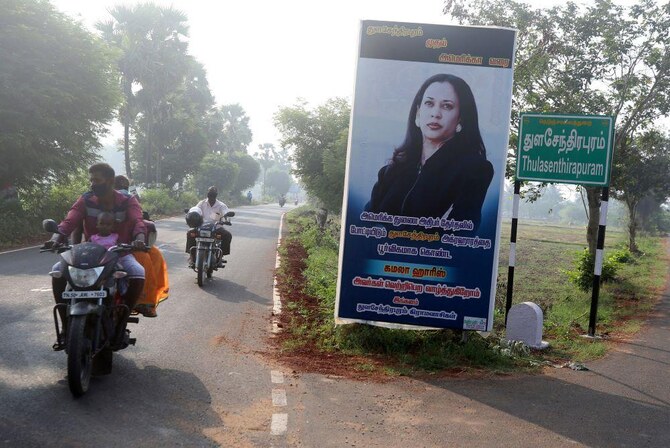
CHICAGO: The daughter of a Jamaican father and Indian mother, both immigrants, Kamala Harris reflects the United States’ changing demographics.
When she steps onto the stage Thursday evening in Chicago to accept the Democratic Party’s nomination as their presidential candidate, she will represent the country’s fastest growing racial category.
Some 42 million Americans now identify as multiracial, or 13 percent of the country, according to the US Census Bureau. That is up from 2 percent in 2000 when the census first allowed people to select multiple races.
America has long been a self-styled “melting pot” of people who trace their origins around the world, but in practice some states legally segregated citizens by race until the civil rights laws of the 1960s and laws prohibiting interracial marriage were not overturned until 1967.
Social change since, though, has been rapid. Barack Obama was elected as the country’s first Black president in 2008, and Harris would be the first Black woman and South Asian if elected in November.
“We’re living in a situation 50 years later where we could be looking at our second mixed-race president, and it’s beautiful,” said Svante Myrick, president of People for the American Way, an advocacy group, whose father was Black and his mother white.
America’s future will look even more diverse. The vast majority of multiracial people are younger than 44 and a third are still children. The trend has been met by confusion, upset and worse from some of the US’s shrinking white majority. Republican presidential candidate Donald Trump drew groans at a gathering of Black journalists last month when he falsely portrayed Harris as pivoting from Indian to Black.
“I don’t know, is she Indian or is she Black,” Trump said. “But you know what, I respect either one.”
Harris has long identified with both her parents’ ancestry. In Trump’s remarks, some multiracial people saw echoes of their own experience of being asked to choose one or the other.
Harris’ upbringing makes her a better leader for America, Democrats in Chicago said.
“When you have individuals who carry multiple experiences in the same person, that’s an asset,” said Representative Maxwell Frost, who is Lebanese, Puerto Rican and Haitian, speaking at a Politico event on the sidelines of the convention. “That enhances her ability to legislate and advocate” on behalf of a broad range of Americans. The Harris campaign did not respond to a request for comment, nor did spokespeople for Trump. As the US becomes more diverse and multicultural, white nationalist groups continue to thrive online, pushing conspiracy theories such as the “The Great Replacement,” while some Republican lawmakers have focused on banning books and canceling classes focused on racial history.
Thousands of racial hate crimes are reported yearly, with 232 aimed at people of multiple races in 2022, the most recent year for which FBI data is available.
“Unfortunately, we’re really into a period of backlash,” said Matthew Belmont, a Dartmouth College history professor who has studied the demographic trend, despite the 2020 election of Harris as vice president and her administration’s elevation of racial justice priorities.
“So much of that was push back that really emerged in response to the Obama presidency and it was really stoked among people who are scared by the demographic trends in the United States.”
Tara Betrayer, an Afro-Latina and white conservative co-founder of political action committee the Seneca Project, said she was once attracted to the Republican Party in part because of its emphasis on color-blind policies.
“Do Democrats take it too far at times with the racial identity politics? Well, yeah,” she said. Now an independent, Betrayer said some of the Republican Party’s recent rhetoric on issues including illegal migration carried undercurrents of racism. Republicans reject those criticisms, saying their focus on border controls are aimed at securing the country for all Americans.
“This is really their last gasp at trying to stop the country from evolving, and I think they’re missing out on something that’s beautiful,” Betrayer said.

Kamala Harris’ multiracial roots reflect changing US demographics
Short Url
https://arab.news/6brmz
Kamala Harris’ multiracial roots reflect changing US demographics
- 42 million Americans identify as multiracial, or 13 percent, up from 2 percent in 2000
- Harris would be the first Black woman and South Asian if elected in November
Afghan polio survivor’s sock factory provides hope by employing disabled workers
HERAT: In a tiny room in the center of Herat, Afghanistan’s westernmost city, Shahabuddin uses his hands to propel himself along the floor to a freshly-made pile of socks waiting to be sorted and packaged.
A double amputee since a roadside bomb took both his legs a decade ago, when Afghanistan was mired in conflict between US-led forces and Taliban insurgents, the 36-year-old father of four had struggled to find work. Unemployed for the last decade, he had been forced to rely on relatives for his family’s survival.
But a new sock production workshop in Herat employing only disabled workers has given him new hope.
“I became disabled due to the explosion. Both my legs were amputated,” Shahabuddin, who like many Afghans goes by only one name, said during a brief pause in his work in early December. “Now I work here in a sock factory, and I am very happy that I have been given a job here.”
The workshop is the brainchild of Mohammad Amiri, 35, a former grocery shop worker who started the business about a month ago. Amiri, himself disabled by childhood polio, wanted to create jobs and help provide income for other people with disabilities, particularly as many of them were injured during the conflict and have no other means of income.
He teamed up with another polio survivor to start the sock factory with a workforce of men disabled either through traumatic injuries or because of congenital issues or other reasons. They make four types of socks: long and short, for winter and summer.
“The factory, which is funded and supported by people with disabilities, began operations last month and currently employs around 50 people with disabilities,” Amiri said. “They are busy in the production, packaging and sale of socks in the city.”
A combination of decades of conflict, a weak health care system and struggling economy have contributed to high levels of disability in Afghanistan. Data from a 2019 Model Disability Survey conducted by The Asia Foundation nonprofit organization indicates that nearly 25 percent of adults live with a mild disability, while 40 percent have moderate and about 14 percent have severe disabilities.
“These figures compel us to act with greater urgency and commitment,” the UN Assistance Mission in Afghanistan said in a statement released on the International Day of Persons with Disabilities on Dec. 3, quoting the same figures. “Persons with disabilities must not be treated as an afterthought; they must be fully integrated into every stage of planning, decision-making, and service delivery.”
Meanwhile, Afghanistan is one of only two countries — along with neighboring Pakistan — where wild poliovirus remains endemic. The infectious disease can cause flu-like symptoms, but can also cause severe reactions, including paralysis, disability and death.
The Afghan Ministry of Martyrs and Disabled Affairs says 189,635 disabled people across the country are registered and receiving financial support from the government.
Amiri said his business faces serious competition from cheap imports of textiles, and expressed the hope that the government would stop imports from abroad. He has hopes of getting a contract to provide the Afghan security forces with socks, and wants to expand his workforce to 2,000 people.
His current employees include former refugees who have recently returned to Afghanistan after spending years abroad.
One such man is Mohammad Arif Jafari, 40, an economics graduate and polio survivor who lived in Iran for years. Returning to Afghanistan has been hard, he said.
“I suffered a lot due to unemployment. But fortunately, now I produce several types of socks,” he said while selling his wares from a stall on the streets of Herat. “I am happy that I am working here and earning an income.”
A double amputee since a roadside bomb took both his legs a decade ago, when Afghanistan was mired in conflict between US-led forces and Taliban insurgents, the 36-year-old father of four had struggled to find work. Unemployed for the last decade, he had been forced to rely on relatives for his family’s survival.
But a new sock production workshop in Herat employing only disabled workers has given him new hope.
“I became disabled due to the explosion. Both my legs were amputated,” Shahabuddin, who like many Afghans goes by only one name, said during a brief pause in his work in early December. “Now I work here in a sock factory, and I am very happy that I have been given a job here.”
The workshop is the brainchild of Mohammad Amiri, 35, a former grocery shop worker who started the business about a month ago. Amiri, himself disabled by childhood polio, wanted to create jobs and help provide income for other people with disabilities, particularly as many of them were injured during the conflict and have no other means of income.
He teamed up with another polio survivor to start the sock factory with a workforce of men disabled either through traumatic injuries or because of congenital issues or other reasons. They make four types of socks: long and short, for winter and summer.
“The factory, which is funded and supported by people with disabilities, began operations last month and currently employs around 50 people with disabilities,” Amiri said. “They are busy in the production, packaging and sale of socks in the city.”
A combination of decades of conflict, a weak health care system and struggling economy have contributed to high levels of disability in Afghanistan. Data from a 2019 Model Disability Survey conducted by The Asia Foundation nonprofit organization indicates that nearly 25 percent of adults live with a mild disability, while 40 percent have moderate and about 14 percent have severe disabilities.
“These figures compel us to act with greater urgency and commitment,” the UN Assistance Mission in Afghanistan said in a statement released on the International Day of Persons with Disabilities on Dec. 3, quoting the same figures. “Persons with disabilities must not be treated as an afterthought; they must be fully integrated into every stage of planning, decision-making, and service delivery.”
Meanwhile, Afghanistan is one of only two countries — along with neighboring Pakistan — where wild poliovirus remains endemic. The infectious disease can cause flu-like symptoms, but can also cause severe reactions, including paralysis, disability and death.
The Afghan Ministry of Martyrs and Disabled Affairs says 189,635 disabled people across the country are registered and receiving financial support from the government.
Amiri said his business faces serious competition from cheap imports of textiles, and expressed the hope that the government would stop imports from abroad. He has hopes of getting a contract to provide the Afghan security forces with socks, and wants to expand his workforce to 2,000 people.
His current employees include former refugees who have recently returned to Afghanistan after spending years abroad.
One such man is Mohammad Arif Jafari, 40, an economics graduate and polio survivor who lived in Iran for years. Returning to Afghanistan has been hard, he said.
“I suffered a lot due to unemployment. But fortunately, now I produce several types of socks,” he said while selling his wares from a stall on the streets of Herat. “I am happy that I am working here and earning an income.”
© 2025 SAUDI RESEARCH & PUBLISHING COMPANY, All Rights Reserved And subject to Terms of Use Agreement.


