Saudi Arabia, Uruguay boost bilateral trade with new joint business council

1 / 3
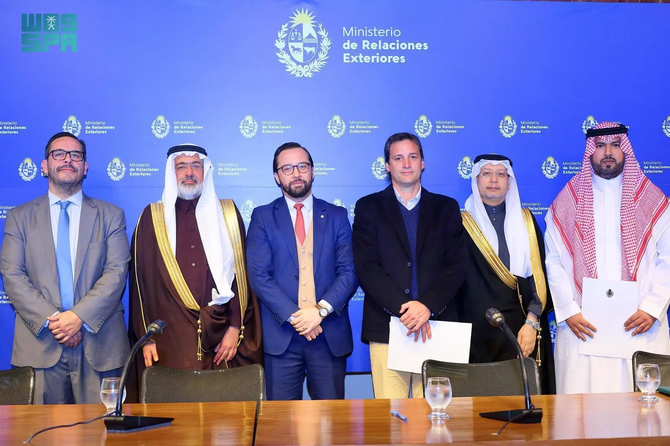
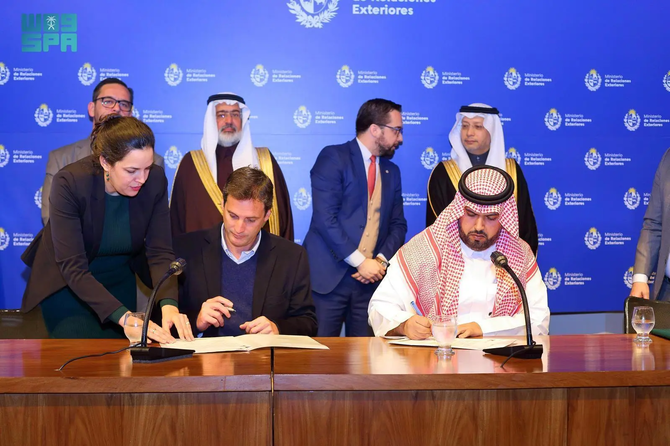
The Saudi Chambers and the Uruguay Exporters Association signed an agreement to establish a joint business council. SPA
2 / 3
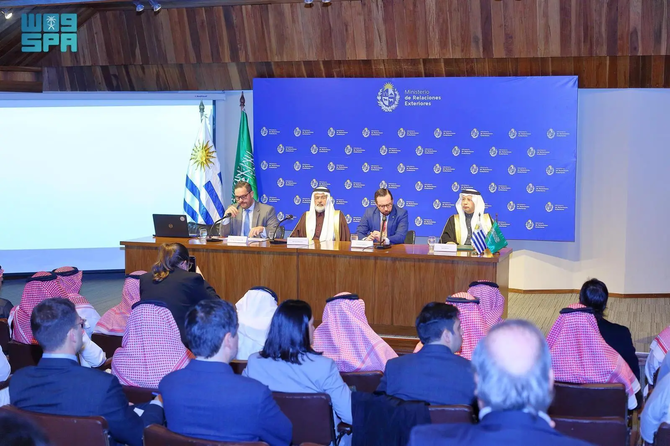
The Saudi Chambers and the Uruguay Exporters Association signed an agreement to establish a joint business council. SPA
3 / 3
The Saudi Chambers and the Uruguay Exporters Association signed an agreement to establish a joint business council. SPA
Short Url
Updated 20 August 2024
Follow

Saudi Arabia, Uruguay boost bilateral trade with new joint business council

  • The inaugural meeting of the Saudi-Uruguayan joint committee concluded with the deal
  • Uruguay’s economy is expected to grow 3.4% this year and 3% next year

RIYADH: Trade relations between Saudi Arabia and Uruguay are poised to advance following the signing of a memorandum of understanding to establish a joint business council. 

The inaugural meeting of the Saudi-Uruguayan joint committee, held at Uruguay’s Ministry of Foreign Affairs in Montevideo, concluded with the deal, according to the Saudi Press Agency. 

The Saudi delegation was led by Ahmed Al-Khamshi, undersecretary of the Ministry of Environment, Water and Agriculture, while Deputy Foreign Minister Nicolas Albertoni headed the Uruguayan side. 

Uruguay, a country of just 3.5 million people sandwiched between giants Argentina and Brazil, is promoting investment options in a number of areas, with emphasis on agribusiness and renewable energy, and its capacity to be a new breadbasket for the Middle East and North Africa. 

Despite its size, Uruguay is the world’s ninth-largest exporter of rice, according to the US Department of Agriculture. It is the 17th-largest beef-producing country and the fourth-largest dairy exporter. 

While beef is certainly among Uruguay’s list of potential products, dairy could be the game-changer of the country’s trade relations with Saudi Arabia. 

Uruguay’s economy is expected to grow 3.4 percent this year and 3 percent next year, according to the International Monetary Fund. 

The Washington-based lender said the recovery of agricultural exports, increased cellulose production, the easing of financial conditions, robust private consumption, and a recovery in real wages are expected to support economic growth. 

In August 2023, a 60-member delegation from Saudi Arabia, led by Investment Minister Khalid Al-Falih, attended an investment forum in Montevideo.  

The visit underscored Saudi Arabia’s increasing focus on Uruguay as a key investment destination and was the third high-profile delegation visit from the Kingdom to Uruguay in the past 18 months.

The previous visit, which occurred just a month before, was headed by Foreign Affairs Minister Adel Al-Jubeir. This pattern of frequent high-level visits reflects the strengthening ties and growing economic interest between the two nations. 

According to the Observatory of Economic Complexity, Saudi Arabia exported $30.5 million worth of goods to Uruguay in 2022. This marked an increase of $10.5 million from 2017. The key Saudi exports to Uruguay included mixed mineral or chemical fertilizers and ethylene polymers. 

In the same year, Uruguay exported $17.3 million worth of goods to Saudi Arabia. The primary products in these exports were concentrated milk, butter, and frozen bovine meat.

This trade exchange highlights the growing economic relationship between the two countries, with Saudi Arabia focusing on industrial and chemical products, while Uruguay exports dairy and meat products. 


Saudi investment hits 32% of GDP, non-oil fixed capital reaches 40%, minister says

Updated 05 January 2026
Follow

Saudi investment hits 32% of GDP, non-oil fixed capital reaches 40%, minister says

RIYADH: Saudi Arabia’s investment now accounts for 32 percent of gross domestic product, with non-oil fixed capital at 40 percent, according to the minister responsible for portfolio.

Speaking during his visit to the Shoura Council, Khalid Al-Falih said that foreign direct investment is expected to grow fivefold, signaling strong Vision 2030 progress.

“Regarding cumulative performance, the Kingdom has exceeded all expectations, achieving high levels of investment,” Al-Falih said, according to a video posted on Al-Ekhbariya’s X account focused on economic matters.

The minister added: “Today, investment accounts for 32 percent of the total GDP. In terms of non-oil GDP, fixed capital represents 40 percent, compared with 41 percent in China, the highest globally.”

If we take the non-oil GDP, he said, fixed capital will make 40 percent. “China is the largest globally with 41 percent. So, we will rank second if we compare it to the non-oil economy and fourth when measured against total GDP,” Al-Falih said.

He emphasized that the Kingdom offers an investment-attractive environment, noting that when focusing on foreign direct investment rather than overall investment, Saudi Arabia ranks among the world’s highest.

The minister of investment added that FDI is expected to grow fivefold by the end of 2025, though these data require confirmation, stressing that this is “a big indicator for the success of Saudi Vision 2030.”

During his address to the session, Al-Falih emphasized that Saudi Vision 2030 prioritizes economic diversification and reducing dependence on oil, through boosting the private sector’s contribution to inclusive economic development, supporting national sectoral priorities, and driving growth in the Kingdom’s GDP.

He highlighted key initiatives enabling the private sector, including the establishment of the Ministry of Investment and the Saudi Investment Promotion Authority, the launch of the “Shareek” program, the development of the National Investment Strategy, and linking all stakeholders in the investment ecosystem.

“The Cabinet’s adoption of the National Investment Strategy, launched by Crown Prince in 2021 and implemented in 2022 as a comprehensive national framework, has played a major role in positioning investment as a driver of economic growth,” he said.

Al-Falih revealed that the ministry has identified more than 2,000 investment opportunities worth over SR1 trillion ($267 billion), noting that 346 of these opportunities have been converted into closed deals valued at over SR231 billion through the “Invest Saudi” platform.

He also highlighted the success of the regional headquarters attraction program, with licenses issued to more than 700 global companies by the end of 2025, surpassing the 2030 target of 500 companies, across diverse sectors that reinforce Saudi Arabia’s role as a regional business hub.

The minister revealed that active investment licenses have grown tenfold, rising from 6,000 in 2019 to 62,000 by the end of 2025, highlighting the role of companies in creating over one million jobs, including numerous positions for Saudi nationals.

Al-Falih noted the Kingdom’s success in attracting 20 of the world’s top 30 banks, as part of efforts to strengthen the presence of leading asset managers and international banks in support of the Saudi banking sector.

He also discussed reforms to enhance the business environment, such as the Civil Transactions Law, Companies Law, and the updated Investment Law issued in mid-2024, which contributed to Saudi Arabia moving up 15 places in the global competitiveness ranking.

The minister also announced the update of the National Investment Strategy in 2025, focusing on quality, productivity, and directing investments toward sectors with the highest economic impact, while developing financing solutions for SMEs.