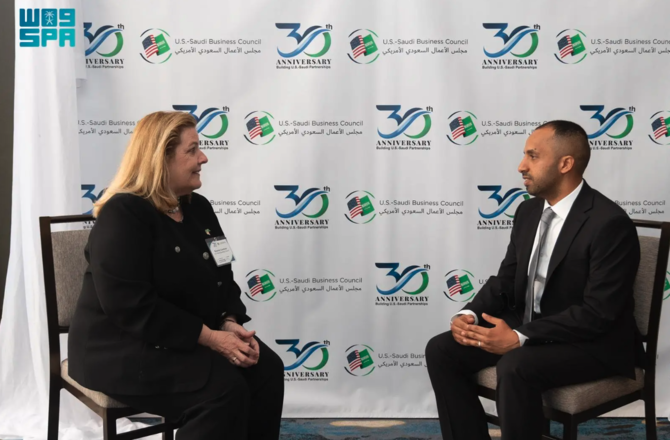

RIYADH: US-based artificial intelligence, cybersecurity, and renewable energy firms are among those set to benefit from changes to Saudi Arabia’s foreign investment rules, according to a business council chief.
In an interview with the Saudi Press Agency, Susan Lindeman, interim CEO of the US-Saudi body, also noted that sports and tourism represent promising investment opportunities in the Kingdom for North American companies.
Lindeman set out that US firms have expertise in these areas, and the recent change to the law means there is a greater chance of these companies investing in Saudi Arabia.
Earlier in August, Saudi Arabia announced new legislation to promote fair competition and ensure equal treatment for both domestic and international investors, as well as providing access to advanced dispute resolution mechanisms through the Saudi Arbitration Center and other affiliated entities.
Lindeman lauded the new system for advancing the council’s mission to ease business between the Kingdom and the US, highlighting its role in fostering a more transparent and accessible investment climate.
These fields support Saudi Arabia’s move in support of the rising demand for AI, which is set to play an increasingly important role in driving the Kingdom’s economy in the future and helping the nation achieve its net-zero targets by 2060.
Other fields that Lindeman mentioned include biotechnology and advanced petrochemicals.
She also explained that the system opens new doors for cooperation between Saudi and US companies.
This, in turn, boosts opportunities and addresses challenges between the two sides in investment areas, as well as the strategies adopted by the council to strengthen commercial ties between the countries.
The interim CEO highlighted a key opportunity to strengthen economic collaboration between Saudi Arabia and the US through increased investment and expanded joint projects involving both the public and private sectors.
She emphasized the US-Saudi Business Council’s dedication to fostering these partnerships by offering strategic consulting, organizing trade missions, and hosting business forums.
Lindeman also noted that the council has organized over 60 development missions and more than 500 seminars and networking events, effectively connecting tens of thousands of companies.
The council offers crucial market insights and consulting services to help businesses navigate both countries’ economic and cultural landscapes.
Acting as a bridge for trade communication and collaboration, the council facilitates partnerships and explores new opportunities through business forums, trade missions, and conferences.
The changes to Saudi Arabia’s business funding system are a key element of the National Investment Strategy under the Kingdom’s Vision 2030 economic diversification plan.
“The law reaffirms Saudi Arabia’s commitment to creating a welcoming and secure environment for investors, driving economic growth, and enhancing the Kingdom’s position as a premier global investment destination,” Saudi Investment Minister Khalid Al-Falih said earlier in August when the investment law was announced.
He added that the policy direction outlined in Vision 2030 allows investors to “invest with certainty” at a time when many other markets are experiencing “considerable volatility.”
Saudi Arabia’s policies in this area have already shown significant results, with foreign direct investment inflows increasing by 158 percent over a six-year period – from $7.46 billion in 2017 to $19.3 billion in 2023.
On August 19, Saudi Arabia’s Assistant Minister of Investment Ibrahim Al-Mubarak said the Kingdom is targeting $100 billion in FDI by 2030.
“We have SR20 billion ($5.33 billion) in FDI last year, which is a 150 percent increase from 2016. Different studies have shown that 60 percent of our FDI comes from existing investors,” Al-Mubarak said.
He added: “I think it is also very important why we are looking at the new investment law and we are broadening the scope for all investors, both domestic and international.”