

Oil Updates – prices edge down on easing geopolitical risks, weak China demand

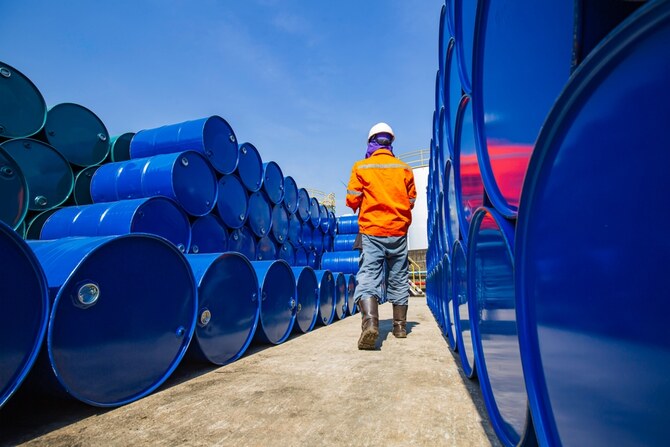
Brent crude was down 67 cents, or 0.86 percent, at $76.99 a barrel, as of 9:00 a.m. Saudi time. Shutterstock
Short Url
Updated 20 August 2024
Follow

Oil Updates – prices edge down on easing geopolitical risks, weak China demand

  • The more actively traded second month contract was last down 63 cents or 0.86% at $73.03 a barrel
  • Brent had fallen about 2.5% on Monday, while WTI eased 3%

SINGAPORE: Oil prices edged lower on Tuesday as Israel accepted a proposal to tackle disagreements blocking a ceasefire deal in Gaza, helping ease concerns over supply disruptions in the Middle East, according to Reuters.

Brent crude was down 67 cents, or 0.86 percent, at $76.99 a barrel, as of 9:00 a.m. Saudi time. Front month US West Texas Intermediate crude futures, which expire on Tuesday, were at $73.75 a barrel, easing 62 cents, or 0.8 percent. The more actively traded second month contract was last down 63 cents or 0.86 percent at $73.03 a barrel.

Brent had fallen about 2.5 percent on Monday, while WTI eased 3 percent.

“Prices seem to find some headwinds from geopolitical developments in the Middle East and China’s demand outlook,” said Yeap Jun Rong, market strategist at IG, referring to weak Chinese economic data, which cast doubts on the country’s oil demand prospects.

“A ceasefire deal in Gaza now seems more likely than not, which saw market participants pricing out the risks of geopolitical tensions on oil supplies disruption,” he added.

US Secretary of State Antony Blinken said on Monday that Israeli Prime Minister Benjamin Netanyahu had accepted a “bridging proposal” presented by Washington to tackle disagreements blocking a ceasefire deal in Gaza, and urged Hamas to do the same.

Also easing supply concerns, production at Libya’s Sharara oilfield has risen to about 85,000 barrels per day in a move aimed at supplying the Zawia oil refinery, two engineers working at the field told Reuters on Monday.

Libya’s National Oil Corporation had declared force majeure on oil exports from the field on Aug. 7 after a blockade by protesters hit production at the 300,000-bpd field.

In the US, crude stockpiles were expected to have fallen by 2.9 million barrels last week, a preliminary Reuters poll showed on Monday.

On the demand side, worries about China’s economic problems pressured oil prices. After a dismal second quarter, the world’s second-largest economy lost momentum further in July as new home prices fell at the fastest pace in nine years, industrial output slowed, export and investment growth dipped and unemployment rose.

“Demand concerns centered around China continue to linger. Recent data releases reinforce the view of weaker Chinese oil demand,” ING analysts said in a note to clients.

“Trade and industrial output numbers last week suggested that apparent oil demand continued to trend lower in July. These worries mean that speculators continue to be hesitant about jumping into the market.”

Investors also awaited indication of the US Federal Reserve’s plans for the next interest rate decision.

The Fed will cut interest rates by 25 basis points at each of the remaining three meetings of 2024, according to a slim majority of economists polled by Reuters who said a recession is unlikely.

Rate cuts reduce borrowing costs and could boost oil demand in the world’s top oil-consuming country.


Major airlines suspend, reroute flights amid US-Israel strikes on Iran

Updated 28 February 2026
Follow

Major airlines suspend, reroute flights amid US-Israel strikes on Iran

  • Saudia says decision taken in line with aviation safety and security standards
  • Emirates said it temporarily suspended it's operations out of Dubai

RIYADH: Major international airlines across the Middle East and South Asia have suspended, canceled or rerouted flights following ongoing US-Israel attacks on Iran and the resulting airspace closures, according to official statements issued via X.

Saudia said in an official statement that it had canceled a number of flights due to developments in the region and the closure of airspace.

The airline said the decision was taken in line with aviation safety and security standards, noting that its Emergency Coordination Center is closely monitoring developments with relevant authorities.

Saudia urged passengers to verify the status of their flights before heading to the airport and said guests would be notified of updates through the contact details associated with their bookings.

The carrier added that further information would be announced in a subsequent statement if available.

Air Arabia said its flights were experiencing cancellations, delays or rerouting as a result of the evolving situation and airspace closures.

The airline advised passengers to check the status of their flights before traveling to the airport by visiting its website or contacting its call center.

Customers booked on affected flights will be notified directly, the airline said, adding that further updates would be provided as the situation develops.

Air India announced a broader suspension, stating that “in view of the developing situation in parts of the Middle East, all Air India flights to all destinations in the Middle East have been suspended.”

The airline said it remains committed to maintaining the highest standards of safety for passengers and crew and will continue to assess the safety and security environment for flight operations, adjusting services proactively as required.

Air India said its teams would extend necessary support to passengers and advised customers to check flight status online or contact its 24/7 call center for assistance.  

All flight operations at Dubai International and Dubai World Central – Al Maktoum International are suspended until further notice, according to a post by Dubai Media Office on X.

Dubai-based Emirates reported that regional airspace closures had caused disruption to several of its flights and that the airline had temporarily suspended its operations from its hub Dubai.

The airline said it is actively monitoring the situation, engaging with relevant authorities and adjusting operations in line with the latest developments. 

The carrier apologized to affected customers and said it is assisting them with rebooking, refunds or alternative travel arrangements, reiterating that the safety and security of passengers and crew remain its highest priority.  

Qatar Airways confirmed a temporary suspension of flights to and from Doha due to the closure of Qatari airspace.

The airline said it is working closely with government stakeholders and relevant authorities to support impacted passengers and will resume operations once the airspace reopens.

It warned that delays are anticipated when usual operations resume and said additional ground staff have been deployed at Hamad International Airport and other key airports to assist passengers.  

Meanwhile, Al Jazeera reported that British Airways had canceled flights to Tel Aviv and Bahrain, adding to the list of carriers adjusting operations.

Across their statements, airlines consistently cited airspace closures and safety considerations as the primary reasons for suspensions and disruptions, while urging passengers to monitor official channels for updates as the situation continues to evolve.