ISLAMABAD: The Pakistan Boat Rally and Fishing Association (PBRFA) has announced the rare sighting this month of an endangered whale shark by a member of the body during a diving trip at Charna Island in the Arabian Sea.
Whale sharks are the biggest fish in the world and possibly the biggest to have ever existed, according to the International Fund for Animal Welfare. They can be found in warm tropical waters around the globe and cruise along the ocean surface to find food. The biggest whale shark on record was 19 meters long and weighed more than 15 tons. Despite their terrifying size, they are called the sea’s gentle giants. As filter-feeders, whale sharks don’t hunt or stalk, and their interactions with humans are peaceful and curious.
The markings on a whale shark’s body make them instantly recognizable. They have dark skin with light horizontal and vertical lines that create a chequered pattern across their bodies. They also have hundreds of lightly colored spots covering the darker areas of their skin, while their bellies are white. As filter feeders, whale sharks eat by opening their huge mouths, swallowing water, and passively filtering small creatures with their mesh-like gills, which they then swallow.
“Manan Sheikh during a diving trip at Charna Island … along with friends Faazil Tapal, Rayan Maker, Arslan Khan, and Mikaeel Ali Habib, had the unforgettable experience of swimming alongside this gentle giant for nearly 20 minutes,” PBRFA said in a statement, announcing the sighting of the whale shark.
“With only an estimated 150,000 whale sharks left worldwide, this encounter highlights the importance of marine conservation.”
The association said the depth around Charna Island, located near Mubarak Goth, Kiamari Town in the port city of Karachi, varied between 20 feet and 60 feet, making it a “rich area” for marine life.
“Whale sharks and whales often visit this region in search of food, especially during the winter or after the monsoon season, when minerals from the mountains are washed into the sea by the Hub River, enriching the waters,” PBRFA said.
Whale sharks, whose scientific name is rhincodon typus, are endangered and listed as such on the International Union for Conservation of Nature Red List of Endangered Species. Their global population has decreased by more than 50 percent over the past 75 years due to a number of threats, including fishing, tourism and marine pollution, such as plastics and oil, finning, and climate change.
Not a lot is known about the lives of whale sharks because they are difficult to track and study, both when alive and when deceased because whale sharks have no bones. Instead, their skeletons are made of bendy cartilage which doesn’t fossilize well. As a result, not much is known about their mating rituals, life span or social tendencies.


Endangered whale shark sighted in Pakistan’s Arabian Sea Churna Island

https://arab.news/42ne2
Endangered whale shark sighted in Pakistan’s Arabian Sea Churna Island
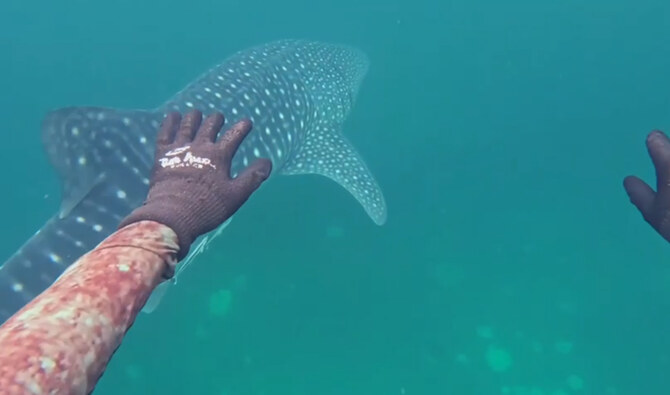
- Whale sharks are listed on International Union for Conservation of Nature Red List of Endangered Species
- Whale shark population has decreased by over 50% in 75 years due to fishing, tourism and marine pollution

Pakistan, Malaysia discuss halal food, energy and tourism to boost cooperation
- Bilateral trade between both countries stands at about $1.4 billion a year
- In Oct., both countries announced a new $200 million halal meat trade quota
ISLAMABAD: Pakistan and Malaysian officials have held talks on halal food, green energy and tourism sectors as part of renewed efforts to expand ties between the two Muslim-majority nations, the Pakistani High Commission in Malaysia on Monday.
The discussions took place during a meeting between Pakistan’s High Commissioner to Malaysia, Syed Ahsan Raza Shah and Tun Pehin Sri Dr. Wan Junaidi Tuanku Jaafar, governor of Malaysia’s Sarawak state.
Bilateral trade between the two countries stands at about $1.4 billion a year, according to official data from both governments. In Oct., both countries announced a new $200 million halal meat trade quota.
“Constructive talks on Pakistan-Malaysia ties in halal [food], palm oil, green energy, rice, labor, tourism, culture & sustainable development,” the Pakistani High Commission in Malaysia said on X.
Malaysia’s exports to Pakistan are led by palm oil and other vegetable fats, followed by machinery, rubber products and organic chemicals. Pakistan’s main exports to Malaysia include rice, textiles, seafood and minerals.
The two countries have also traded under the Malaysia-Pakistan Closer Economic Partnership Agreement since 2008, which provides preferential market access for goods and services.
Pakistan has been rapidly growing its green energy, halal food, and tourism sectors. Its halal food industry is attracting global buyers with Shariah-compliant products, while tourism is leveraging the country’s natural beauty, heritage sites and cultural attractions to draw international visitors.


