

Major Pakistani cities on alert as torrential rains threaten urban floods in next 24 hours

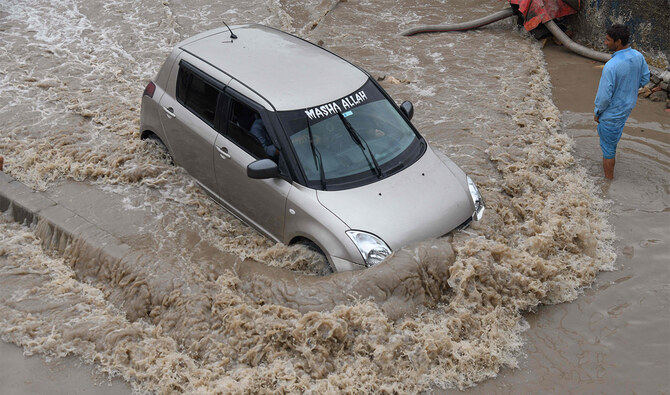
Commuters drive through a flooded street after heavy monsoon rains in Larkana in Sindh province on August 18, 2024. (AFP)
Short Url
Updated 18 August 2024
Follow

Major Pakistani cities on alert as torrential rains threaten urban floods in next 24 hours

  • Pakistan is recognized as one of the most vulnerable countries to climate change
  • Monsoon downpours have killed at least 180 people across Pakistan since July 1

ISLAMABAD: Pakistan’s National Disaster Management Authority (NDMA) has put administration of all major cities on alert as heavy monsoon showers are likely to cause urban flooding in the next 24 hours, Pakistani state media reported on Sunday.

The NDMA’s National Emergencies Operation Center anticipates more monsoon rains from Sunday night till Monday with occasional gaps, the state-run APP news agency reported.

Torrential rains may trigger flash floods in low-lying areas of Islamabad, Rawalpindi, Gujranwala, Lahore, Sheikhupura, Kasur, Sialkot, Sargodha, Faisalabad, Nowshera and Peshawar.

“Residents of these areas are advised to remain vigilant and follow guidance from local authorities,” the report read. “The NDMA has issued instructions to all relevant departments to take necessary precautions to mitigate the possible effects of flooding and extreme weather.”

In the southern Sindh province, authorities have warned of flash floods in Jacobabad, Qambar Shahdadkot, Jamshoro and Dadu districts.

Torrential monsoon rains have killed at least 180 people across Pakistan, including 64 in the Khyber Pakhtunkhwa province, since July 1, according to disaster management authorities.

Pakistan is recognized as one of the most vulnerable countries to climate change effects in the world. This year, the South Asian country recorded its “wettest April since 1961,” with 59.3 millimeters rainfall and at least 144 deaths in thunderstorms and house collapses, according to authorities.

Pakistan’s President Asif Ali Zardari on Sunday stressed the need for citizens to actively participate in a national tree plantation campaign to battle climate challenges, according to an APP report.

Zardari highlighted that only 5 percent of Pakistan’s total land area is covered by forests, saying that they were under severe pressure due to increasing demand for wood and other land uses.

“Through this Monsoon Tree Plantation Campaign, we have the opportunity to make a lasting impact on our environment and secure a greener, healthier future for our younger generation,”

the president was quoted as saying.

In 2022, unusually heavy rains triggered flash floods in many parts of the country, killing over 1,700 people, inflicting losses of around $30 billion, and affecting at least 30 million people.


Pakistan launches final nationwide polio drive for 2025 amid rise in global cases

Updated 11 sec ago
Follow

Pakistan launches final nationwide polio drive for 2025 amid rise in global cases

  • Global polio tracking data shows Pakistan accounted for 30 of the world’s 39 cases in 2025, with remainder in Afghanistan
  • Health authorities urge parents to cooperate with vaccination teams and ensure all children under five receive polio drops

ISLAMABAD: Pakistan will launch its final nationwide polio vaccination campaign for 2025 from tomorrow, aiming to immunize more than 45 million children under the age of five, health authorities said on Sunday, as the country remains at the center of global efforts to eradicate the disease.

Global polio tracking data shows that 30 of the 39 confirmed wild poliovirus type 1 (WPV1) cases worldwide 2025 were reported in Pakistan, with the remainder in neighboring Afghanistan.

Pakistan recorded 74 polio cases in 2024, a sharp increase from six cases in 2023 and just one case in 2021, highlighting the volatility of eradication efforts in a country where misinformation, vaccine hesitancy and security issues have repeatedly disrupted progress.

“The final national polio campaign of 2025 will formally begin across the country from tomorrow,” Pakistan’s National Emergency Operations Center (NEOC) said in a statement.

“During the campaign, polio drops will be administered to more than 45 million children nationwide,” it said, adding that the seven-day drive would run from Dec. 15 to Dec. 21.

The NEOC said more than 400,000 male and female polio workers would take part in the campaign, with vaccination targets including over 23 million children in Punjab, 10.6 million in Sindh, 7.2 million in Khyber Pakhtunkhwa, 2.6 million in Balochistan and smaller numbers in Islamabad, Gilgit-Baltistan and Azad Jammu and Kashmir.

“Protecting children from polio is a shared national responsibility,” the NEOC said. “Parents must fully cooperate with polio workers to secure the future of the nation.”

It urged families to ensure that all children under five years of age receive the required two drops of the vaccine during the campaign.

Pakistan has drastically reduced polio prevalence since the 1990s, when annual cases exceeded 20,000.

By 2018, the number had fallen to eight. But health authorities warn that without consistent access to children — particularly in high-risk and underserved regions — eradication will remain out of reach.

Violence has also hampered the program. Polio teams and their security escorts have frequently come under attack from militants in parts of northwestern Khyber Pakhtunkhwa and southwestern Balochistan.

Officials say continued security threats, along with natural disasters such as recent flooding, remain major obstacles to reaching every child.