Serbian police kill armed man in arrest shootout

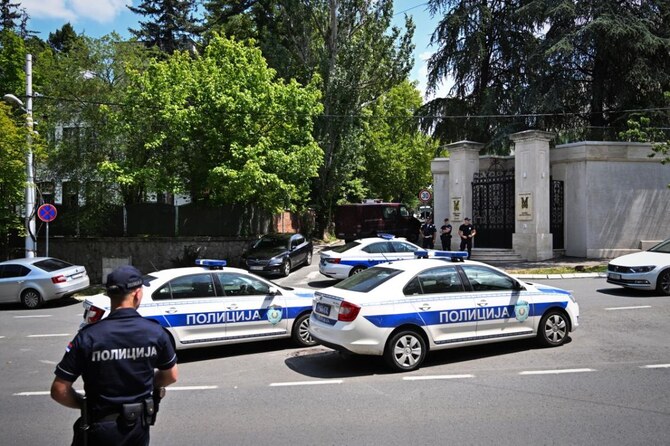
Police cars and officers are stationed on a street around the Israeli embassy in Belgrade, on June 29, 2024. (AFP)
Short Url
Updated 18 August 2024
Follow

Serbian police kill armed man in arrest shootout

BELGRADE: A man has been shot dead by Serbian police, the interior minister said Sunday, after being connected with the attacker behind a crossbow shooting at the Israeli embassy in Belgrade in June.
Interior minister Ivica Dacic said the man fired shots toward the police near the southern city of Novi Pazar late Saturday and refused to surrender.
“During the arrest, he resisted, fired three to four shots at the police, and members of the Special Anti-Terrorist Unit neutralized him,” Dacic told local media.
He added that the man had previously been convicted and jailed for terrorist offenses.
The police operation took place in the village of Hotkovo, near Novi Pazar — a historical and political center of Serbia’s Bosniak Muslim minority.
Police said the man was wanted in connection with another man killed by police in Belgrade on June 29th, after shooting a police officer in the neck with a crossbow outside the Israeli embassy.
The attack in the Serbian capital was characterised as a “terrorist act” by officials, who described the assailant as a Serbian convert to Islam.
The man killed Saturday night was the landlord of the June attacker, police said, who had lived in his apartment in Novi Pazar prior to his attack at the embassy.
He had been on the run since the June attack, the police minister stated.
Local media describe the man killed in Novi Pazar as a “well-known follower” of the Wahhabi movement — a purist form of Islam that dominates in Saudi Arabia.
The interior ministry confirmed that he was arrested in 2007, and sentenced to 13.5 years in prison as part of a group that engaged in an armed conflict with police officers in the village of Trnava, near Novi Pazar.
At that time, 14 of his associates were also arrested.
They were charged with planning terrorist attacks in Belgrade and Novi Pazar.


UK interior minister insists asylum reforms ‘fair’ amid blowback

Updated 8 sec ago
Follow

UK interior minister insists asylum reforms ‘fair’ amid blowback

  • Mahmood argued in a speech that she was “restoring order and control” to Britain’s borders
  • Amnesty International called the latest measure a “punitive blow”

LONDON: Britain’s interior minister doubled down Thursday on her tough stance on immigration despite criticism from charities and unease within the ruling Labour party that it is shedding left-wing voters.
Shabana Mahmood announced that asylum seekers who break the law or work illegally will be thrown out of government-funded accommodation and lose their support payments.
The policy forms part of a major overhaul of migration rules announced late last year and modelled on Denmark’s strict asylum system that aims to slash irregular migration to the UK.
Mahmood argued in a speech that she was “restoring order and control” to Britain’s borders and that her overhaul of the asylum was “firm but fair,” adding she would open new and safe legal routes.
But Amnesty International called the latest measure a “punitive blow” that “risks forcing people into destitution, homelessness and exploitation while they wait for their claims to be decided.”
Mahmood’s reforms are widely seen as an attempt to stem support for the hard-right Reform UK party, led by anti-immigrant firebrand Nigel Farage.
It has topped opinion polls for a year, in part because of the government’s failure to stop thousands of migrants from arriving in England from northern France on small boats.
But her stance has also been credited with contributing to Labour losing support to the progressive Green party, which won a local election in a traditional Labour heartland last week.
Mahmood said there was a middle path between Farage’s “nightmare pulling up the drawbridge and shutting out the world” and Green Party leader Zack Polanski’s “fairy tale of open borders.”
Her reform that makes refugee status temporary, including for accompanied children, came into force this week.
The status will be reviewed every 30 months, with refugees forced to return to their home countries once those are deemed safe.
They will also need to wait for 20 years, instead of the current five, before they can apply for permanent residency.
She also announced earlier this week that the government would stop issuing education visas to nationals from Afghanistan, Cameroon, Myanmar and Sudan.
It said there had been a surge in asylum applications by students from those countries and almost 135,000 asylum seekers in total had entered the UK using legal routes since 2021.