UK police charge two after investigation into right-wing terrorism

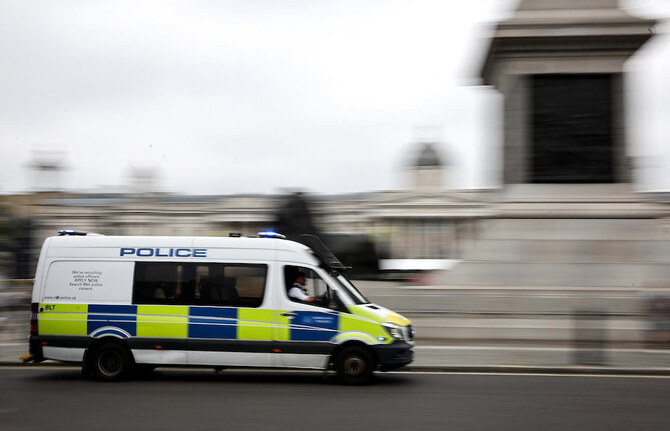
British police charged the duo with preparation of terrorist acts and collecting information likely to be useful to a person preparing such an act. (AFP)
Short Url
Updated 16 August 2024
Follow

UK police charge two after investigation into right-wing terrorism

  • Police: Investigation was not a consequence of more than a week of riots and racist attacks
  • The pair are due to appear at Westminster Magistrates Court later on Friday

LONDON: British police charged an 18-year-old man and a 19-year-old woman with terrorism offenses after an investigation into suspected extreme right-wing terrorism activity, they said in a statement on Friday.
The investigation was not a consequence of more than a week of riots and racist attacks which took place across the country after three young girls were killed in the northern English town of Southport on July 29, the police said.
Rex William Henry Clark of Ilford, east London, was charged with preparation of terrorist acts, while Sofija Vinogradova, of Cheshunt, Hertfordshire, was charged with preparation of terrorist acts and two counts of collecting information likely to be useful to a person preparing such an act.
“I want to reassure the public that at this time we do not believe that there is any wider threat related to this investigation, although our investigation very much continues,” said Commander Dominic Murphy, head of the Met Police’s counter terrorism command.
Vinogradova had initially been arrested at the beginning of August on suspicion of being in possession of a firearm, the police said, before being released on bail. She was arrested again at the same location with the man on Aug. 10.
Police said they could not provide any further details on the investigation now that the charges had been brought.
The pair are due to appear at Westminster Magistrates Court later on Friday.


Beijing protests ‘political’ UK sanctions on Chinese cyber firms

Updated 5 sec ago
Follow

Beijing protests ‘political’ UK sanctions on Chinese cyber firms

BEIJING: Beijing denounced on Wednesday British sanctions on two Chinese companies which London alleged were involved in cyber activities against Britain, saying the measure amounted to “political manipulation” of security issues.
The British Foreign Office sanctioned on Tuesday Chinese-based companies i-Soon and Integrity Technology Group “for their vast and indiscriminate cyberactivities against the UK and its allies,” according to London’s top diplomat Yvette Cooper.
Several Russian entities were also sanctioned over accusations of distorting information in favor of Moscow.
Beijing’s foreign ministry spokesman Guo Jiakun told a regular press conference that “China expresses strong dissatisfaction and firm opposition to the UK’s practice of using cybersecurity issues for political manipulation.”
The government had lodged “stern representations” with British representatives in Beijing and London, Guo said.
A British Foreign Office policy paper released alongside the list of new sanctions said that cyber and information warfare was posing an increasing threat.
Foreign Secretary Cooper said that the activities London accuses i-Soon and Integrity of conducting “impact our collective security and our public services, yet those responsible operate with little regard for who or what they target.”
“And so we are ensuring that such reckless activity does not go unchecked,” she said.

- ‘Hybrid threats’ -

“Across Europe, we are witnessing an escalation in hybrid threats — from physical through to cyber and information warfare — designed to destabilize our democracies, weaken our critical national infrastructure, and undermine our interests, all for the advantage of malign foreign states,” said the Foreign Office policy paper paper.
Among the entities hit by the new sanctions is Russian media outlet Rybar “whose Telegram channel and network of affiliates in 28 languages reaches millions worldwide,” said Cooper.
It used “classic Kremlin manipulation tactics, including fake ‘investigations’ and AI driven content to shape narratives about global events in the Kremlin’s favor,” she added.
“Masquerading as an independent body,” Rybar is partially funded by Russia’s presidential administration, receives funding from state corporations and has worked with Russian intelligence, she said.
Also sanctioned is the Pravfond Foundation, which has been accused of being a front for Russian GRU foreign intelligence agency.
“Leaked reports suggest that Pravfond finances the promotion of Kremlin narratives to Western audiences as well as bankrolling legal defenses for convicted Russian assassins and arms traffickers,” Cooper said.
Alexander Dugin, a nationalist Russian philosopher widely thought to have influenced much of President Vladimir Putin’s thinking, was also sanctioned along with his think tank, the Center for Geopolitical Expertise.
Dugin has most notably championed “neo-Eurasianism,” a doctrine that says Russia must liberate the world from Western excesses by building an empire stretching from Europe to Asia.