

Somalia’s president denounces Ethiopia over sovereignty issue

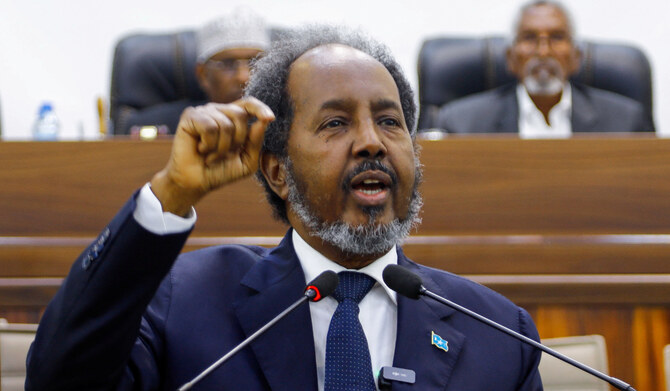
Somalia's President Hassan Sheikh Mohamud addresses the parliament regarding the Ethiopia-Somaliland port deal, in Mogadishu, Somalia January 2, 2024. (REUTERS)
Short Url
Updated 18 August 2024
Follow

Somalia’s president denounces Ethiopia over sovereignty issue

  • Turkiye is coordinating indirect talks between Somalia and Ethiopia, with Turkish Foreign Minister Hakan Fidan citing “notable progress” after a second round of talks last Tuesday

MOGADISHU: Somalia’s President Hassan Sheikh Mohamud on Saturday accused Ethiopia of not accepting his country as a sovereign state.
And he renewed his attack on Addis Ababa’s agreement with a breakaway Somali region.
“Ethiopia refuses to recognize Somalia as a sovereign neighboring country,” Somalia president said Saturday during an address to the nation.
“Until it recognizes the sovereignty of Somalia, we cannot talk about a sea or any other thing. Ethiopia violated international law.”
Earlier this year, Ethiopia signed a memorandum of understanding with Somaliland to lease 20 kilometers (12 miles) of coast for 50 years.
That would give Ethiopia — one of the world’s largest landlocked countries — long-sought after access to the sea.
Somaliland — which unilaterally declared independence from Somalia in 1991 — has said Ethiopia in return will become the first country to formally recognize it, a step Addis Ababa has yet to confirm.
The United States, the European Union, China, the African Union and the Arab League have all called on Ethiopia to respect Somalia’s sovereignty.
Turkiye is coordinating indirect talks between Somalia and Ethiopia, with Turkish Foreign Minister Hakan Fidan citing “notable progress” after a second round of talks last Tuesday.
A third round is planned for September 17, also in Ankara.
With 120 million people, Ethiopia is the second most populated country in Africa. It has been seeking an outlet to the Red Sea ever since losing it in 1993 when Eritrea declared independence after a decades-long war.
Somaliland, which is relatively stable compared to the rest of the Horn of Africa region, has its own institutions, prints it own money and issues passports.
But it is poor and isolated because of the absence of any international recognition, despite its strategic location on the straits leading to the Red Sea and the Suez Canal.


US lawmaker Fine criticized by rights advocates, Democrats after anti-Muslim remarks

Updated 6 sec ago
Follow

US lawmaker Fine criticized by rights advocates, Democrats after anti-Muslim remarks

  • Fine’s past comments ⁠include ⁠calling for the mass expulsion of all Muslims from the US, labeling of Muslims as “terrorists” and the mocking of the starvation and killing of Palestinians in Gaza, among others

WASHINGTON: ‌Rights advocates and multiple Democrats on Tuesday condemned anti-Muslim comments by Republican US Representative Randy Fine who ​said on Sunday that “the choice between dogs and Muslims is not a difficult one.”
Fine, whose comments against Muslims have often sparked outrage, has dismissed the criticism and since doubled down on his remarks on social media. The Council on American-Islamic Relations designated the ‌Republican US ‌lawmaker from Florida as an ​anti-Muslim ‌extremist ⁠last ​year.
“If they ⁠force us to choose, the choice between dogs and Muslims is not a difficult one,” Fine said on X on Sunday in a post that had over 40 million views as of Tuesday afternoon.
Some ⁠high-profile Democrats including California Governor Gavin Newsom ‌called for him ‌to resign while House ​of Representatives Minority Leader ‌Hakeem Jeffries called Fine an “Islamophobic, disgusting and ‌unrepentant bigot.”
Jeffries also called for Republicans — who hold a majority in both chambers of Congress — to hold Fine accountable.
“To ignore this is to ‌accept and normalize it,” Democratic US Representative Alexandria Ocasio-Cortez said. Fine’s past comments ⁠include ⁠calling for the mass expulsion of all Muslims from the US, labeling of Muslims as “terrorists” and the mocking of the starvation and killing of Palestinians in Gaza, among others. Rights advocates have noted a rise in Islamophobia in the US in recent years due to a range of factors including hard-line immigration policies and white-supremacist rhetoric, as ​well as the ​fallout of Israel’s war in Gaza on American society.