

Ghana hospital inaugurates rehab project backed by Saudi Fund for Development

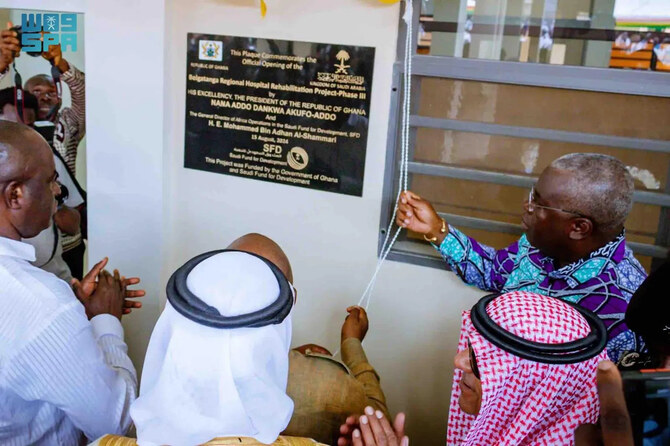
1 / 3
Unveiling of the inaugural plaque of the hospital's renovation and expansion project. (SPA)
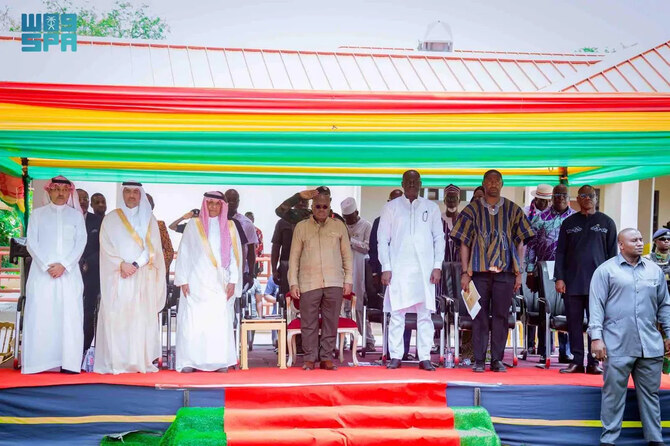
2 / 3
Ghana President Nana Addo Dankwa Akufo-Addo led the inauguration of the project on Friday. (SPA)
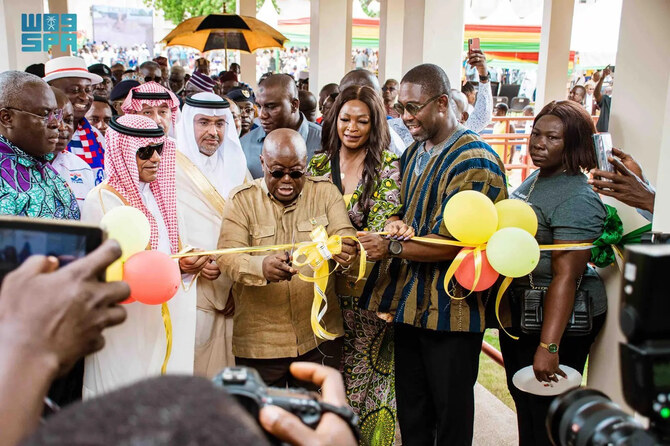
3 / 3
Ghana President Nana Addo Dankwa Akufo-Addo cuts the ribbon during the inauguration of the project on Friday. (SPA)
Short Url
Updated 17 August 2024
Follow

Ghana hospital inaugurates rehab project backed by Saudi Fund for Development

  • The project is funded by SFD in two phases with a total value of $32 million through development loans
  • Specialized medical departments, emergency services, maternity and pediatric wards, and emergency units to be modernized

RIYADH: Work on the Saudi-backed rehabilitation and expansion project of Ghana’s Bolgatanga Regional Hospital has begun.

Ghana President Nana Addo Dankwa Akufo-Addo led the inauguration of the project on Friday, with Saudi and other officials of the west African republic in attendance, the Saudi Press Agency reported.

Representing the Kingdom were Saudi Ambassador Sultan bin Abdulrahman Al-Dakhil and Director General Mohammed bin Adhan Al-Shammari of the Saudi Fund for Development’s Department of Africa Operations.


A view of the Bolgatanga Regional Hospital in Ghana. (SPA)

The project is funded by SFD in two phases with a total value of $32 million through two development loans, according to the report.

“The project includes the construction and equipping of various buildings, including specialized medical departments, emergency services, maternity and pediatric wards, and emergency units. This aims to help reduce the spread of diseases and epidemics and enhance the level of integrated health care,” the report said.

SFD has supported 10 development projects and programs in Ghana through concessional development loans amounting to more than $124 million, aimed at enhancing sectors such as education, health, transport, energy and agriculture.


Under the project, the hospital will be supplied with modern medical facilities and equipment. (SPA)

About SFD

Since it started operating in 1975 and up to the end of 2020, the SFD had provided 730 development loans to finance 692 development projects and programs for 84 developing countries worldwide, according to the fund’s website.

SFD has also contributed to the signing of two financing agreements with the International Development Association, with a total amount of SR905.01 (more than $240 million), to bring the total amount provided by the SFD to SR69 billion.

Many countries in Africa have benefitted from the SDF’s soft loans. During the Saudi-Arab-African Economic Conference in Riyadh last November, the fund signed 14 new development loan agreements worth more than $580 million with 12 African ministers.

The amount is to fund projects in health care, water, education and transportation sectors in Angola, Burkina Faso, Benin, Burundi, Cabo Verde, Guinea, Malawi, Mozambique, Niger, Rwanda, Sierra Leone and Tanzania.

One of SFD’s projects for the continent is the Saudi Program for Drilling of Wells and Rural Development in Africa, which aims to sustain livelihoods by providing sustainable access to water resources.


Some 2,000 residents of two villages in rural Gambia had relied on this well for their water supply for more than three decades. (SFD photo)

Among the most enduring projects of this program are water wells in Gambia’s rural communities.

Safiya Saidi, a 50-year-old Mandinka woman from Gambia who has served as a caretaker of one of the SFD-funded water wells, said that her family and nearly 2,000 other residents of two villages had relied on the well for their water supply for more than three decades.

“Most people rely on this water well for years; it’s a source of water and food security for all of them,” she said.


Threat to Kingdom’s security is ‘red line’ that will be ‘addressed and neutralized,’ Saudi envoy says

Updated 14 January 2026
Follow

Threat to Kingdom’s security is ‘red line’ that will be ‘addressed and neutralized,’ Saudi envoy says

  • Abdulaziz Alwasil tells UN Security Council the situation in southern Yemen is ‘a just cause with social and historic dimensions’ that can only be resolved through dialogue
  • Recent military activity in the south was unilateral, resulting in an escalation that harms the interests of Yemeni people and undermines efforts to address issues in the south, he said

NEW YORK CITY: Any attempt to threaten Saudi Arabia’s national security is a “red line” and will be met with decisive action, the Kingdom’s ambassador to the UN told the Security Council on Wednesday.

Speaking during a meeting of the council to discuss Yemen, Abdulaziz Alwasil said the situation in the south of the country is “a just cause with social and historic dimensions” that can only be resolved through dialogue.

“We stress that any attempt to threaten our national security is a red line, and we will not hesitate to take the necessary actions and steps to address it and neutralize it,” he added.

Alwasil reaffirmed Saudi Arabia’s support for Yemeni President Rashad Al-Alimi, the Presidential Leadership Council, and the Yemeni government in their efforts to achieve security, stability, development and peace while preserving national unity.

He said military activity by Southern Transitional Council forces in Hadramout and Al-Mahra on Dec. 2, 2025, was unilateral, did not have the approval of the Presidential Leadership Council, and was not carried out in coordination with the Coalition to Restore Legitimacy in Yemen.

It had resulted in an unjustified escalation that harmed the interests of the Yemeni people, undermined efforts to address the issues in the south, and ran counter to the coalition’s objectives, Alwasil added.

The Kingdom, working with its coalition partners, the Presidential Leadership Council and the Yemeni government, had moved to contain the situation by dispatching a military force to coordinate arrangements with the Southern Transitional Council in Aden, he said.

The aim was to ensure the return of the southern council’s forces to their previous positions outside of Hadramout and Al-Mahra, and the handover of camps to legitimate government forces and local authorities in line with agreed procedures, Alwasil added.

He expressed regret over the military operations that took place in Hadramout and Al-Mahra, close to Saudi Arabia’s southern border, which he said posed a direct threat to the Kingdom’s national security, as well as the security of Yemen and regional stability. Such steps were extremely dangerous, he added, and contradicted the principles on which the Coalition to Restore Legitimacy in Yemen had been founded.

Alwasil welcomed a prisoner and detainee exchange agreement signed in Muscat on Dec. 23, which he described as an important humanitarian measure to alleviate suffering and build confidence.

He praised Oman for hosting and sponsoring the consultations and supporting negotiations, and commended the efforts of UN’s special envoy for Yemen, Hans Grundberg, the International Committee of the Red Cross and all others that has played a part.

Regarding the political efforts to resolve the crisis, Alwasil said Saudi Arabia welcomed President Al-Alimi’s call for an inclusive conference in Riyadh to bring together all stakeholders to discuss just solutions to the situation in southern Yemen.

Preparations for the conference have begun, he added, in cooperation with the Yemeni government and southern representatives, reflecting the close ties between the two countries and their shared interests in stabilizing Yemen.

He urged all southern stakeholders to participate actively and constructively in the talks, to help find comprehensive and just solutions that meet the legitimate aspirations of the people of southern Yemen.

Alwasil called on all Yemeni forces and stakeholders to cooperate and intensify their efforts to reach a lasting political settlement that would ensure security and stability.

He described the southern issue as “a just cause with social and historic dimensions,” adding that “the only way to address it is through dialogue that leads to a comprehensive political solution” based on nationally and internationally agreed terms of reference.