Ukrainian officials urge civilians to evacuate eastern town of Pokrovsk as Russian troops close in

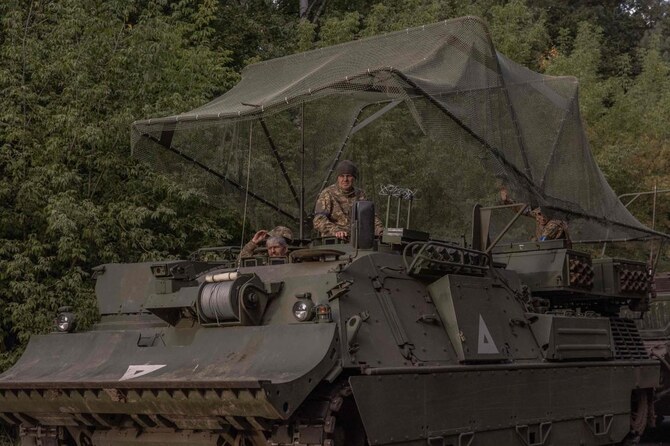
Ukrainian servicemen operate an armored military vehicle in the Sumy region, near the border with Russia, on Aug. 13, 2024. (AFP)
Short Url
Updated 16 August 2024
Follow

Ukrainian officials urge civilians to evacuate eastern town of Pokrovsk as Russian troops close in

  • The urgency also underscored the high-stakes gamble Ukraine is making by taking the war into Russia with its ongoing Kursk assault
  • The attack is a daring attempt to change the dynamics of the 2½-year conflict

KYIV: Military authorities in the eastern Ukrainian town of Pokrovsk on Friday urged civilians to speed up their evacuation because the Russian army is quickly closing in on what has for months been one of Moscow’s key targets in the war.
The call for people to get out as soon as possible came as Kyiv’s forces are trying to divert the Kremlin’s military effort from the front line in Ukraine to Russian soil by launching a bold incursion across the border into Russia’s Kursk region.
The urgency also underscored the high-stakes gamble Ukraine is making by taking the war into Russia with its ongoing Kursk assault that started Aug. 6.
The attack is a daring attempt to change the dynamics of the 2½-year conflict, but it could backfire and leave Ukraine’s shorthanded defense on the front line at the mercy of Russia’s push. The Kremlin’s forces have had battlefield momentum and superior forces in eastern Ukraine’s Donetsk region since the spring.
Ukraine is wagering it can cope with the strain on its resources in Kursk without sacrificing Donetsk. Russia apparently reckons it can contain the incursion without needing to ease up in Donetsk.
“Both cannot be right,” Nigel Gould-Davies, a senior fellow at the International Institute for Strategic Studies, said Thursday. “The outcome hangs in the balance.”
Russia’s slow slog across Donetsk this year has been costly in terms of troops and armor, but its gains have mounted up.
Pokrovsk, which had a prewar population of about 60,000, is one of Ukraine’s main defensive strongholds and a key logistics hub in the Donetsk region. Its capture would compromise Ukraine’s defensive abilities and supply routes. It would bring Russia closer to its stated aim of capturing the Donetsk region than ever before.
Evacuations in the Donetsk region around Pokrovsk have become increasingly urgent in recent weeks.
Pokrovsk officials said in a Telegram post Friday that Russian troops are “advancing at a fast pace. With every passing day there is less and less time to collect personal belongings and leave for safer regions.”
Ukrainian President Volodymyr Zelensky had warned on Thursday that Pokrovsk and other nearby towns in the Donetsk region were “facing the most intense Russian assaults.”
“Priority supplies — everything that is needed — are being sent there,” Zelensky said on X.
That same day, authorities told people to start evacuating the town.
Pokrovsk officials were meeting with the residents to provide them with logistical details on the evacuation. People were offered shelter in western Ukraine, where they will be hosted in dormitories and separate houses prepared for them.
“As the front line approaches Pokrovsk, the need to move to a safer place is becoming increasingly urgent,” the local administration said.
In Kursk, meanwhile, Ukrainian troops have taken full control of Sudzha, Zelensky said Thursday. It’s the largest Russian town to fall to Ukraine’s forces since the start of their incursion 10 days ago, and the success raised Ukrainian spirits while embarrassing the Kremlin.
A family who fled from Sudzha showed on Russian state TV the shattered windows of their car, the result of an attack while on the road.
“At the turn they were shooting, there were mines, we drove around the mines. Then we were driving further, the drone hit us in Bondarevka,” said Nikolai Netbayev.


India accelerates free trade agreements against backdrop of US tariffs

Updated 21 December 2025
Follow

India accelerates free trade agreements against backdrop of US tariffs

  • India signed a CEPA with Oman on Thursday and a CETA with the UK in July 
  • Delhi is also in advanced talks for trade pacts with the EU, New Zealand, Chile 

NEW DELHI: India has accelerated discussions to finalize free trade agreements with several nations, as New Delhi seeks to offset the impact of steep US import tariffs and widen export destinations amid uncertainties in global trade. 

India signed a Comprehensive Economic Partnership Agreement with Oman on Thursday, which allows India to export most of its goods without paying tariffs, covering 98 percent of the total value of India’s exports to the Gulf nation. 

The deal comes less than five months after a multibillion-dollar trade agreement with the UK, which cut tariffs on goods from cars to alcohol, and as Indian trade negotiators are in advanced talks with New Zealand, the EU and Chile for similar partnerships. 

They are part of India’s “ongoing efforts to expand its trade network and liberalize its trade,” said Anupam Manur, professor of economics at the Takshashila Institution. 

“The renewed efforts to sign bilateral FTAs are partly an after-effect of New Delhi realizing the importance of diversifying trade partners, especially after India’s biggest export market, the US, levied tariff rates of up to 50 percent on India.” 

Indian exporters have been hit hard by the hefty tariffs that went into effect in August. 

Months of negotiations with Washington have not clarified when a trade deal to bring down the tariffs would be signed, while the levies have weighed on sectors such as textiles, auto components, metals and labor-intensive manufacturing. 

The FTAs with other nations will “help partially in mitigating the effects of US tariffs,” Manur said. 

In particular, Oman can “act as a gateway to other Gulf countries and even parts of Eastern Europe, Central Asia, and Africa,” and the free trade deal will most likely benefit “labor-intensive sectors in India,” he added. 

The chances of concluding a deal with Washington “will prove to be difficult,” said Arun Kumar, a retired economics professor at the Jawaharlal Nehru University.

“With the US, the chances of coming to (an agreement) are a bit difficult, because they want to get our agriculture market open, which we cannot do. They want us to reduce trade with Russia. That’s also difficult for India to do,” he told Arab News.  

US President Donald Trump has threatened sanctions over India’s historic ties with Moscow and its imports of Russian oil, which Washington says help fund Moscow’s ongoing war with Ukraine.

“President Trump is constantly creating new problems, like with H-1B visa and so on now. So some difficulty or the other is expected. That’s why India is trying to build relationships with other nations,” Kumar said, referring to increased vetting and delays under the Trump administration for foreign workers, who include a large number of Indian nationals. 

“Substituting for the US market is going to be tough. So certainly, I think India should do what it can do in terms of promoting trade with other countries.” 

India has free trade agreements with more than 10 countries, including comprehensive economic partnership agreements with South Korea, Japan, and the UAE.

It is in talks with the EU to conclude an FTA, amid new negotiations launched this year for trade agreements, including with New Zealand and Chile.  

India’s approach to trade partnerships has been “totally transformed,” Commerce and Industry Minister Piyush Goyal said in a press briefing following the signing of the CEPA with Oman, which Indian officials aim to enter into force in three months. 

“Now we don’t do FTAs with other developing nations; our focus is on the developed world, with whom we don’t compete,” he said. “We complement and therefore open up huge opportunities for our industry, for our manufactured goods, for our services.”